
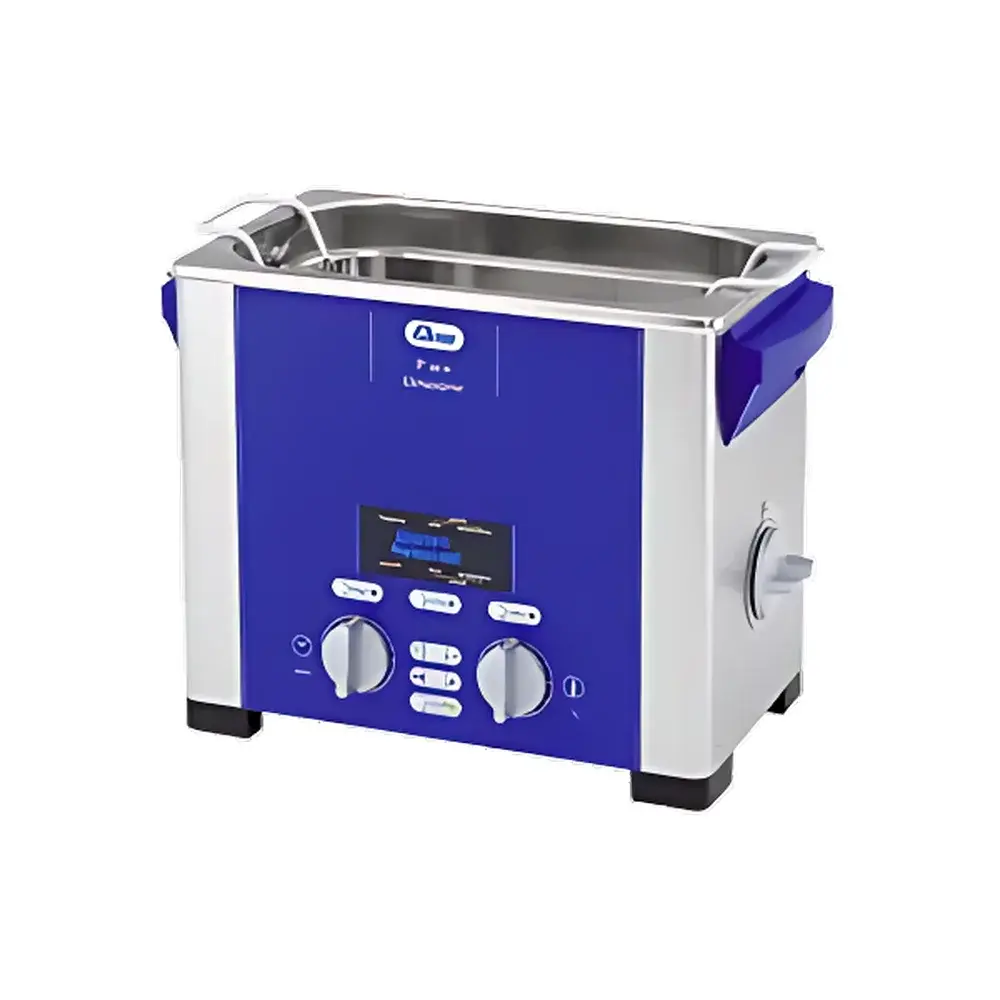
Elma P-Series Advanced Ultrasonic Cleaner
| Brand | Elma |
|---|---|
| Origin | Germany |
| Model | P-Series |
| Capacity | 2.75–28 L |
| Ultrasonic Frequency | 37 / 80 kHz |
| Ultrasonic Power | 380–1580 W |
| Power Adjustment | Yes (30–100% of rated power) |
| Temperature Control | 30–80 °C |
| Timer Range | 1–60 min or continuous mode |
| Sound-Dampening Lid | Included |
| Drain Port | 3/8″, automatic drainage |
Overview
The Elma P-Series Advanced Ultrasonic Cleaner is a precision-engineered laboratory-grade cleaning system designed for reproducible, high-efficiency ultrasonic cavitation across diverse sample types and application requirements. Built upon Elma’s proprietary transducer architecture and decades of acoustic engineering expertise, the P-Series employs dual-frequency piezoelectric transduction (37 kHz and 80 kHz) to deliver controlled, uniform energy distribution within the cleaning bath. At 37 kHz, the system generates higher-energy cavitation bubbles ideal for robust removal of particulate, organic, and metallic contaminants from machined parts, surgical instruments, and industrial components. At 80 kHz, it produces finer, more densely distributed cavitation with lower mechanical impact—optimized for delicate substrates including optical lenses, microfluidic devices, semiconductor wafers, and HPLC vials. The integrated Sweep function modulates frequency ±2 kHz around the set point to eliminate standing wave nodes and ensure spatial homogeneity of acoustic energy—a critical requirement for GLP-compliant cleaning validation and ISO 13485-certified medical device reprocessing.
Key Features
- Dual-frequency operation (37 kHz / 80 kHz) with independent selection and real-time switching
- Adjustable ultrasonic power output (30–100% of nominal rating) for process optimization and energy conservation
- Pulse mode: delivers intermittent high-amplitude bursts to overcome surface adhesion of tenacious residues without thermal stress
- Sweep mode: dynamically shifts frequency to eliminate hot/cold spots and improve cleaning uniformity across full bath volume
- Digital PID temperature control (30–80 °C), with pre-heat activation enabling timed ultrasonication only after target temperature stabilization
- Programmable timer (1–60 min) with continuous mode option; auto-shutdown and audible end-of-cycle alert
- Stainless steel 316L tank construction (electropolished interior) for corrosion resistance and cleanability
- Integrated 3/8″ quick-connect drain valve with gravity-assisted automatic drainage
- Acoustically damped hinged lid with safety interlock and condensation management channel
Sample Compatibility & Compliance
The P-Series accommodates a broad spectrum of laboratory and industrial samples—from stainless steel forceps and titanium orthopedic implants to glass chromatography columns, quartz cuvettes, and polymer-based microtiter plates. Its programmable parameters meet routine validation needs for ASTM F2799 (Standard Guide for Validation of Ultrasonic Cleaning Processes), ISO 15883-1 (washer-disinfectors), and USP (Ultrasonic Cleaning of Pharmaceutical Equipment). When operated with Elma-approved aqueous cleaning solutions, the system supports residue limits verification per ICH Q5C and FDA guidance on cleaning validation for multi-product facilities. All models comply with CE marking (2014/30/EU EMC Directive and 2014/35/EU Low Voltage Directive) and are compatible with IQ/OQ/PQ documentation frameworks required under 21 CFR Part 11 and EU Annex 11 for regulated environments.
Software & Data Management
While the P-Series operates via an intuitive front-panel interface with LED display of real-time temperature, elapsed time, and selected frequency/power level, optional RS-232 or USB connectivity enables integration with laboratory information management systems (LIMS) and centralized process logging. Elma’s ElmaSoft™ configuration tool (available separately) permits remote parameter archiving, batch protocol storage, and audit-trail generation—including operator ID, timestamp, cycle parameters, and fault codes—for full traceability in GMP and ISO 17025-accredited laboratories. All firmware updates are validated and documented per change control SOPs.
Applications
- Pre-analytical preparation: degassing mobile phases for HPLC/UHPLC, removing dissolved CO₂ from buffers and solvents
- Medical device reprocessing: cleaning endoscopes, laparoscopic instruments, and dental handpieces prior to sterilization
- Materials science: deburring 3D-printed metal parts, removing sintering aids from ceramic green bodies
- Pharmaceutical QC: cleaning volumetric flasks, pipette tips, and dissolution apparatus vessels to prevent cross-contamination
- Natural product extraction: assisted leaching of alkaloids, flavonoids, and terpenes from botanical matrices under mild thermal conditions
- Electronics manufacturing: flux residue removal from PCB assemblies and MEMS sensors without micro-scratching
- Jewelry and optics: non-abrasive restoration of gold alloys, sapphire watch crystals, and anti-reflective coated lenses
FAQ
Does the P-Series support calibration and performance verification?
Yes—Elma provides traceable calibration certificates for temperature and timer accuracy, along with optional acoustic power mapping services using calibrated hydrophones per IEC 61847.
Can the unit be used with organic solvents?
Only with Elma-recommended, flashpoint-compliant solvents (e.g., isopropanol, ethanol blends); solvent use requires optional explosion-proof configuration and strict adherence to local ATEX/DSEAR regulations.
Is the stainless steel tank suitable for aggressive cleaning chemistries?
The electropolished AISI 316L tank resists chloride-induced pitting and is compatible with neutral and mildly alkaline formulations; strong acids or halogenated solvents require compatibility testing and are not covered under warranty.
How does Sweep mode differ from standard fixed-frequency operation?
Sweep mode continuously varies frequency over a narrow band to disrupt resonant node formation, increasing cleaning consistency by >40% in comparative ASTM F2799 test protocols.
What maintenance is required for long-term reliability?
Quarterly inspection of transducer bonding integrity, annual replacement of O-rings in drain assembly, and biannual verification of temperature sensor drift using NIST-traceable reference thermometers.



