
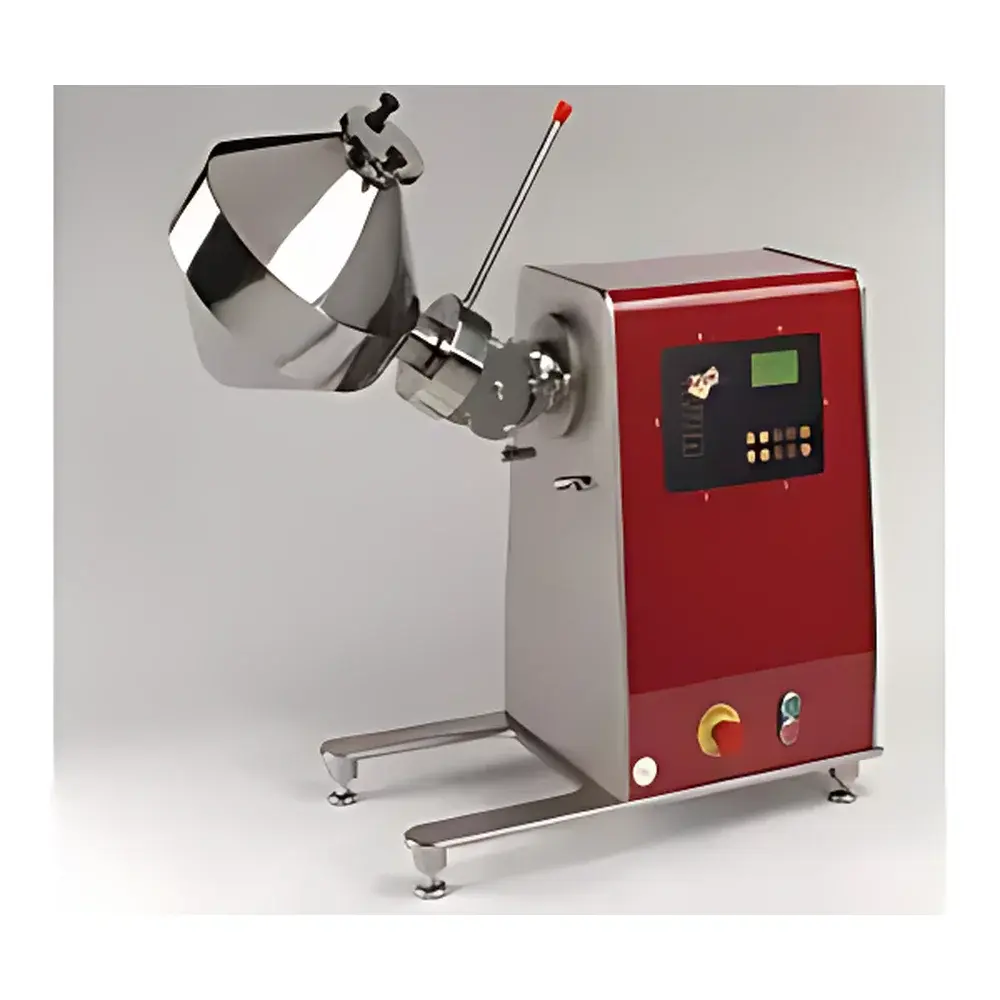
Pharmag Biconical Mixing Unit
| Brand | Pharmag |
|---|---|
| Origin | Germany |
| Manufacturer Type | Authorized Distributor |
| Origin Category | Imported |
| Model | Biconical Mixing |
| Pricing | Upon Request |
| Construction Material | Stainless Steel |
| Total Volume | 5 L |
| Usable Volume | 3 L |
| Principle | Free-flow mixing via biconical drum rotation |
| Sample Type Compatibility | Free-flowing powders and granules |
Overview
The Pharmag Biconical Mixing Unit is a precision-engineered, gravity-driven powder mixer designed for gentle yet effective homogenization of free-flowing solid dosage forms in pharmaceutical development, clinical trial manufacturing, and small-batch GMP production environments. Operating on the principle of free-flow mixing, the unit rotates a biconical stainless-steel drum along its central axis, inducing three-dimensional tumbling motion that promotes uniform particle redistribution without shear stress, attrition, or segregation. Unlike high-shear mixers or fluidized-bed systems, this design eliminates mechanical agitation elements—such as paddles, blades, or impellers—thereby minimizing cross-contamination risk, heat generation, and particle damage. Its geometry ensures symmetrical mass flow patterns, resulting in high reproducibility and batch-to-batch consistency essential for formulation screening, blend uniformity studies (per USP & Ph. Eur. general chapter ), and pre-compression blending prior to tablet compression.
Key Features
- Biconical stainless-steel mixing chamber (AISI 316L) with polished interior surface (Ra ≤ 0.8 µm) for enhanced cleanability and compliance with ISO 14644-1 Class 7 cleanroom requirements.
- Fixed-axis rotational drive system with variable speed control (typically 5–25 rpm range) and programmable mixing time (1–999 min), enabling precise process parameter definition for DoE-based optimization.
- Sealed drum design with validated gasketed access port, supporting containment during handling of potent compounds (OEL ≤ 10 µg/m³) when integrated with local exhaust ventilation (LEV) or isolator interfaces.
- Compact footprint (W × D × H ≈ 650 × 520 × 980 mm) and low-vibration operation suitable for installation in QC labs, R&D cleanrooms, or modular manufacturing suites.
- CE-marked electrical system compliant with IEC 61000-6-2 (immunity) and IEC 61000-6-4 (emission); full documentation package includes Factory Acceptance Test (FAT) report and IQ/OQ protocol templates.
Sample Compatibility & Compliance
The unit is validated for use with dry, free-flowing materials exhibiting Hausner ratio < 1.25 and Carr index 2% w/w) or electrostatic propensity. Regulatory alignment includes support for FDA 21 CFR Part 11-compliant electronic records when paired with validated third-party SCADA or MES integration (e.g., Siemens Desigo CC or Rockwell FactoryTalk). The design conforms to ISO 20957-1 (fitness equipment safety) adapted for industrial mixing applications, and meets EU Machinery Directive 2006/42/EC essential health and safety requirements.
Software & Data Management
While the base model operates via analog timer and manual speed dial, optional digital control modules provide RS485 Modbus RTU or Ethernet/IP connectivity for centralized monitoring. Audit-trail-enabled firmware (v2.1+) logs all operational parameters—including start/stop timestamps, actual RPM, elapsed time, and door-open events—with SHA-256 hashing for integrity verification. Data export supports CSV and PDF formats compatible with LIMS (e.g., LabWare, Thermo Fisher SampleManager) and electronic batch record (EBR) systems. All software components are developed per IEC 62304 Class B and undergo annual revalidation per GAMP 5 guidelines.
Applications
- Blend uniformity qualification for Phase I–III clinical trial batches under ICH Q5C and Q7A guidance.
- Excipient compatibility testing during preformulation studies.
- Final blend preparation for capsule filling or direct compression in pilot-scale facilities.
- Reconstitution aid mixing for lyophilized biologics (non-sterile intermediate step).
- Reference standard homogenization in analytical method development laboratories.
FAQ
What is the maximum recommended fill level for optimal mixing performance?
The usable volume is specified at 3 L (60% of total 5 L capacity) to ensure sufficient headspace for particle cascade and avoid overpacking-induced density gradients.
Can the unit be cleaned-in-place (CIP)?
No—CIP is not supported due to fixed-axis geometry and absence of internal spray nozzles; however, the drum is fully removable for manual cleaning using validated SOPs per PDA Technical Report No. 29.
Is validation documentation included with delivery?
Yes—each unit ships with a comprehensive User Requirement Specification (URS), FAT report, and blank IQ/OQ templates aligned with ASTM E2500-13 and Annex 15 of the EU GMP Guidelines.
Does Pharmag offer GMP-compliant calibration services?
Yes—traceable calibration of rotational speed (±0.5% accuracy) and timer function (±0.1 s) is available through Pharmag’s certified service centers in Frankfurt and Basel, with NIST-traceable certificates issued per ISO/IEC 17025.
How is operator safety ensured during maintenance?
The unit incorporates dual-channel emergency stop circuitry, interlocked access doors with position sensors, and mechanical locking pins for drum immobilization during servicing—all verified during FAT per EN ISO 13857.



