
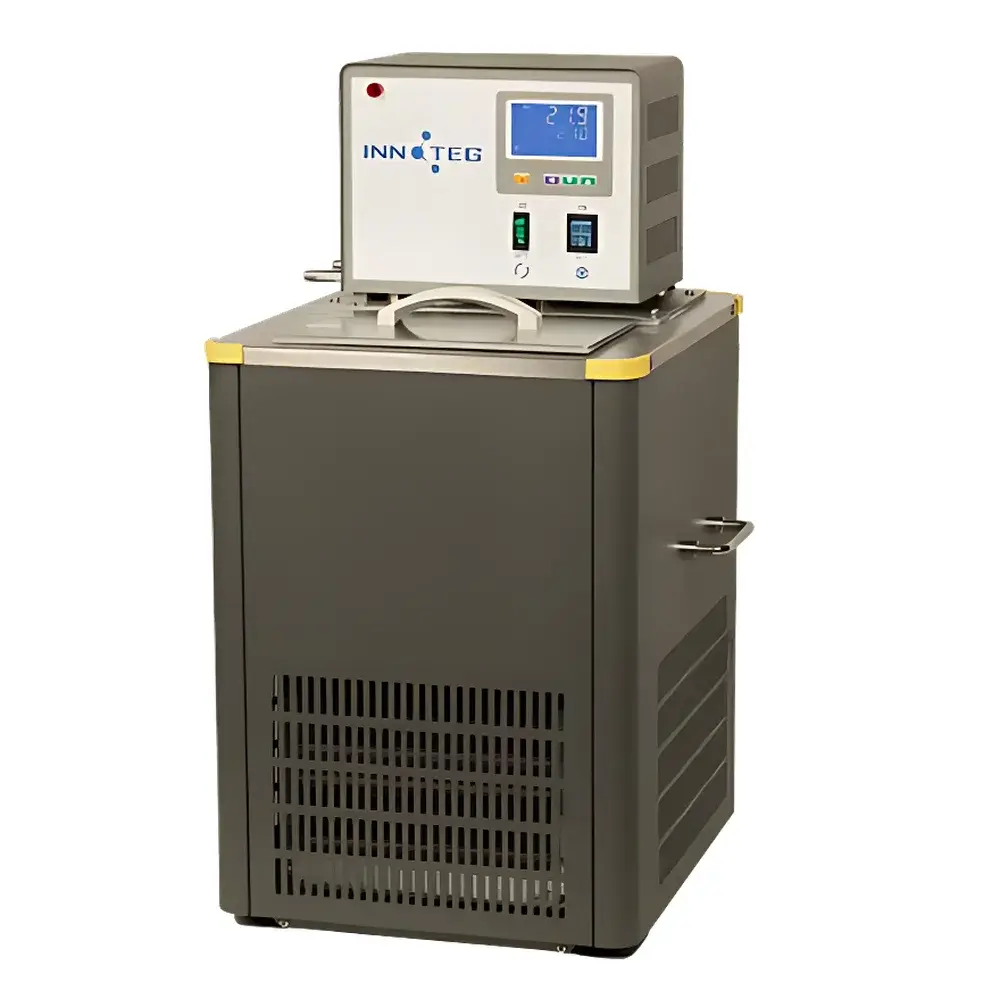
INNOTEG TCS-2 Circulating Temperature Control Bath
| Brand | INNOTEG |
|---|---|
| Model | TCS-2 |
| Type | Refrigerated/Heating Circulating Bath |
| Capacity | 10 L |
| Temperature Range | −20 °C to 100 °C |
| Temperature Stability | ±0.05 °C (at 25 °C, water or ethanol) |
| Display Resolution | 0.1 °C |
| Cooling Power | 0.47 kW @ 20 °C |
| Bath Opening Dimensions | 215 mm × 170 mm × 150 mm (W × D × H) |
| Circulation Mode | Internal & External |
| Control System | Microprocessor-based PID with Auto-tuning |
| Construction | 304 Stainless Steel Interior, Insulated Foam Housing |
| Safety Features | Dual-level Liquid Level Detection (Visual + Audible Alarm), Dry-run Protection, Independent Heating/Cooling Status Indicators, Programmable Heating Timer |
Overview
The INNOTEG TCS-2 Circulating Temperature Control Bath is a precision-engineered laboratory thermal management system designed for applications requiring stable, bidirectional temperature control across a wide operational range (−20 °C to 100 °C). Utilizing a dual-mode thermoelectric and compressor-assisted cooling/heating architecture, the TCS-2 maintains high thermal uniformity and dynamic response in both internal bath and externally connected systems via its integrated circulation pump. Its core function is to serve as a stable, programmable heat transfer medium source—enabling accurate temperature conditioning of analytical instruments (e.g., viscometers, spectrophotometers, calorimeters), reaction vessels, and sensor calibration setups. The bath’s microprocessor-controlled PID algorithm with auto-tuning ensures minimal overshoot and rapid stabilization, while its ±0.05 °C temperature stability (measured at 25 °C using water or ethanol) meets stringent requirements for method validation in regulated environments.
Key Features
- Wide operational range from −20 °C to 100 °C, supporting both cryogenic and high-temperature experimental protocols.
- Dual-circulation capability (internal recirculation and external loop connection) enables integration with jacketed reactors, chromatography columns, or custom test fixtures.
- High-resolution dual-display interface: separate digital windows for setpoint and real-time bath temperature, with visual alarm (ALM LED) activation when measured temperature deviates by >3 °C from setpoint.
- Dedicated status indicators for heating and cooling modes—providing immediate operational feedback without menu navigation.
- Programmable heating timer allows scheduled termination of heating cycles, enhancing protocol reproducibility and energy efficiency.
- Robust 304 stainless steel construction throughout critical wetted components—including tank interior, impeller, and pump housing—ensuring long-term corrosion resistance with aqueous and organic media.
- Tool-free front-panel access facilitates routine maintenance of condenser coils and pump assemblies, reducing downtime during GLP/GMP-compliant lab operations.
- Integrated dual-stage liquid level monitoring: low-level warning (LED only) followed by audible/visual alarm at critically low levels, preventing dry-run damage and ensuring operator safety.
Sample Compatibility & Compliance
The TCS-2 is compatible with common heat-transfer fluids including deionized water, 30–70% aqueous glycol solutions, and ethanol-based mixtures—validated for use under ISO 17025-accredited calibration workflows. Its sealed foam-insulated housing minimizes ambient thermal interference, supporting compliance with ASTM E2877 (Standard Practice for Calibration of Temperature-Controlled Baths) and USP (Thermal Analysis). While not certified to IEC 61010-1 for Class I medical use, the unit conforms to general laboratory equipment safety standards (EN 61010-1:2010) and includes overtemperature cutoff, ground-fault protection, and reinforced insulation barriers. Its design supports audit-ready documentation practices required for FDA 21 CFR Part 11–aligned environments when paired with validated external data logging systems.
Software & Data Management
The TCS-2 operates via embedded firmware with no proprietary PC software dependency; all parameters are configured directly through the front-panel interface. However, analog voltage output (0–5 V DC) and RS-232 serial port enable third-party integration with LabVIEW, MATLAB, or LIMS platforms for automated temperature logging and remote monitoring. When used with compliant data acquisition hardware, the system supports ALCOA+ principles—ensuring attributable, legible, contemporaneous, original, accurate, and complete records per GxP guidelines. The auto-tuning PID controller stores tuning history in non-volatile memory, allowing traceability of control parameter adjustments during qualification (IQ/OQ/PQ).
Applications
- Calibration of temperature-sensitive sensors (RTDs, thermistors, infrared pyrometers) in metrology labs.
- Thermal conditioning of HPLC autosampler trays, column ovens, and detector cells to reduce baseline drift.
- Controlled-rate heating/cooling studies in polymer rheology, protein denaturation kinetics, and phase-transition analysis.
- Stabilization of optical benches and interferometric setups requiring sub-0.1 °C thermal drift suppression.
- Support of ASTM D2857 (viscosity of asphalt binders), ISO 3104 (petroleum products), and ISO 1628 (polymer solution viscosity) testing protocols.
- Cell culture incubator pre-conditioning and bioreactor jacket temperature control in QC microbiology suites.
FAQ
What temperature accuracy can be expected across the full operating range?
Accuracy is ±0.05 °C at 25 °C (with water or ethanol); deviation increases slightly at extremes (±0.15 °C at −20 °C and ±0.12 °C at 100 °C), consistent with ISO 17025 uncertainty budgeting for bath-type calibrators.
Is external circulation flow rate adjustable?
Yes—the integrated centrifugal pump delivers up to 18 L/min at 0.3 bar backpressure; flow is manually regulated via an inline needle valve on the outlet port.
Can the TCS-2 maintain temperature stability during extended unattended operation?
It supports continuous 24/7 operation with active thermal load monitoring; however, periodic verification of fluid level and refrigerant pressure is recommended every 72 hours for >96-hour runs.
Does the unit comply with electromagnetic compatibility (EMC) directives for shared lab environments?
Yes—it meets EN 61326-1:2013 for laboratory equipment emissions and immunity, minimizing interference with adjacent analytical instrumentation such as mass spectrometers or NMR consoles.
What maintenance intervals are recommended for optimal performance?
Condenser cleaning every 3 months (or more frequently in dusty environments), annual refrigerant pressure check, and biannual verification of PID tuning parameters against NIST-traceable reference thermometers.



