
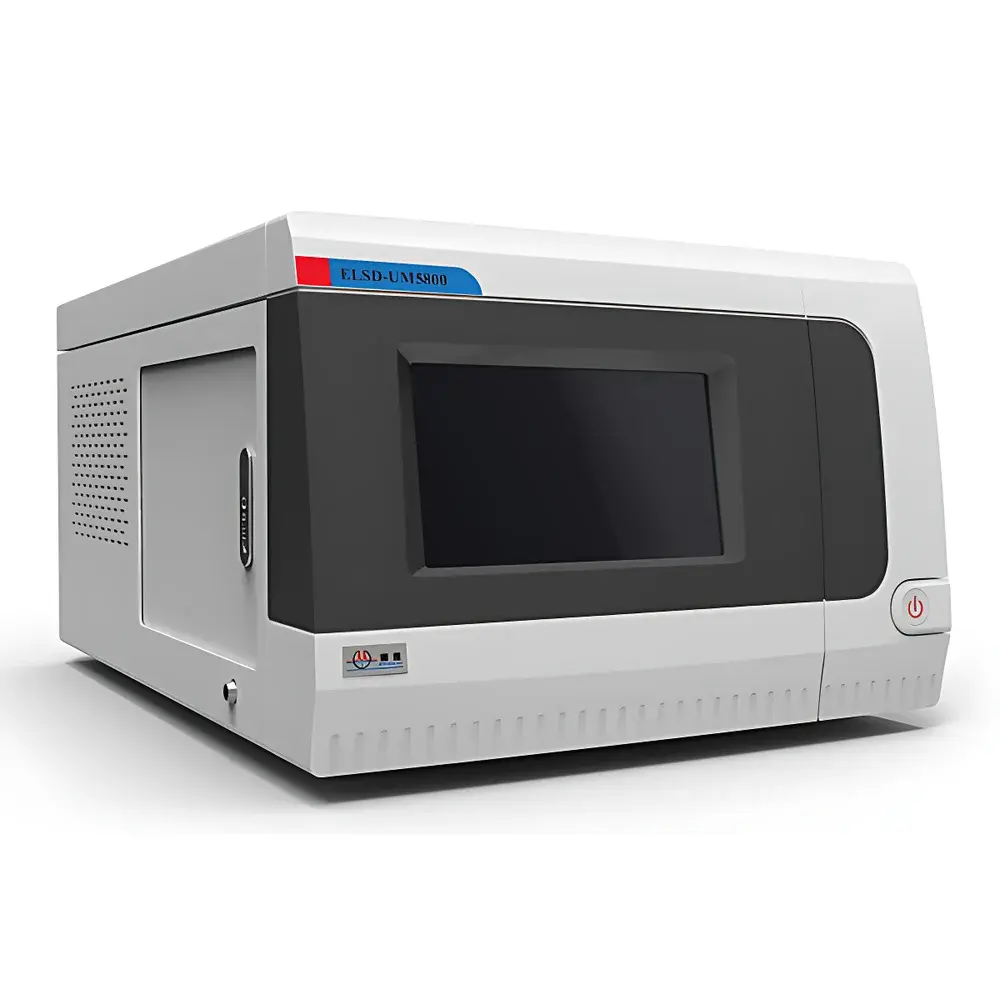
Unimicro Technologies UM5800 Evaporative Light Scattering Detector
| Brand | Unimicro Technologies |
|---|---|
| Origin | Shanghai, China |
| Manufacturer Type | Original Equipment Manufacturer (OEM) |
| Country of Origin | China |
| Model | UM5800 |
| Instrument Type | Evaporative Light Scattering Detector (ELSD) |
| Wavelength | 650 nm |
| Detection Principle | Evaporative Light Scattering |
| Light Source | Semiconductor Laser |
| Power Supply | 220 V, 50 Hz |
| Dimensions (W×D×H) | 460 × 330 × 220 mm |
| Operating Temperature | 15–40 °C |
| Relative Humidity | <90% RH |
| Evaporation Temperature Range | Ambient to 130 °C |
| Temp. Increment | 1 °C |
| Temp. Accuracy | ±1 °C |
| Carrier Gas | Nitrogen or Compressed Air |
| Gas Input Pressure | 2–5 bar |
| Pressure Sensing Accuracy | 0.01 bar |
| Gas Flow Rate | 1–4 L/min |
| Flow Accuracy | ≤1% or ±0.02 L/min |
| Liquid Flow Compatibility | 10 μL/min – 3 mL/min |
| Baseline Noise | <0.03 mV |
| Baseline Drift | <0.3 mV/h |
| Limit of Detection (LOD) | <1 ng (on-column, glucose) |
| Typical Quantitative Range | 0.1–30 μg (glucose) |
| Precision (RSD₆) | <2% (glucose) |
| Signal Output | 0–1 V DC |
| Interface | RS-232 |
Overview
The Unimicro Technologies UM5800 Evaporative Light Scattering Detector (ELSD) is a high-performance, benchtop-compatible detection system engineered for universal, non-destructive quantification of non-volatile and semi-volatile analytes in liquid chromatography workflows. Unlike UV-Vis or fluorescence detectors, the UM5800 operates on the principle of nebulization, solvent evaporation, and light scattering—making it uniquely suited for compounds lacking chromophores or native fluorescence, including carbohydrates, lipids, glycosides, saponins, polymers, and thermally labile natural products. As the first domestically developed ELSD in China and a key outcome of the national “Tenth Five-Year Plan” Science & Technology Key Project, the UM5800 meets ISO/IEC 17025-aligned design rigor and complies fully with GB/T 33600–2017 (Chinese National Standard for ELSD performance evaluation). Its core optical architecture integrates a temperature-stabilized 650 nm semiconductor laser and a low-noise photomultiplier tube (PMT), delivering industry-leading signal-to-noise ratio and dynamic range across diverse HPLC and UHPLC platforms.
Key Features
- Optimized dual-stage evaporation chamber enabling precise, programmable temperature control from ambient to 130 °C — supporting both low-temperature detection of heat-sensitive compounds and high-efficiency desolvation of high-boiling solvents.
- Integrated carrier gas pressure and mass flow monitoring with real-time digital feedback (±0.01 bar pressure resolution; ≤1% flow accuracy), ensuring reproducible aerosol generation and minimizing baseline instability.
- Modular, tool-free雾化 (nebulizer) assembly designed for rapid disassembly, ultrasonic cleaning, and reinstallation—reducing maintenance downtime and cross-contamination risk in regulated QC labs.
- Large-format capacitive touchscreen interface (domestically pioneered in ELSD class) with intuitive workflow navigation, method storage, and real-time parameter visualization—including live temperature, gas pressure, and flow rate graphs.
- Enhanced electromagnetic compatibility (EMC) via compact internal layout, shielded signal paths, and noise-suppressed power regulation—achieving baseline noise <0.03 mV and drift <0.3 mV/h under ISO 8573-1 Class 4 clean air conditions.
- Comprehensive safety protocol suite: automated over-pressure cutoff, thermal runaway protection, and configurable alarms for gas supply failure, temperature deviation, or flow anomaly.
Sample Compatibility & Compliance
The UM5800 supports broad solvent compatibility—including acetonitrile, methanol, ethanol, THF, chloroform, and aqueous buffers—without solvent peak interference, even under steep gradient elution. It accommodates flow rates from 10 μL/min (microbore/UHPLC) to 3 mL/min (standard bore), making it interoperable with Agilent, Waters, Shimadzu, Thermo Fisher, and other major HPLC systems via standard RS-232 serial interface. The detector has been validated per Chinese Pharmacopoeia (ChP) monographs for ELSD-based assay of polysaccharides (e.g., astragalosid IV), triterpenoid saponins (e.g., ginsenosides), and fatty acid esters. It satisfies GLP-compliant data integrity requirements through timestamped audit logs, user-access controls, and method-lock functionality—fully traceable for FDA 21 CFR Part 11 readiness when paired with compliant chromatography data systems (CDS).
Software & Data Management
The UM5800 communicates natively with third-party CDS platforms (e.g., Empower, Chromeleon, LabSolutions) via ASCII-based RS-232 protocol, transmitting analog voltage output (0–1 V DC) synchronized to chromatographic time. Local instrument control is managed through embedded firmware supporting up to 99 user-defined methods, each storing evaporation temperature, gas flow setpoint, gain calibration, and alarm thresholds. All operational events—including power-on sequence, method load, alarm triggers, and sensor diagnostics—are recorded in a non-volatile event log with UTC timestamps. Raw signal data are exportable as CSV for post-acquisition processing in MATLAB, Python (SciPy/Pandas), or statistical validation packages used in method transfer and ICH Q2(R2) compliance documentation.
Applications
- Quantitative analysis of non-UV-absorbing active pharmaceutical ingredients (APIs) in traditional Chinese medicine (TCM) extracts—e.g., puerarin in Gegen decoction, icariin in Epimedii Herba.
- Stability-indicating assays for lipid-based drug delivery systems (liposomes, nanoemulsions) where UV detection fails due to excipient interference.
- Method development support for polymer molecular weight distribution (MWD) profiling using size-exclusion chromatography (SEC), particularly for polyethylene glycols (PEGs) and poloxamers.
- Routine QC of carbohydrate content in food additives (e.g., inulin, fructooligosaccharides) per AOAC 2012.01 and ISO 16593 protocols.
- Residual solvent screening in biopolymer synthesis where volatile organics co-elute with target macromolecules.
FAQ
Can the UM5800 be integrated with UHPLC systems operating at >600 bar?
Yes—the detector’s flow path is rated for continuous operation up to 3 mL/min at ambient backpressure; no additional pressure regulation is required for standard UHPLC outputs.
Does the UM5800 support multi-wavelength detection?
No—it employs a fixed 650 nm laser source optimized for Mie scattering efficiency across typical particle sizes generated during nebulization (0.1–5 µm); wavelength scanning is not applicable to ELSD physics.
Is nitrogen gas mandatory, or can compressed air be used?
Both are supported; however, nitrogen is strongly recommended for quantitative applications requiring lowest baseline noise and avoidance of oxidative degradation in sensitive analytes.
How is calibration performed for quantitative analysis?
Calibration uses external standard solutions (e.g., glucose, sucrose) injected across a defined mass range; response is log-linear over 0.1–30 µg, with R² ≥0.999 and RSD₆ <2% under controlled environmental conditions.
What regulatory documentation is provided for GMP environments?
Factory-issued IQ/OQ protocols, traceable NIST-calibrated temperature and pressure sensor certificates, and full electrical safety test reports (GB 4793.1–2019 / IEC 61010-1) are supplied with each unit.




