
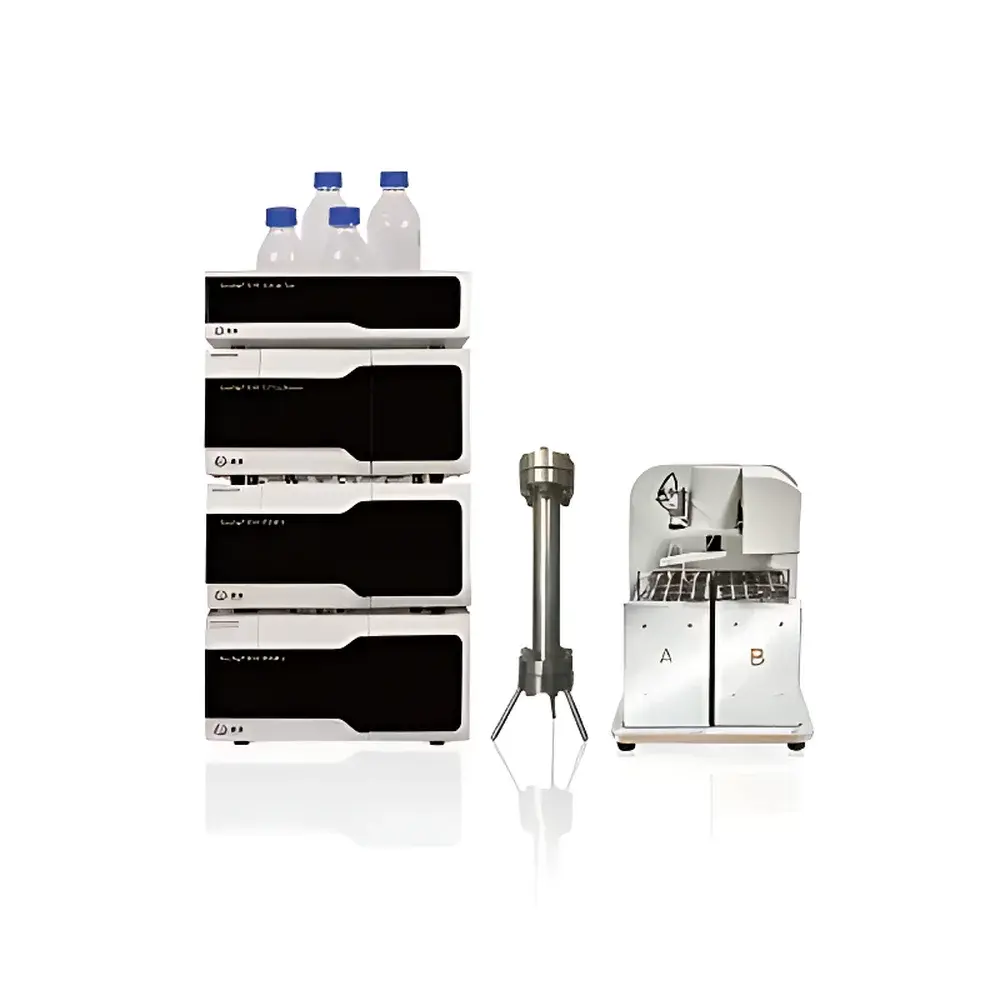
Unimicro EasySep®-3050 Preparative and Analytical Liquid Chromatography System
| Brand | Unimicro Technologies |
|---|---|
| Origin | Jiangsu, China |
| Manufacturer Type | Original Equipment Manufacturer (OEM) |
| Instrument Type | Conventional High-Performance Liquid Chromatograph (HPLC) |
| Model | EasySep®-3050 |
| Flow Rate Range | 0–50 mL/min |
| Maximum Operating Pressure | 35 MPa |
| Autosampler Capacity | 96 positions |
| Injection Volume Range | 0–5 mL |
| Column Oven Temperature Range | –100 °C (requires optional cryogenic module) |
| UV-Vis Detection Wavelength Range | 190–800 nm |
| Data Acquisition Frequency | 20 Hz |
| Detector Options | UV-Vis, Diode Array (DAD), Fluorescence (FLD), Evaporative Light Scattering (ELSD), Mass Spectrometry (MS) interfaces |
| Software Control | Unimicro ChromStation (full bidirectional control) |
Overview
The Unimicro EasySep®-3050 is a dual-purpose liquid chromatography system engineered for seamless transition between analytical method development and preparative-scale purification. Built on a modular, high-pressure gradient architecture, it employs standard HPLC principles—namely, separation based on differential partitioning of analytes between a mobile phase (liquid solvent gradient) and a stationary phase (packed column)—to deliver reproducible retention time alignment across method scales. Its 35 MPa pressure rating supports sub-2 µm particle columns for high-resolution analysis, while the 0–50 mL/min flow range enables direct scalability from µg-level screening to gram-scale isolation without re-optimization. The system integrates thermally stabilized fluidic paths and low-dead-volume manifolds to minimize band broadening and ensure consistent peak shape across flow regimes—critical for both quantitative assay validation and fraction-based recovery.
Key Features
- High-flow binary or quaternary gradient pump with pulseless delivery and <±0.5% RSD flow precision at 5–50 mL/min, compliant with ISO 13842:2017 for volumetric accuracy in preparative systems.
- Column compartment with extended temperature control (–100 °C to +80 °C), achievable via optional cryogenic chiller integration; supports retention time reproducibility per ICH Q5C guidelines for stability-indicating methods.
- Dual-wavelength UV-Vis detector featuring deuterium and tungsten lamp sources, enabling simultaneous monitoring at two user-defined wavelengths (190–800 nm); spectral bandwidth ≤4 nm, photometric noise <±2.5×10⁻⁵ AU at 254 nm.
- 96-position refrigerated autosampler (4 °C–40 °C) with needle wash station, programmable injection volume (0.1–5000 µL in 0.1 µL increments), and carryover <0.005% as verified by USP test protocols.
- Full bidirectional hardware control via Unimicro ChromStation v4.x software—including real-time pump pressure feedback, detector baseline stabilization algorithms, and event-triggered fraction collection logic.
Sample Compatibility & Compliance
The EasySep®-3050 accommodates standard 1/16″ stainless steel and PEEK tubing configurations, compatible with reversed-phase (C18, C8), HILIC, ion-exchange, and size-exclusion columns ranging from 2.1 mm to 30 mm internal diameter. It meets mechanical safety requirements per EN 61010-1:2010 and electromagnetic compatibility per EN 61326-1:2013. For regulated environments, ChromStation supports 21 CFR Part 11-compliant audit trails, electronic signatures, and role-based access control—validated for GLP and GMP workflows including QC release testing and impurity profiling per ICH Q2(R2). All firmware and software revisions are documented under a formal change control process aligned with ISO 9001:2015.
Software & Data Management
Unimicro ChromStation provides integrated method building, sequence scheduling, real-time chromatogram visualization, and post-run processing—including peak integration using tangent skim and valley-to-valley algorithms, purity assessment via spectral homogeneity mapping (for DAD), and customizable report templates exportable to PDF, CSV, or XML. Raw data files adhere to ANDI/NetCDF format for long-term archival and third-party reprocessing. System suitability tests (SST) can be automated per USP and EP 2.2.46, with pass/fail criteria configurable per parameter (e.g., resolution ≥2.0, tailing factor ≤2.0, RSD ≤1.0% for replicate injections). Audit logs record all user actions, instrument state changes, and calibration events with timestamp, operator ID, and IP address.
Applications
- Purification of synthetic intermediates and active pharmaceutical ingredients (APIs) under cGMP pilot-scale conditions.
- Isolation of natural product fractions for NMR characterization and bioactivity screening.
- Method transfer from UHPLC analytical platforms to preparative systems with <±1.5% retention time deviation.
- Stability-indicating assays for forced degradation studies, leveraging low-temperature column operation to resolve thermal degradation products.
- Quality control of oligonucleotides and peptides where UV detection at 260 nm or 214 nm is required alongside mass confirmation via optional MS coupling.
FAQ
Does the EasySep®-3050 support method validation per ICH Q2(R2)?
Yes—its documented performance specifications, software audit trail functionality, and hardware traceability enable full validation of accuracy, precision, specificity, linearity, range, and robustness per ICH Q2(R2) requirements.
Can the system operate unattended overnight?
Yes—ChromStation supports fully automated sequences including auto-injection, gradient elution, peak-triggered fraction collection, and post-run column washing, with hardware fault detection and email alerts configured via SMTP.
Is cryogenic column cooling validated for method robustness?
The –100 °C capability is achieved via external chiller integration; thermal stability and gradient reproducibility at sub-0 °C are verified per system qualification protocol IQ/OQ/PQ and included in the vendor’s validation package.
What detector interfaces are available for mass spectrometry coupling?
Standard ESI and APCI source interfaces are supported, with analog voltage output (0–10 V) and TTL trigger synchronization for external MS acquisition control.
How is data integrity ensured during multi-user lab operations?
ChromStation enforces user authentication, session locking, and write-protected raw data folders; all modifications to processed data require justification entries logged in the electronic audit trail.




