
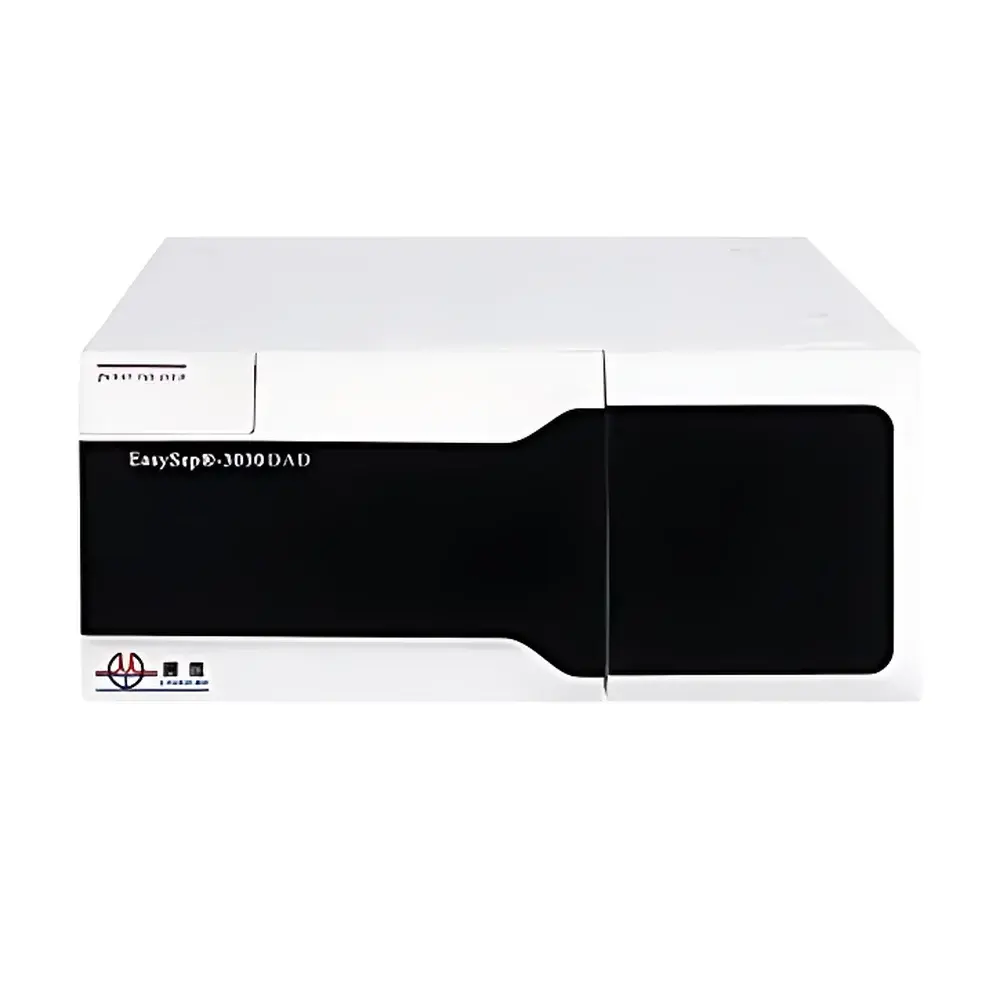
Unimicro Technologies DAD-2000 Diode Array Detector
| Brand | Unimicro Technologies |
|---|---|
| Origin | Jiangsu, China |
| Manufacturer Type | Original Equipment Manufacturer (OEM) |
| Product Category | Domestic |
| Model | DAD-2000 |
| Instrument Type | Diode Array Detector (DAD) |
| Wavelength Range | 200–800 nm |
| Detection Method | Simultaneous Multi-Wavelength Photodiode Array |
| Light Source | Deuterium Lamp + Tungsten Lamp |
| Output Interfaces | Digital (USB/Ethernet) and Analog (0–1 V, 0–5 V, 0–10 V) |
| Compatible Systems | HPLC, UHPLC, and Modular LC Platforms |
Overview
The Unimicro Technologies DAD-2000 Diode Array Detector is a high-performance, benchtop UV-Vis spectral detector engineered for integration into liquid chromatography systems—including conventional HPLC and pressure-rated UHPLC platforms. It operates on the principle of simultaneous multi-wavelength absorbance detection using a fixed grating spectrometer coupled with a 1024-element silicon photodiode array. Unlike single-wavelength UV detectors, the DAD-2000 captures full UV-Vis spectra (200–800 nm) across every data point in real time, enabling post-run spectral reconstruction, peak identification, and quantitative analysis at user-selected wavelengths without re-injection. Its optical architecture—featuring a dual-lamp system (deuterium lamp for deep-UV stability below 350 nm and tungsten lamp for visible-range consistency above 350 nm)—ensures broad spectral coverage with minimal baseline drift and high photometric linearity (<±0.002 AU over 0–2 AU range). Designed for routine QC laboratories and method development environments, the DAD-2000 delivers sensitivity comparable to high-end single-wavelength UV detectors (typical LOD: <5 ng on-column for caffeine in methanol/water), while supporting advanced spectral validation workflows required under GLP and GMP-regulated operations.
Key Features
- Real-time acquisition of full 200–800 nm spectra at up to 100 Hz sampling rate, supporting high-speed gradient separations
- Dual-lamp illumination system with automatic lamp switching and lifetime monitoring (lamp usage hours logged in system diagnostics)
- Optimized flow cell design (10 mm path length, 1 µL volume) compatible with standard 3.9–4.6 mm ID analytical columns and low-dispersion microbore configurations
- Simultaneous digital (USB 2.0 & Ethernet TCP/IP) and analog output (selectable 0–1 V / 0–5 V / 0–10 V ranges) for seamless integration with third-party data systems or legacy integrators
- Onboard spectral library matching capability with user-definable reference spectra (stored in non-volatile memory)
- Embedded self-diagnostic routines including wavelength accuracy verification (using holmium oxide filter traceable to NIST SRM 2034) and photometric repeatability assessment
Sample Compatibility & Compliance
The DAD-2000 is compatible with common HPLC mobile phases, including aqueous buffers (e.g., phosphate, acetate), organic modifiers (acetonitrile, methanol), and ion-pairing reagents—provided system backpressure remains within the detector’s specified operating limit (≤40 MPa). Its flow cell is constructed from fused silica and stainless steel, resistant to corrosion from pH 1.5–12 solvents. The instrument complies with IEC 61010-1:2010 for electrical safety and meets electromagnetic compatibility requirements per EN 61326-1:2013. Data integrity features—including electronic audit trails, user access levels (admin/operator/analyst), and secure method storage—support adherence to FDA 21 CFR Part 11, EU Annex 11, and ISO/IEC 17025 documentation requirements when used with validated chromatography data systems.
Software & Data Management
The DAD-2000 operates with Unimicro’s ChromoLink DAD Control Suite (v3.2+), a Windows-based application supporting method setup, spectral acquisition, peak purity assessment (via absorbance ratio, spectral correlation, and orthogonal angle analysis), and 3D chromatogram visualization. Raw spectral data are stored in vendor-neutral .cdf (NetCDF) format, enabling export to third-party chemometric tools (e.g., MATLAB, Python SciPy) for multivariate curve resolution (MCR) or principal component analysis (PCA). All acquisition parameters, calibration logs, and maintenance records are timestamped and digitally signed, fulfilling ALCOA+ (Attributable, Legible, Contemporaneous, Original, Accurate, Complete, Consistent, Enduring, Available) data governance principles.
Applications
- Pharmaceutical impurity profiling and forced degradation studies requiring spectral confirmation of degradants
- Natural product fingerprinting and marker compound quantification in herbal extracts
- Food additive authentication (e.g., synthetic dyes vs. natural pigments) via spectral library matching
- Environmental analysis of polycyclic aromatic hydrocarbons (PAHs) and phenolic contaminants in water matrices
- Method transfer between labs using spectral overlay and peak purity metrics to verify chromatographic identity
FAQ
Is the DAD-2000 compatible with Agilent, Waters, and Shimadzu HPLC systems?
Yes—the analog outputs and Ethernet interface support hardware-level synchronization with major OEM controllers; driver packages for OpenLAB CDS, Empower, and LabSolutions are available upon request.
Does the detector support compliance with pharmacopeial methods (e.g., USP , EP 2.2.46)?
Yes—its wavelength accuracy (±0.5 nm), photometric precision (RSD <0.5% at 0.5 AU), and spectral bandwidth (<4 nm) meet stated requirements for UV-Vis detectors in compendial monographs.
Can spectral data be exported for multivariate analysis?
Yes—full-scan .cdf files contain wavelength, time, and absorbance matrices; no proprietary codecs or license locks restrict external processing.
What maintenance is required beyond lamp replacement?
Annual verification of wavelength accuracy and photometric linearity is recommended; no optical alignment or grating recalibration is field-serviceable—these are factory-performed during certification.
Related Products




