
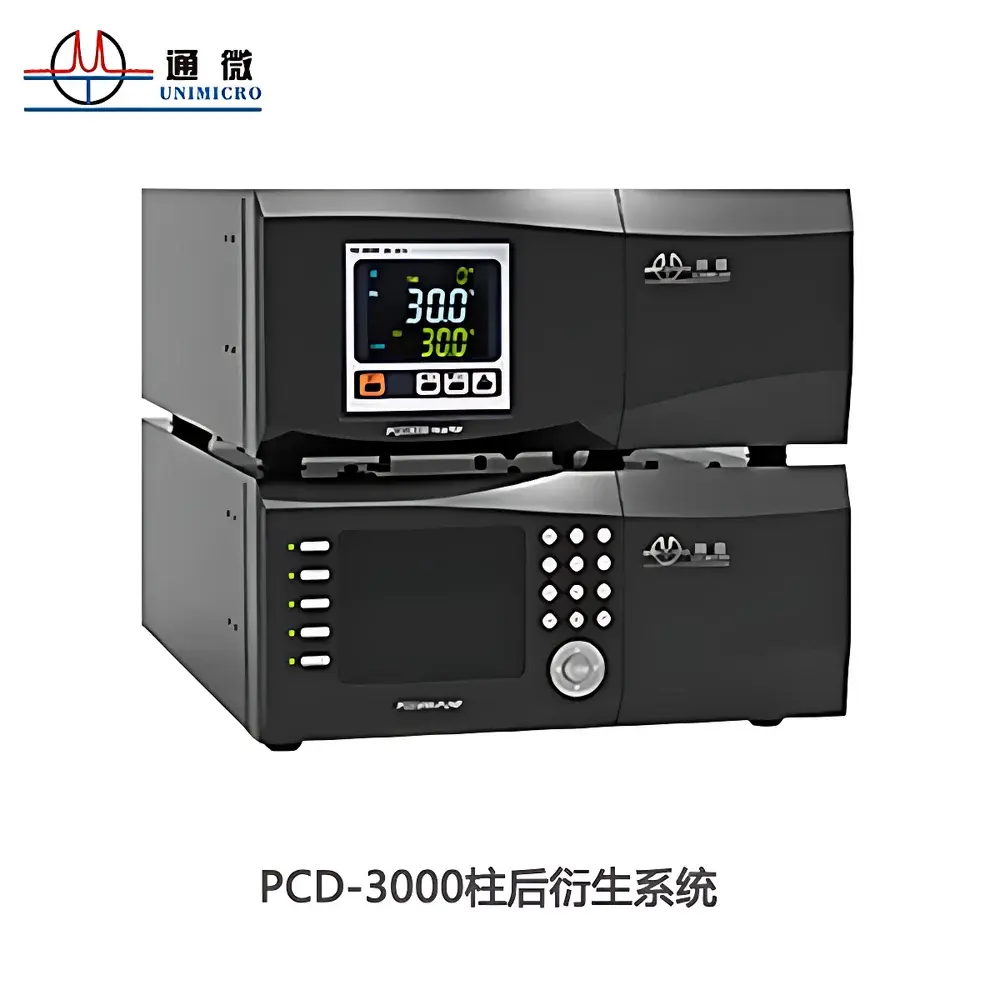
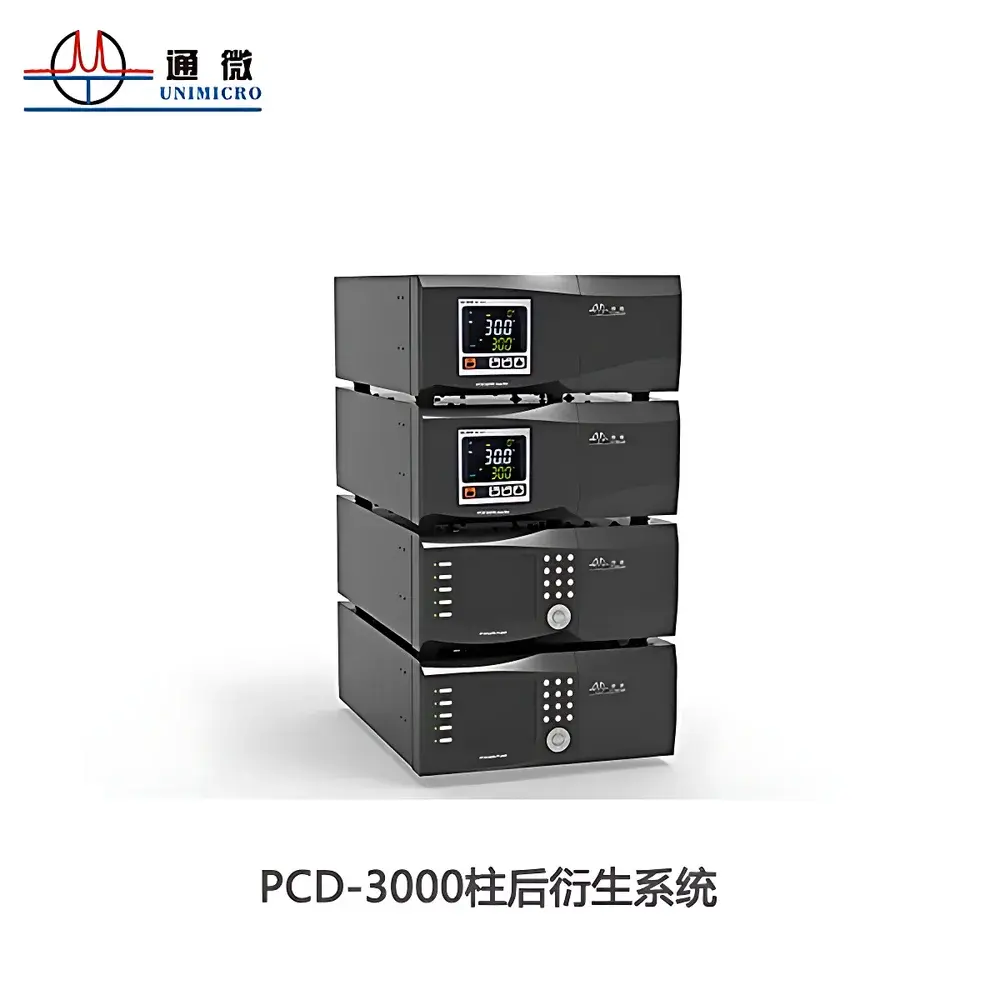
Unimicro Technologies PCD-3000 Series Post-Column Derivatization System
| Brand | Unimicro Technologies |
|---|---|
| Origin | Shanghai, China |
| Manufacturer Type | Original Equipment Manufacturer (OEM) |
| Product Origin | Domestic (China) |
| Model | PCD-3000 |
| Temperature Range | Ambient to 150 °C |
| Derivatization Reagent Flow Rate | 0.001–9.999 mL/min |
| Reaction Coil Material | Chemically Inert (e.g., PEEK, Hastelloy, or fused silica) |
Overview
The Unimicro Technologies PCD-3000 Series Post-Column Derivatization System is an engineered solution for enhancing detection sensitivity and selectivity in high-performance liquid chromatography (HPLC) and ultra-high-performance liquid chromatography (UHPLC) workflows. It operates on the principle of post-column chemical derivatization—introducing a reactive reagent downstream of the chromatographic column to convert non-chromophoric or weakly fluorescent analytes into detectable derivatives prior to detection (typically by UV-Vis, fluorescence, or electrochemical detectors). Designed for robust integration with existing LC platforms, the PCD-3000 supports both single-stage (primary) and dual-stage (secondary) derivatization configurations via modular pump and reactor assemblies. Its architecture ensures precise reagent delivery, thermally controlled reaction kinetics, and full compatibility with aggressive derivatization chemistries—including strong acids (e.g., o-phthalaldehyde/mercaptoethanol in borate buffer), strong bases (e.g., sodium hydroxide for glyphosate), and oxidizing agents—without compromising flow integrity or system longevity.
Key Features
- Modular dual-pump configuration: Independent derivatization pumps support primary and secondary derivatization pathways, enabling complex multi-step reactions (e.g., hydrolysis followed by condensation) without manual intervention.
- Chemically inert fluidic path: Entire reagent delivery path—from pump head through reaction coil to detector interface—is constructed from high-purity PEEK, Hastelloy C-276, or fused silica tubing, ensuring resistance to corrosion from concentrated acids (e.g., 6 M HCl), alkalis (e.g., 4 M NaOH), and halogenated solvents.
- Ultra-low pulsation constant-flow pump: Positive displacement syringe-type pump with real-time plunger washing capability; integrated solvent rinse cycle removes residual salts, acids, or bases after each injection, minimizing plunger seal degradation and maintaining volumetric accuracy over >10,000 cycles.
- Programmable heated reaction coil: Temperature-controlled stainless-steel or aluminum block heater with PID regulation; setpoint range: ambient to 150 °C ±0.5 °C, ramp rate up to 10 °C/min, and hardware-enforced overtemperature cutoff at 150 °C for safety compliance.
- Adjustable reaction volume: Interchangeable reaction coils (0.5–5 mL internal volume) allow optimization of residence time (tR = Vcoil/Fflow) for kinetic-limited derivatizations such as dansylation of amines or ninhydrin-based amino acid detection.
- Integrated pressure monitoring and overpressure protection: Real-time backpressure sensing with user-definable shutdown threshold (0.1–20 MPa); automatic pump halt prevents damage to reaction coils, mixing tees, or detector flow cells during line blockage or viscosity spikes.
Sample Compatibility & Compliance
The PCD-3000 is validated for use in regulated analytical environments requiring adherence to ICH Q2(R2), USP , and ASTM D7823–19 protocols for derivatization-based residue analysis. Its inert flow path meets FDA 21 CFR Part 11 requirements when paired with compliant chromatography data systems (CDS), supporting audit-trail-enabled method execution and electronic signature workflows. The system accommodates derivatization chemistries for analytes including but not limited to: glyphosate and aminomethylphosphonic acid (AMPA) (via FMOC-Cl or trichloroacetyl chloride), carbamate pesticides (e.g., carbaryl, aldicarb) using naphthalene-2,3-dicarboxaldehyde (NDA), paralytic shellfish toxins (PSTs) via alkaline hydrolysis and oxidation, and sulfonamide antibiotics using chloramine-T. All wetted materials comply with ISO 10993-5 cytotoxicity standards for laboratory equipment.
Software & Data Management
The PCD-3000 operates via Unimicro’s PCDSuite v3.x control software—compatible with Windows 10/11 64-bit—providing synchronized timing control between LC gradient events and derivatization pump activation. Software features include: method-based temperature ramp profiles, flow-rate ramping with dwell-time compensation, automated plunger wash sequence scheduling, real-time pressure/temperature logging (CSV export), and configurable alarm triggers (e.g., “low reagent level”, “coil temperature deviation >±2 °C”). Data files conform to AnIML 1.0 schema for interoperability with LIMS and ELN platforms. Remote monitoring via Ethernet (TCP/IP) enables integration into centralized lab automation networks compliant with IEEE 1394-2008 instrumentation control standards.
Applications
The PCD-3000 delivers reproducible derivatization performance across pharmaceutical QC (e.g., vitamin B1/B6 assay per USP ), environmental monitoring (glyphosate in drinking water per EPA Method 547.1), food safety testing (sulfonamides in meat per EU Commission Decision 2002/657/EC), and clinical toxicology (formaldehyde adduct quantification in blood samples). Its dual-stage capability supports advanced workflows such as sequential enzymatic hydrolysis + OPA derivatization for peptide mapping, or acid-catalyzed hydrolysis followed by dansyl chloride labeling for amino sugar profiling. Reaction coil thermal stability ensures retention time reproducibility <0.1% RSD across 100+ injections under GLP-compliant validation protocols.
FAQ
Can the PCD-3000 be integrated with third-party HPLC systems (e.g., Agilent, Waters, Thermo)?
Yes—standard 1/16″ OD stainless-steel or PEEK tubing interfaces and TTL/RS-232 trigger inputs enable seamless synchronization with external LC controllers.
What is the minimum derivatization reagent volume required for stable flow at 0.001 mL/min?
With syringe pump calibration and low-dead-volume fittings, stable sub-µL/min delivery is achievable; recommended minimum reservoir volume is 5 mL to ensure consistent priming and avoid air entrapment.
Is the reaction coil replaceable without tools?
Yes—quick-connect ferrules and standardized coil cartridges allow tool-free coil exchange in <60 seconds, minimizing system downtime during method development.
Does the system support gradient derivatization (e.g., time-programmed reagent concentration changes)?
Not natively; however, external reagent blending modules (e.g., auxiliary HPLC quaternary pump) can be interfaced via analog voltage input for dynamic reagent composition control.
How is calibration traceability maintained for flow and temperature?
Factory calibration certificates (NIST-traceable) are provided for both pump flow rate (gravimetric verification per ISO 8655-5) and temperature sensor (PT100 probe, calibrated against Fluke 724 RTD standard).
Related Products




