
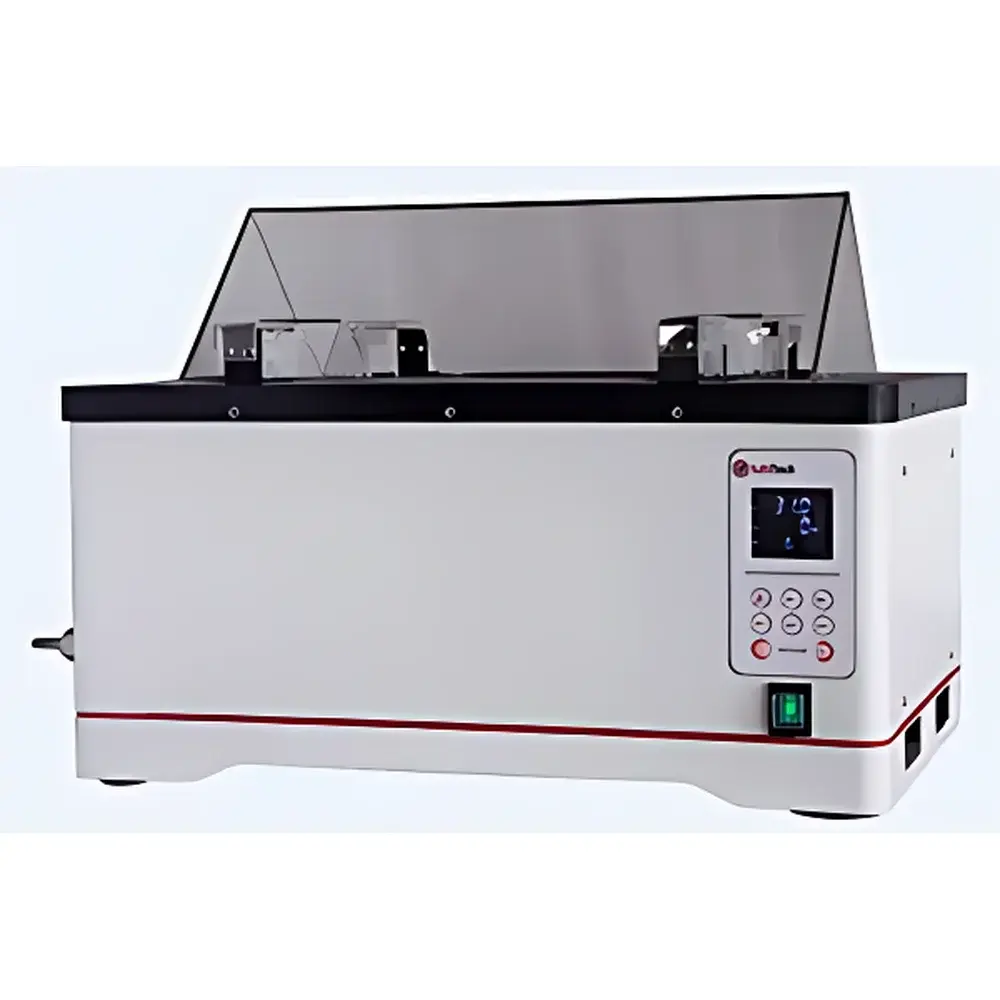
LabTech LW-20 Intelligent Corrosion-Resistant Orbital Shaking Water Bath
| Brand | LabTech |
|---|---|
| Origin | Beijing, China |
| Manufacturer Type | Direct Manufacturer |
| Product Category | Domestic |
| Model | LW-20 |
| Instrument Type | Constant-Temperature Circulating Bath |
| Circulation Mode | Internal & External Circulation |
| Temperature Control | Refrigeration & Heating Capable |
| Construction | Fully Corrosion-Resistant Polymer Housing with Epoxy-Coated Stainless Steel Bath Chamber |
| Oscillation Type | Programmable Orbital Shaking (Reciprocating & Intermittent Modes) |
| Control System | Microprocessor-Based PID Controller with Memory Function |
| Safety Features | High-Level Overflow Alarm, Self-Diagnostic Fault Codes, Auto-Recovery After Power Interruption |
| Water Management | Automatic Level-Sensing Refill System with Adjustable Flow Rate |
| Lid | Transparent Acid-Resistant Condensation-Return Cover |
| Timer Options | Four Independent Timing Modes (Duration, Delay Start, Cyclic, Interval) |
| Remote Operation Support | Scheduled Power-On Function for Unattended Operation |
| Compliance Framework | Designed to support GLP-compliant workflows with audit-ready operation logging (via optional RS485/USB interface) |
Overview
The LabTech LW-20 Intelligent Corrosion-Resistant Orbital Shaking Water Bath is an engineered solution for laboratories routinely handling aggressive chemical environments—particularly those involving concentrated mineral acids (e.g., HCl, HNO₃, HF), strong alkalis (e.g., NaOH, KOH), or oxidizing reagents. Unlike conventional stainless steel water baths, the LW-20 integrates a dual-material architecture: the bath chamber features electrophoretically deposited epoxy-coated 316 stainless steel, while all user-accessible surfaces—including platform, tube holders, and lid—are constructed from high-purity polypropylene (PP) and polytetrafluoroethylene (PTFE)-compatible polymers. This design eliminates galvanic corrosion pathways and prevents pitting or passivation failure under prolonged exposure. The unit operates on a thermoelectric refrigeration and resistive heating hybrid system, enabling precise temperature maintenance across a typical operational range of 5 °C to 99.9 °C (custom calibration available per ASTM E1137/E1137M). Its orbital shaking mechanism delivers controlled agitation at frequencies from 20 to 300 rpm, with programmable reciprocating or intermittent duty cycles—critical for uniform dissolution, digestion kinetics, or heterogeneous reaction mixing.
Key Features
- Corrosion-optimized construction: Epoxy-coated 316SS bath chamber + fully polymer-based work surface, tube racks (available in 12×15 mm, 16×100 mm, and 20×150 mm configurations), and condensation-return transparent lid
- Intelligent water level management: Ultrasonic level sensing triggers automatic refill via solenoid-controlled inlet; flow rate adjustable from 10–100 mL/min to prevent thermal overshoot during top-up
- Multi-mode oscillation control: Selectable orbital motion patterns—continuous, reciprocating, intermittent-on-time/off-time, or pulse-synchronized—with real-time rpm feedback
- Unattended operation capability: Delayed start scheduling (up to 99 h), power-loss recovery with method retention (EEPROM-backed), and four independent timer protocols
- Proactive safety architecture: Dual-level liquid detection (high-level overflow alarm + low-level dry-run lockout), real-time fault diagnostics with ISO-standardized error codes (E01–E12)
- Thermal performance: ±0.1 °C temperature stability (at 37 °C, load-dependent), <±0.3 °C uniformity across 15 L working volume (typical), external circulation port rated for ≤1.2 bar pressure
Sample Compatibility & Compliance
The LW-20 accommodates standard borosilicate glassware (including digestion tubes, centrifuge tubes, and volumetric flasks), as well as PTFE, quartz, and acid-washed polypropylene vessels. Its non-metallic interior ensures compatibility with EPA Method 3050B, ASTM D1129, and ISO 11466 sample preparation protocols requiring trace-metal-free conditions. The system supports regulatory traceability through optional data export (CSV/TXT) via USB or RS485, aligning with FDA 21 CFR Part 11 requirements when paired with LabTech’s validated LIMS integration module. All electrical components comply with IEC 61010-1:2010 safety standards for laboratory equipment, and the housing meets IP22 ingress protection rating.
Software & Data Management
While the LW-20 operates autonomously via its front-panel membrane keypad and OLED display, it supports bidirectional communication through industry-standard interfaces. The embedded firmware logs timestamped events—including temperature setpoint changes, oscillation activation, refill cycles, and fault occurrences—with retention of ≥10,000 entries. Optional LabSuite-Bath software (v3.2+) enables remote configuration, batch method deployment, and PDF report generation compliant with ISO/IEC 17025 documentation requirements. Audit trails include operator ID tagging (when integrated with LDAP/RADIUS), electronic signatures, and immutable export timestamps—essential for GLP audits and quality assurance reviews.
Applications
- Acid digestion of geological and environmental samples prior to ICP-MS or AAS analysis
- Controlled leaching studies per TCLP (US EPA Method 1311) and SPLP protocols
- Hydrolysis kinetics of ester-based pharmaceutical excipients under accelerated stability conditions
- Cell lysis optimization using chaotropic agents in molecular biology workflows
- Standardization of reference material homogenization in metrology labs
- Calibration of pH and ion-selective electrodes in high-ionic-strength media
FAQ
Does the LW-20 support external temperature probe input for sample-specific monitoring?
Yes—via the auxiliary Pt100 input port (IEC 60751 Class B), enabling dual-loop control where bath setpoint follows measured sample temperature.
What is the maximum recommended working volume for optimal thermal uniformity?
15 L is the validated capacity for ±0.3 °C spatial uniformity; exceeding this may require recalibration per ISO 17025 clause 5.5.2.
Can the oscillation function operate independently of temperature control?
Yes—shaking can be enabled at ambient temperature or during cooling-only mode, provided refrigeration capacity is not exceeded.
Is firmware update supported in-house without service engineer intervention?
Firmware upgrades are performed via USB drive using signed .bin files; version verification and rollback capability are built into the bootloader.
How does the system handle evaporation during extended overnight runs?
The condensation-return lid reduces evaporation by >65% vs. open-bath designs; combined with auto-refill, uninterrupted 72-h operation is achievable under typical lab humidity (40–60% RH).



