
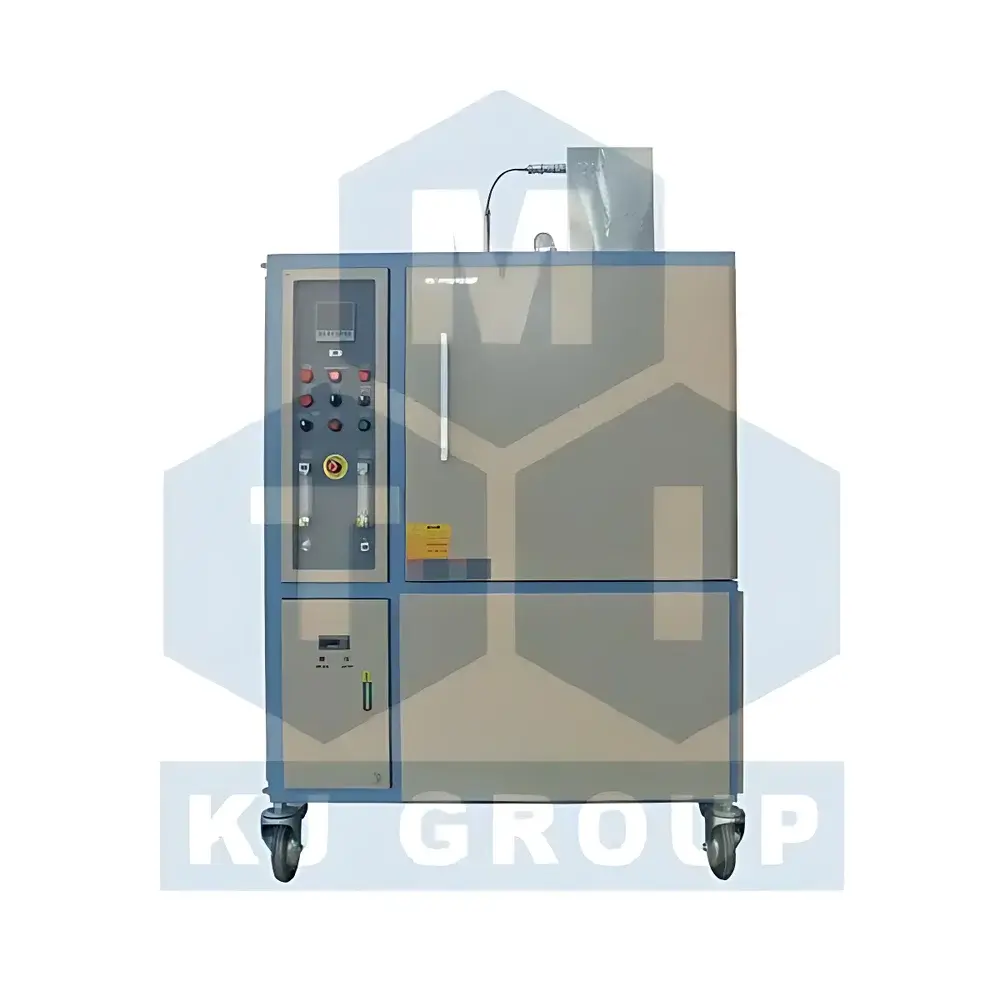
KSL-1700X-H2 High-Temperature Hydrogen Atmosphere Box Furnace (12 L, 1700 °C)
| Brand | Hefei Kejing |
|---|---|
| Origin | Anhui, China |
| Model | KSL-1700X-H2 |
| Chamber Volume | 12 L |
| Max Operating Temperature | 1700 °C (≤1 hr) |
| Continuous Operating Temperature | 1600 °C |
| Control Accuracy | ±1 °C |
| Heating Rate | 5 °C/min |
| Heating Element | Molybdenum Wire |
| Chamber Dimensions | 200 × 200 × 300 mm |
| Insulation | Alumina Fiber with Al₂O₃ Coating |
| Cooling | Integrated Water-Cooled Top Seal + 16 L/min Recirculating Chiller |
| Gas Control | Dual Rotameters (N₂: 0–1000 SCCM |
| H₂ | 0–400 SCCM) |
| Pressure Range | +1 MPa to –0.1 MPa |
| Safety System | Auto-ignition H₂ Burn-off with Flame-Out Detection & Solenoid Cut-off |
| Vacuum Interface | KF25 Flange (Rear-Mounted) |
| Power Supply | AC 208–240 V, 50 Hz, 6 kW Avg / 30 A Max |
| Certification | CE, UL/MET/CSA-compliant Components (>24 V), TÜV/CAS Certification Available on Request |
| Warranty | 12 months (excl. heating elements) |
Overview
The KSL-1700X-H2 is a CE-certified, high-temperature box furnace engineered for controlled thermal processing under reactive or inert atmospheres—specifically optimized for hydrogen (H₂) and nitrogen (N₂) environments. Designed for materials synthesis, sintering, reduction annealing, and post-processing of oxygen-sensitive or reducible compounds, it operates up to 1700 °C for short-duration cycles (≤1 hour) and maintains stable, repeatable performance at 1600 °C for extended operation. Its core architecture integrates a dual-layer stainless steel shell with forced-air and water-cooled thermal management, ensuring structural integrity and long-term seal reliability during pressurized gas operation. The furnace chamber—lined with high-purity alumina fiber insulation and coated with a dense Al₂O₃ layer—minimizes particle shedding, improves thermal efficiency, and resists chemical degradation in reducing atmospheres. Crucially, the system incorporates intrinsic safety features aligned with IEC 61508 functional safety principles: real-time flame monitoring, automatic H₂ shutoff upon flame extinction, and pressure-regulated gas delivery—all essential for compliant operation in research labs and pilot-scale production facilities handling flammable process gases.
Key Features
- Robust dual-shell construction with integrated air- and water-cooling pathways, enabling sustained operation under ±1 MPa pressure differentials
- MoSi₂-free molybdenum wire heating elements—selected for superior stability in low-oxygen and reducing atmospheres up to 1700 °C
- Water-cooled top sealing plate (16 L/min recirculating chiller included) ensures consistent gasket compression and prevents thermal drift-induced leaks
- Two calibrated rotameters (N₂: 0–1000 SCCM; H₂: 0–400 SCCM) mounted on the left side for independent, visual flow regulation
- KF25 vacuum port at rear panel, compatible with standard turbomolecular or dry scroll pumps for pre-process evacuation and leak testing
- 30-segment PID temperature controller with programmable ramp/soak profiles, ±1 °C accuracy, and data logging capability via RS485 interface
- Integrated H₂ combustion unit with thermocouple-based flame detection, auto-ignition circuitry, and fail-safe solenoid valve actuation
Sample Compatibility & Compliance
The KSL-1700X-H2 supports a broad range of sample types requiring atmosphere-controlled thermal treatment—including rare-earth phosphors, Ti-6Al-4V and other titanium alloys, metal hydrides, transition-metal oxides, and ceramic precursors susceptible to oxidation. Its 12 L chamber (200 × 200 × 300 mm) accommodates crucibles up to Φ100 mm × 120 mm height. All electrical components rated above 24 V meet UL, MET, and CSA safety standards; the full system carries CE marking per Machinery Directive 2006/42/EC and Electromagnetic Compatibility Directive 2014/30/EU. Upon customer request—and with additional certification fees—the unit can be submitted for TÜV Rheinland or CSA Group third-party verification to support ISO/IEC 17025-accredited lab validation or GMP-aligned process qualification.
Software & Data Management
While the standard configuration uses a front-panel PID controller with local display and manual setpoint entry, optional RS485 communication enables integration into centralized LabVIEW™, Python-based SCADA, or enterprise MES platforms. Logged temperature and time data are exportable as CSV files for traceability. For regulated environments, an optional 21 CFR Part 11-compliant software package (with electronic signatures, audit trails, and user access controls) is available—supporting GLP/GMP documentation requirements for pharmaceutical excipient development or battery cathode material qualification.
Applications
- Sintering of hydrogen-reducible ceramics (e.g., tungsten carbide, silicon nitride composites)
- Reductive annealing of Ni-based superalloys and Fe–Co soft magnetic powders
- Synthesis of luminescent phosphors (YAG:Ce, SrAl₂O₄:Eu²⁺) under controlled H₂/N₂ mixtures
- Thermal decomposition of metal-organic frameworks (MOFs) in inert or mildly reducing atmospheres
- Post-synthesis deoxygenation of oxide-derived electrocatalysts (e.g., Cu₂O → metallic Cu)
- Heat treatment of lithium-ion battery cathode precursors (e.g., LiNi₀.₈Co₀.₁₅Al₀.₀₅O₂) under low-pO₂ conditions
FAQ
Is the KSL-1700X-H2 suitable for continuous operation at 1700 °C?
No. The maximum continuous operating temperature is 1600 °C. Operation at 1700 °C is permitted only for durations ≤60 minutes per cycle to preserve heating element longevity and thermal insulation integrity.
Can this furnace be used with argon or forming gas (5% H₂/95% N₂)?
Yes. The gas control system supports any non-corrosive inert or reducing gas mixture. Flow rates must remain within the specified rotameter ranges, and compatibility with seals and internal components should be verified for long-term use with forming gas.
What vacuum level can be achieved with the standard KF25 interface?
When paired with a typical 10⁻³ mbar-rated dry scroll pump, the system achieves base pressures of ≤5 × 10⁻² mbar after 30 minutes of pumping. For ultra-high vacuum applications, a secondary turbomolecular pump is recommended.
Does the furnace include overpressure protection?
Yes. The dual-pressure gauge assembly (mechanical pressure indicator on top, digital transducer optional) monitors internal pressure in real time. Exceeding +1 MPa triggers an audible alarm and initiates automated gas cutoff—compliant with EN 14727 pressure equipment safety guidelines.
How is calibration traceability maintained for temperature control?
The PID controller accepts external Type S thermocouple input. Users may perform in-chamber calibration using NIST-traceable reference thermocouples and document results per ISO/IEC 17025 Section 6.6. Factory calibration certificates are provided with each unit.



