
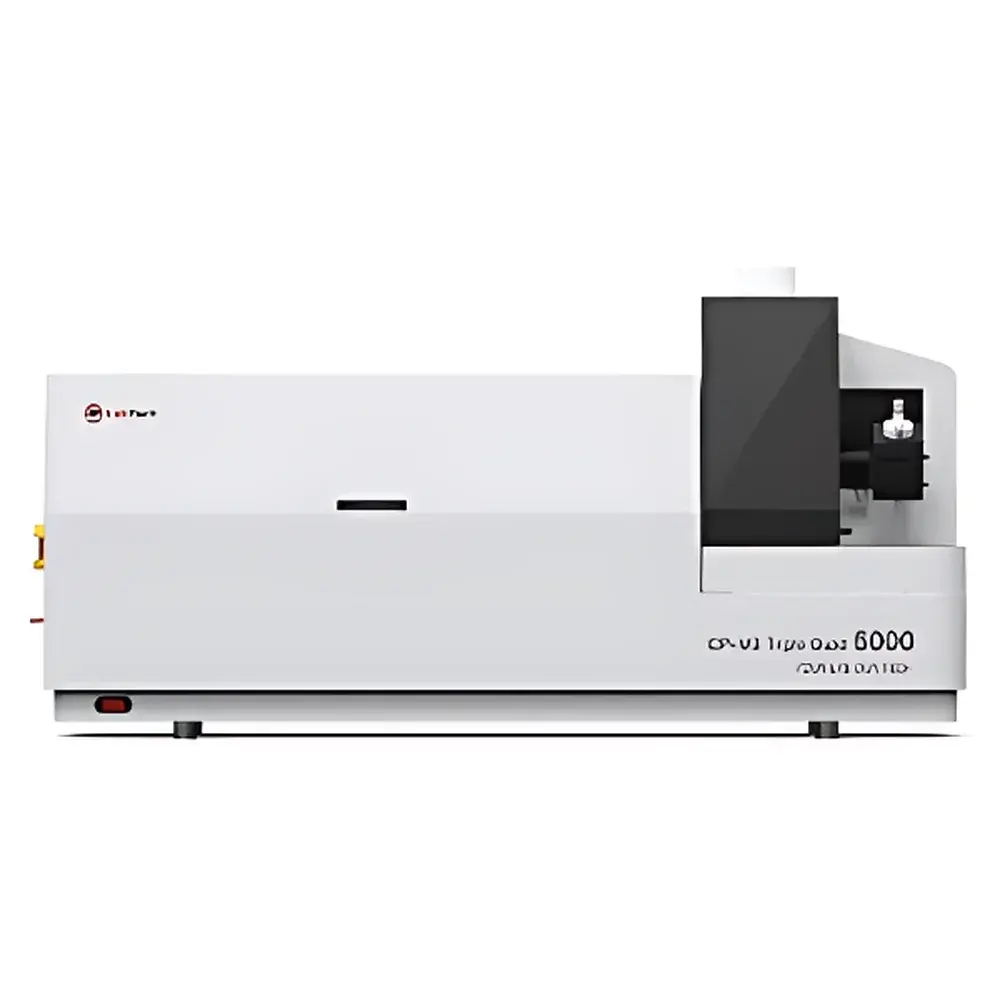
LabTech LabMS 5000 Triple Quadrupole Inductively Coupled Plasma Mass Spectrometer (ICP-MS/MS)
| Brand | LabTech |
|---|---|
| Origin | Beijing, China |
| Manufacturer Type | Original Equipment Manufacturer (OEM) |
| Instrument Type | Quadrupole-based ICP-MS/MS |
| Configuration | Dual-mode (QqQ and single-quadrupole) |
| Application Domain | Laboratory-based elemental and isotopic analysis |
| Regulatory Compliance | SEMI S2 certified |
| Safety Architecture | 10-layer integrated hardware and firmware safety interlocks |
| Software Platform | HiMass Intelligent Workstation (v3.2+) |
| Ion Source | Robust 27 MHz solid-state RF generator with auto-matching plasma system |
| Interface Design | High-efficiency nickel sampler/skimmer cone assembly with active cooling |
| Ion Optics | Multi-stage electrostatic ion guide with collision/reaction cell (CRC) featuring mass-resolved reaction monitoring (MRM) capability |
Overview
The LabTech LabMS 5000 Triple Quadrupole Inductively Coupled Plasma Mass Spectrometer (ICP-MS/MS) is an advanced elemental analysis platform engineered for ultra-trace quantification of metals and non-metals in complex matrices. It operates on the principle of inductively coupled plasma ionization followed by tandem mass spectrometric separation—utilizing two quadrupole mass filters (Q1 and Q3) with an intermediate collision/reaction cell (q2) to enable mass-resolved reaction monitoring (MRM), kinetic energy discrimination (KED), and on-mass or mass-shift interference removal strategies. Unlike conventional single-quadrupole ICP-MS systems, the LabMS 5000 delivers deterministic control over polyatomic interferences (e.g., 40Ar16O+ on 56Fe+, 40Ar35Cl+ on 75As+) through selective precursor ion filtering and reactive gas–mediated ion chemistry (e.g., O2, NH3, He). This architecture supports both quantitative isotope ratio analysis and high-fidelity speciation workflows under GLP/GMP-aligned operational protocols.
Key Features
- Dual-operation mode: Seamless switching between single-quadrupole (Q-ICP-MS) and triple-quadrupole (QqQ-ICP-MS/MS) configurations via software command—enabling method flexibility without hardware reconfiguration.
- 27 MHz solid-state RF generator with real-time impedance matching: Delivers stable plasma power output (750–1600 W) across variable nebulizer gas flows and matrix loadings, ensuring long-term signal stability (RSD < 2.5% over 8 h).
- High-transmission ion optics: Optimized electrostatic lens stack and cooled interface cones maintain >65% ion transmission efficiency in MS/MS mode—even at low m/z (250).
- Modular collision/reaction cell (CRC): Equipped with fast-switching gas delivery (O2, NH3, He, H2) and dynamic bandpass tuning for optimized reaction kinetics and minimal product ion fragmentation.
- SEMI S2-certified mechanical and electrical safety architecture: Includes redundant vacuum interlocks, RF shielding integrity monitoring, coolant flow sensors, emergency shutdown sequencing, and ten independent hardware-level safety circuits.
- Full-matrix sample introduction: Compatible with standard PFA microflow nebulizers, desolvating systems (e.g., Aridus III), and laser ablation interfaces—validated for direct analysis of seawater, digested biological tissues, semiconductor slurries, and nuclear fuel cycle solutions.
Sample Compatibility & Compliance
The LabMS 5000 is validated for liquid, solid (via LA-ICP-MS), and gaseous sample introduction. It meets ISO/IEC 17025:2017 requirements for testing laboratories when operated with documented SOPs and calibration traceability to NIST SRMs (e.g., SRM 3100 series, SRM 3133). For regulated environments—including pharmaceutical QC (USP /), environmental compliance (EPA Method 6020C), and nuclear material accountancy—the system supports full 21 CFR Part 11-compliant audit trails, electronic signatures, and role-based access control within HiMass v3.2+. All safety-critical subsystems are certified to SEMI S2-0218 standards for semiconductor manufacturing equipment, confirming suitability for Class 100 cleanroom deployment.
Software & Data Management
HiMass Intelligent Workstation provides a modular, wizard-driven interface for method development, acquisition, and reporting. Key capabilities include: automated tuning and optimization (mass calibration, sensitivity check, oxide/double-charge ratio), MRM method builder with reaction gas selection logic, real-time interference diagnostic dashboards, and batch processing with customizable report templates (PDF/Excel/XML). Raw data files (.raw) are stored in vendor-neutral mzML format; audit logs record every parameter change, user action, and instrument state transition with timestamped digital signatures. Integration with LIMS platforms (e.g., Thermo Fisher SampleManager, LabVantage) is supported via ASTM E1384-compliant APIs.
Applications
The LabMS 5000 addresses analytical challenges in multiple regulated sectors: semiconductor metrology (trace metal contamination in ultrapure water and etchants), nuclear safeguards (isotopic ratios of U/Pu in spent fuel reprocessing streams), environmental monitoring (sub-pg/g As, Cd, Pb in drinking water per WHO guidelines), clinical research (elemental biomarkers in serum and CSF), geochronology (U–Pb zircon dating), and biopharmaceutical quality control (residual catalyst metals in monoclonal antibody formulations). Its MS/MS capability enables unambiguous quantification of analytes co-eluting with isobaric or polyatomic interferences—eliminating reliance on mathematical correction algorithms or matrix-matched calibrants.
FAQ
What distinguishes LabMS 5000 from single-quadrupole ICP-MS instruments?
It employs true tandem mass spectrometry (QqQ) to physically isolate precursor ions in Q1, induce controlled reactions in q2, and detect product ions in Q3—providing orthogonal selectivity beyond kinetic energy discrimination or mathematical interference correction.
Is the LabMS 5000 compliant with FDA 21 CFR Part 11 requirements?
Yes—HiMass v3.2+ implements full electronic signature management, audit trail generation with immutable timestamps, and secure user authentication aligned with Part 11 Annex 11 expectations.
Can the instrument operate in both MS/MS and single-quadrupole modes during the same analytical run?
No—mode switching requires a brief reconfiguration (typically <90 s), but methods can be sequenced automatically within a single batch to leverage optimal detection strategies per element.
What maintenance intervals are recommended for the RF generator and interface components?
The solid-state RF generator requires no routine servicing; sampler/skimmer cones are rated for ≥3 months continuous operation in high-salt matrices and should be inspected weekly per ISO/IEC 17025 preventive maintenance schedules.
Does LabTech provide application support for method development in regulated industries?
Yes—qualified application scientists offer remote and on-site method validation support, including protocol documentation, uncertainty budgeting per EURACHEM/CITAC Guide, and IQ/OQ/PQ execution assistance.





