
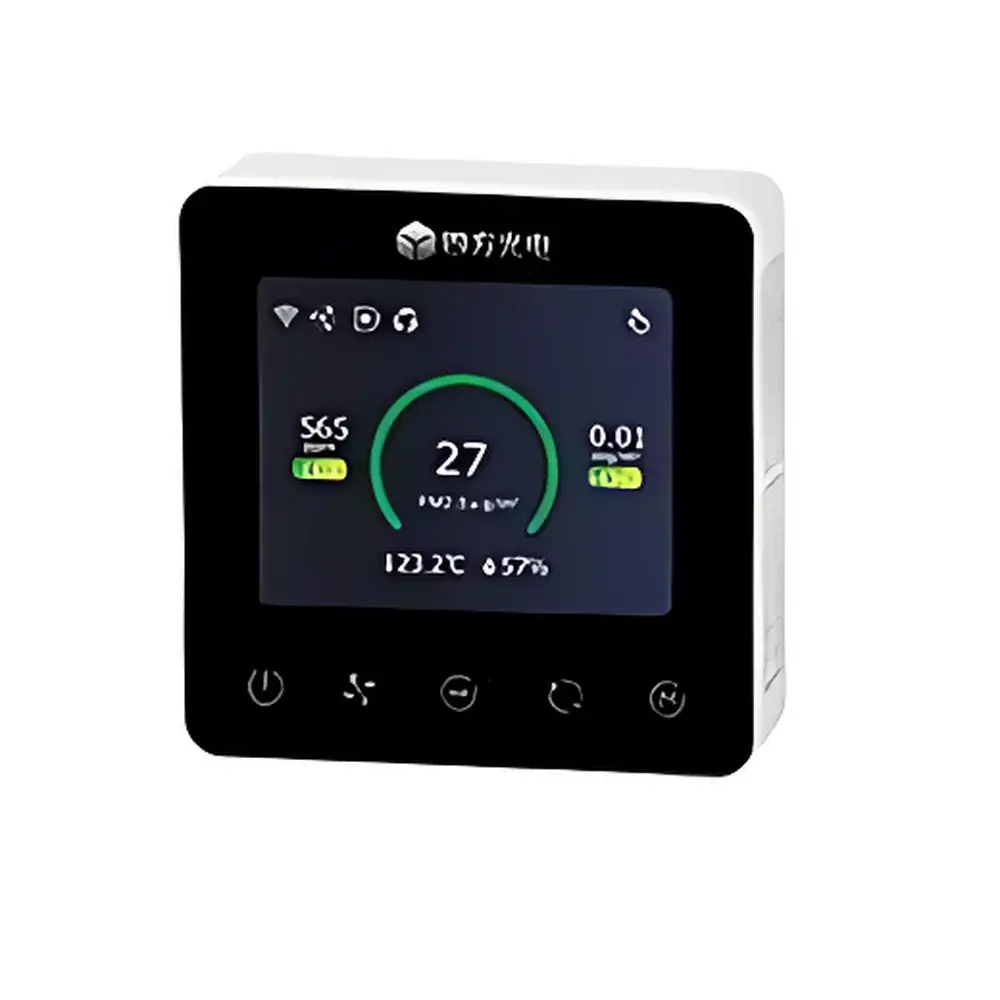
Cubic AM6108B Indoor Air Quality Controller with Integrated Ventilation Management
| Brand | Cubic |
|---|---|
| Origin | Hubei, China |
| Model | AM6108B |
| Instrument Type | Online Monitoring Controller |
| CO₂ Detection Principle | Non-Dispersive Infrared (NDIR) |
| PM₂.₅ Detection Principle | Optical Scattering |
| Formaldehyde Detection Principle | Electrochemical Sensing |
| Measurement Range | PM₂.₅: 0–1000 µg/m³ |
| CO₂ | 0–5000 ppm |
| Formaldehyde | 0–0.5 mg/m³ (up to 1 mg/m³) |
| Temperature | −10°C to +50°C |
| Relative Humidity | 0–95% RH |
| Data Update Interval | 1 s |
| Operating Voltage | DC 12 V |
| Current Consumption | <140 mA |
| Communication Interface | RS485 |
| Dimensions | 86 mm × 86 mm × 24.9 mm (W×H×D) |
| Mounting Options | Embedded or Wall-Mounted |
| Control Output | Three-Speed Fan Regulation, Supply/Exhaust Switching, Mode Selection (Smart/Manual/Silent/Time-Scheduled) |
| Optional Feature | Filter Replacement Alert |
| Sensor Configuration | Modular — PM₂.₅, CO₂, Formaldehyde, Temperature & Humidity sensors selectable per application requirement |
Overview
The Cubic AM6108B Indoor Air Quality (IAQ) Controller is an integrated online environmental management system engineered for real-time, multi-parameter air quality monitoring and intelligent ventilation control. Unlike standalone gas detectors, the AM6108B functions as a closed-loop IAQ management node—combining precision sensing, embedded logic processing, and direct actuation of mechanical ventilation components. Its core architecture leverages three validated physical detection principles: non-dispersive infrared (NDIR) spectroscopy for CO₂ quantification, laser-based optical scattering for PM₂.₅ mass concentration determination, and electrochemical transduction for formaldehyde (HCHO) measurement. These sensor modalities are calibrated and temperature-compensated in accordance with ISO 16000-23 (indoor air—determination of formaldehyde) and ISO 7726 (ergonomics of the thermal environment—instruments for measuring physical quantities), ensuring metrological traceability under variable ambient conditions. Designed for continuous operation in occupied spaces, the controller continuously acquires, validates, and time-stamps all five primary IAQ parameters—PM₂.₅, CO₂, HCHO, temperature, and relative humidity—at 1-second intervals, enabling dynamic response to transient contamination events such as cooking emissions, occupancy surges, or off-gassing from new furnishings.
Key Features
- Modular five-sensor architecture: Users select only the required combination of PM₂.₅, CO₂, formaldehyde, temperature, and humidity sensors—reducing total cost of ownership and optimizing calibration cycles.
- Dual-mount flexibility: Compatible with both recessed (embedded) installation into HVAC control panels and surface-mounted wall deployment—supporting retrofit and OEM integration workflows.
- Multi-mode ventilation control: Delivers deterministic actuation via RS485 Modbus RTU protocol to compatible fresh-air handling units, supporting four operational profiles—Smart (algorithm-driven demand-controlled ventilation), Manual (user-defined setpoints), Silent (low-noise fan operation), and Time-Scheduled (pre-programmed on/off and speed sequences).
- Simultaneous formaldehyde and TVOC inference: The electrochemical formaldehyde sensor provides cross-sensitive response to broader volatile organic compounds; output can be configured to report inferred TVOC index when calibrated against reference standards per ISO 16000-29.
- Filter life monitoring interface: Optional firmware extension enables runtime tracking of particulate filter usage based on cumulative PM₂.₅ exposure and airflow duration—generating maintenance alerts compliant with ISO 16890-4 (air filters for general ventilation).
- Industrial-grade power and communication design: Operates reliably at DC 12 V with peak current draw below 140 mA; RS485 interface supports daisy-chained deployment across distributed building automation systems with noise immunity up to 2.5 kV ESD per IEC 61000-4-2.
Sample Compatibility & Compliance
The AM6108B is validated for indoor ambient air sampling in residential, commercial office, educational, and light industrial environments where representative air mixing is achieved (per ASHRAE Standard 62.1-2022 section 6.2.2). It does not require sample conditioning or pre-filtration for standard applications. All sensors meet RoHS Directive 2011/65/EU and REACH Annex XVII requirements. CO₂ measurements comply with EN 14687:2017 (residential demand-controlled ventilation systems), while formaldehyde detection aligns with the performance criteria outlined in ISO 16017-1 for passive sampler correlation. The device’s enclosure conforms to IP20 (IEC 60529) for indoor use, and its electromagnetic compatibility satisfies Class B limits per CISPR 32. For GxP-regulated facilities, optional audit-trail-enabled firmware (with timestamped configuration changes and sensor calibration logs) supports alignment with FDA 21 CFR Part 11 data integrity expectations.
Software & Data Management
The AM6108B communicates exclusively via RS485 Modbus RTU (function codes 03h/06h), enabling seamless integration into BACnet/IP, KNX, or proprietary building management systems (BMS) through standard protocol gateways. Raw sensor outputs are provided in engineering units (ppm, µg/m³, °C, %RH, mg/m³) with 16-bit resolution and linear scaling coefficients stored in EEPROM. No cloud dependency or vendor-specific software is required for basic operation. For advanced analytics, Cubic provides a free Windows-based configuration utility (AMConfig v2.4) supporting firmware updates, sensor zero-point adjustment, alarm threshold definition (e.g., CO₂ > 1000 ppm triggers “ventilate” command), and export of CSV-formatted time-series logs. All configuration changes are logged with UTC timestamps and user identifiers—enabling GLP-compliant record retention when deployed with external BMS historian modules.
Applications
- Residential smart ventilation: Automatically modulates ERV/HRV fan speed based on real-time CO₂ and HCHO levels to maintain IAQ thresholds while minimizing heating/cooling energy loss.
- Classroom and lecture hall IAQ optimization: Triggers increased outdoor air intake during occupancy peaks, reducing absenteeism linked to elevated CO₂ (>1200 ppm) per ASHRAE Guideline 44-2022.
- Post-renovation indoor air verification: Monitors formaldehyde decay kinetics following installation of composite wood products—supporting clearance testing per EPA Method TO-11A.
- Office building demand-controlled ventilation (DCV): Integrates with HVAC DDC controllers to reduce fan energy consumption by up to 30% compared to fixed-air-volume operation, as verified in DOE Commercial Reference Building models.
- Pharmaceutical cleanroom antechamber monitoring: Provides secondary IAQ assurance in gowning areas where particulate and VOC ingress must be detected before entry into classified zones (ISO 14644-1 Class 8).
FAQ
Does the AM6108B support analog voltage outputs (e.g., 0–10 V or 4–20 mA)?
No—the device uses RS485 Modbus RTU exclusively for digital communication. Analog output requires an external protocol converter.
Can the formaldehyde sensor be recalibrated in the field?
Yes—using certified formaldehyde gas standard (100 ppb in N₂) and the AMConfig utility; full recalibration requires access to the sensor’s internal zero and span registers.
Is the PM₂.₅ measurement compliant with ISO 25548-1 for portable monitors?
The optical scattering module meets the size-selective inlet and counting efficiency requirements specified in ISO 25548-1 Annex A for PM₂.₅, though it is classified as a fixed-location monitor per clause 3.2.
What is the recommended calibration interval for routine operation?
Annual calibration is advised for CO₂ (NDIR) and formaldehyde (electrochemical) sensors; PM₂.₅ optical modules require biannual verification against gravimetric reference samplers per ISO 12103-1 A2 test dust.
Does the unit provide relay outputs for direct fan control?
No—actuation is performed exclusively via RS485 commands to external ventilation controllers; no onboard dry-contact relays are included.
Related Products







