

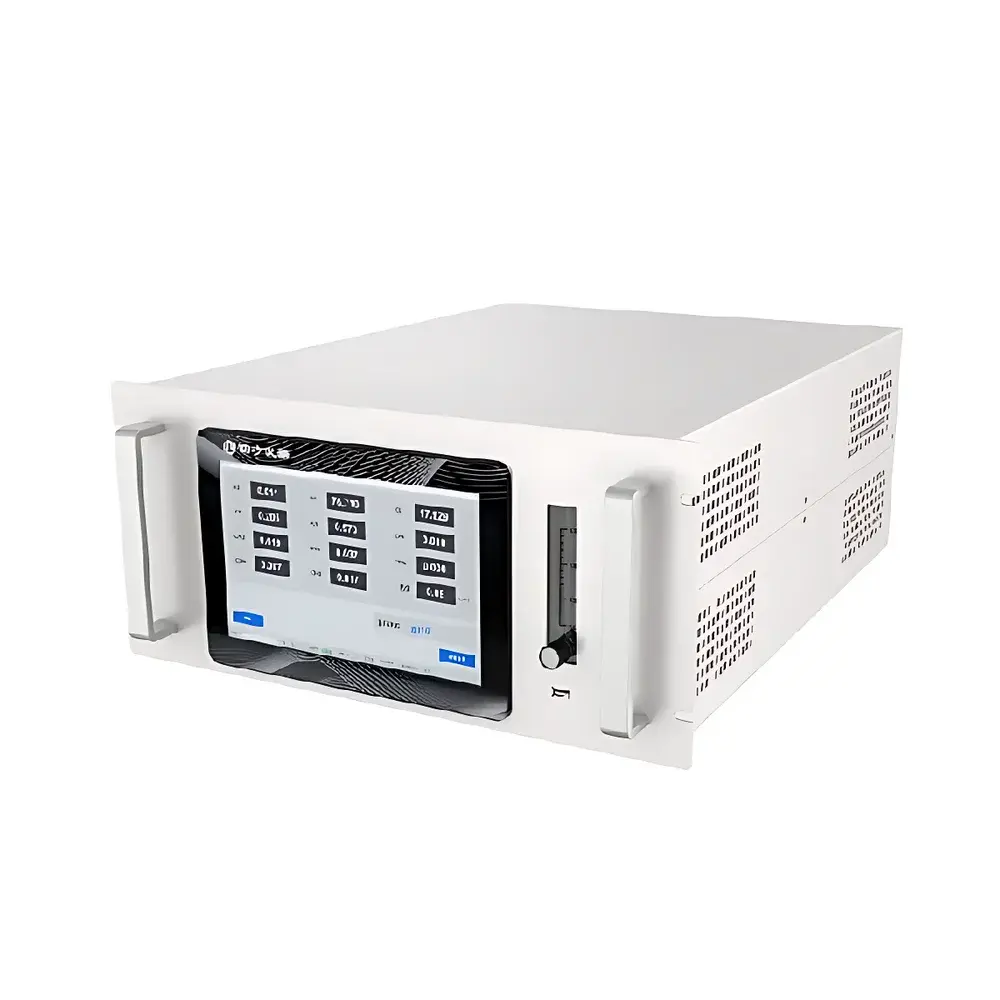
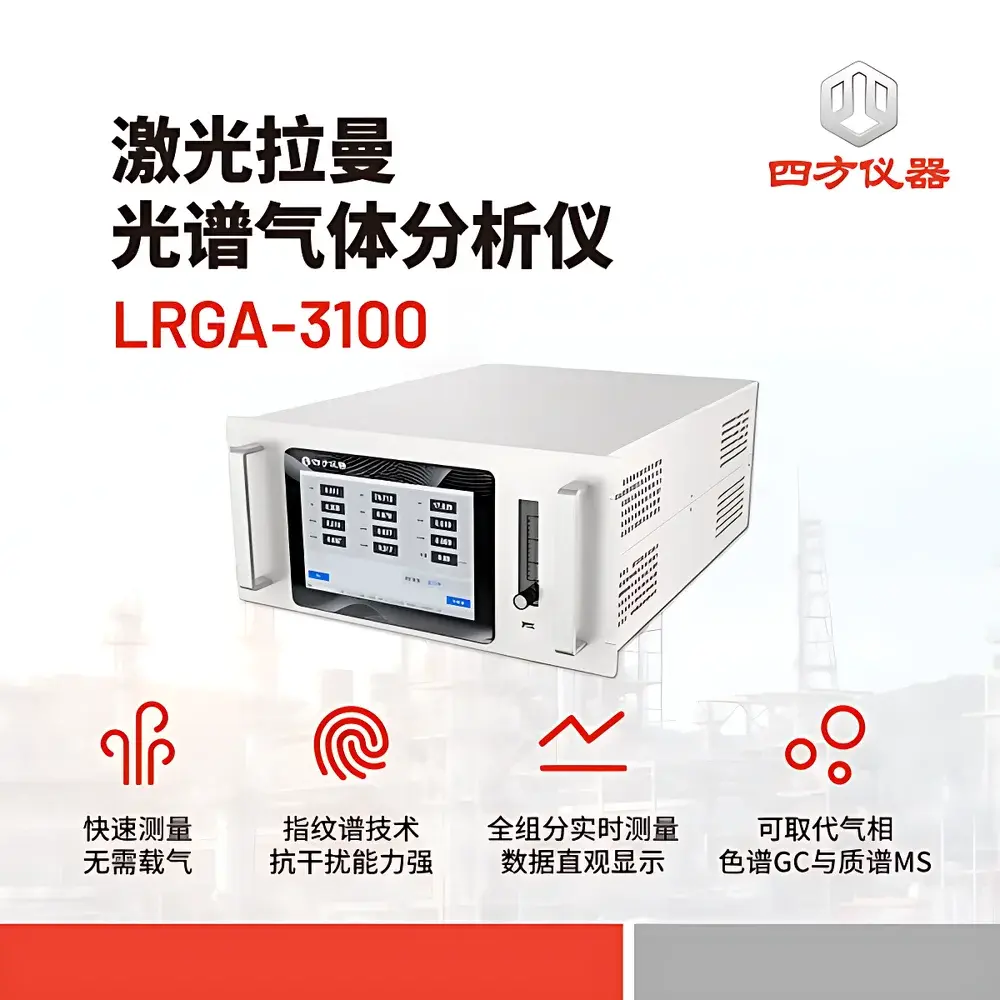
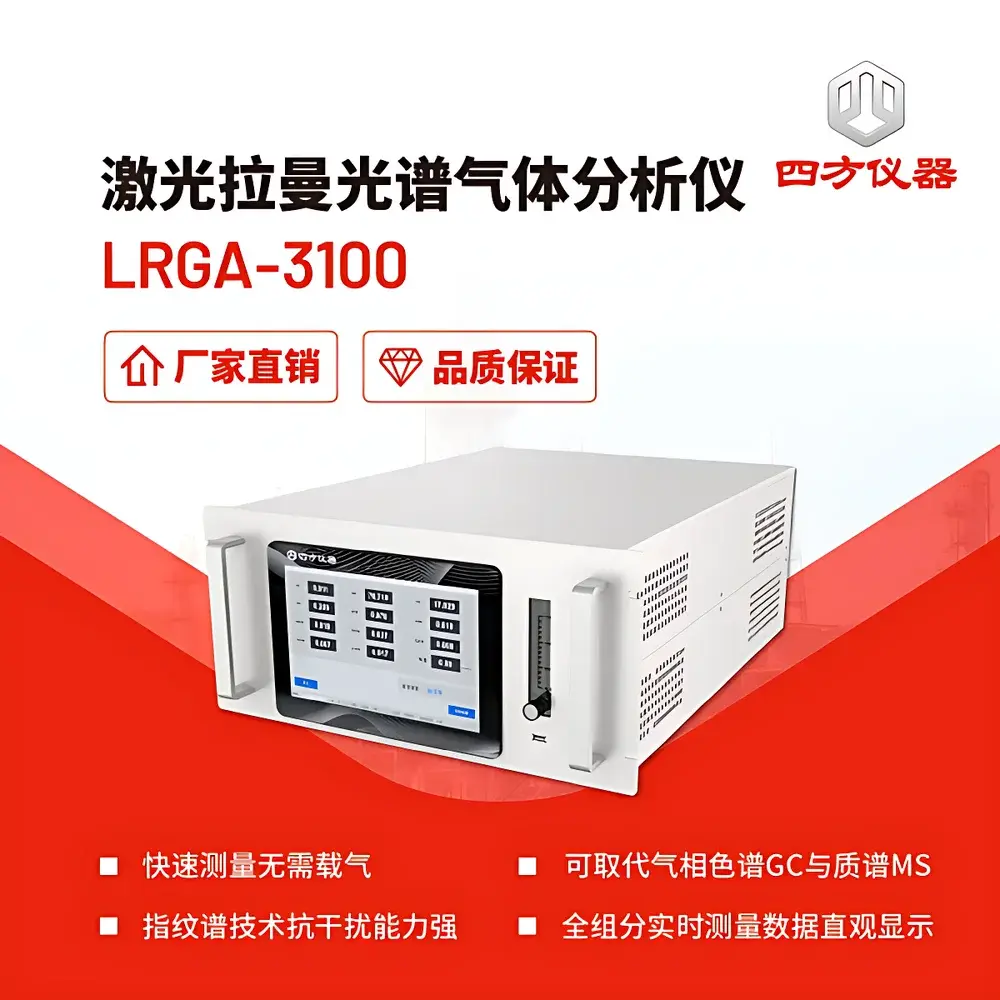
CUBIC INSTRUMENTS LRGA-3100 Laser Raman Gas Analyzer
| Brand | CUBIC INSTRUMENTS |
|---|---|
| Origin | Hubei, China |
| Manufacturer Type | Authorized Distributor |
| Regional Category | Domestic (China) |
| Model | LRGA-3100 |
| Price Range | USD 140,000 – 280,000 |
| Instrument Type | Grating-Based Raman Spectrometer |
| Spectral Repeatability | ≤1% |
Overview
The CUBIC INSTRUMENTS LRGA-3100 Laser Raman Gas Analyzer is an industrial-grade, real-time multicomponent gas analysis system engineered for precision, robustness, and field-deployable operation. It operates on the fundamental principle of spontaneous Raman scattering: a monochromatic laser beam (typically 532 nm or 785 nm) is focused into a pressurized gas cell, where incident photons interact inelastically with molecular vibrational modes, generating wavelength-shifted Stokes and anti-Stokes scattered light. The resulting Raman spectrum—comprising molecule-specific fingerprint peaks—is dispersed by a high-efficiency transmission grating and detected using a thermoelectrically cooled CCD or CMOS array. Unlike chromatographic or mass spectrometric methods, Raman spectroscopy requires no consumables (e.g., carrier gases, columns, or filaments), enables simultaneous quantification of up to 12 gas species, and delivers full-spectrum acquisition within <10 seconds—making it ideal for dynamic process monitoring in continuous-flow environments.
Key Features
- Real-time, continuous multicomponent gas analysis with ≤10 s response time and zero measurement dead time between samples
- Simultaneous quantification of H2, N2, O2, CO, CO2, CH4, C2H2, C2H4, C2H6, C3H6, C3H8, and H2S across 0–100% v/v concentration range
- Laser-based fingerprint spectral identification with inherent immunity to cross-interference from water vapor, particulates, or inert matrix gases
- Full-spectrum calibration via internal reference standards; no external calibration gases required for routine operation
- Integrated touchscreen HMI with intuitive graphical interface; optional remote control and data export via USB, RS-232/RS-485, and Ethernet (TCP/IP)
- Compact benchtop form factor (605 × 483 × 220 mm) with low power consumption (<70 W, AC 220 V / 50 Hz) suitable for integration into mobile labs, skids, or hazardous-area enclosures (ATEX/IECEx-ready configurations available upon request)
Sample Compatibility & Compliance
The LRGA-3100 is validated for direct analysis of raw, unconditioned process streams—including humid, dusty, or thermally unstable gas matrices—without sample conditioning, dilution, or pre-concentration. Its optical design eliminates dependence on gas-phase absorption coefficients or refractive index changes, ensuring stable performance across varying pressure (1–5 bar typical) and temperature (10–35 °C ambient operating range) conditions. The analyzer complies with ISO 17025 traceability requirements for calibration documentation and supports GLP/GMP-compliant audit trails when paired with optional software modules. While not certified to IEC 61508 SIL2 out-of-the-box, its architecture meets functional safety prerequisites for integration into SIS loops under end-user responsibility per ISA-84.00.01.
Software & Data Management
The embedded firmware runs on a Linux-based real-time OS with deterministic acquisition timing. Spectral processing employs proprietary algorithms including cosmic-ray spike removal, dark-current subtraction, baseline correction via asymmetric least squares (AsLS), and multivariate curve resolution–alternating least squares (MCR-ALS) for overlapping peak deconvolution. Quantitative models are built using partial least squares regression (PLSR) trained on NIST-traceable reference mixtures. Data output conforms to OPC UA (IEC 62541) and Modbus TCP protocols, enabling seamless integration with DCS, SCADA, and MES platforms. All raw spectra, processed results, instrument logs, and user actions are timestamped and stored locally (≥1 year retention); optional cloud synchronization supports remote diagnostics and predictive maintenance analytics.
Applications
- Natural & Shale Gas Processing: Accurate H2/N2 quantification where GC fails due to lack of retention; rapid compositional profiling without column aging or carrier gas dependency
- Drilling Mud Logging (Geochemical Logging): Meets SY/T 5788.2–2018 specifications for real-time hydrocarbon ratio analysis; eliminates GC oven ramp delays during rapid depth progression
- Petrochemical Refining: In-situ monitoring of hydrogenation, reforming, and cracking unit off-gases; detects trace H2S and olefins with sub-0.1% v/v LOD
- Coal & Biomass Gasification: Continuous syngas composition tracking (H2:CO ratio, CH4, tars) without catalyst poisoning or sensor drift
- Steelmaking & Coking: Hot-wet blast furnace top gas analysis; resistant to Fe-oxide particulate interference and thermal quenching effects
- Tire & Rubber Pyrolysis: Discriminative identification of butadiene, styrene, and limonene signatures in complex hydrocarbon mixtures without chromatographic separation
FAQ
Does the LRGA-3100 require carrier gas or calibration standards for daily operation?
No. It uses absolute intensity-based quantification calibrated against primary reference spectra; only initial factory calibration is required.
Can the analyzer operate in high-humidity or corrosive gas environments?
Yes—optical path is sealed and purged; sample interface is configurable with Hastelloy C-276 or quartz-lined flow cells for aggressive chemistries.
Is spectral data export compatible with third-party chemometrics software?
Yes. Raw .csv and .spc files include full wavelength-intensity arrays, metadata headers, and calibration coefficients for MATLAB, Python (scikit-learn), or Unscrambler import.
What maintenance intervals are recommended?
Laser diode lifetime exceeds 20,000 hours; optical alignment is factory-set and non-adjustable; annual verification of spectral accuracy and repeatability is advised per ISO/IEC 17025.
How is measurement uncertainty determined for each gas component?
Uncertainty budgets follow GUM (JCGM 100:2008) methodology, incorporating contributions from spectral noise, peak fitting residuals, calibration model RMSE, and environmental drift—reported as ±1% FS at 95% confidence.






