
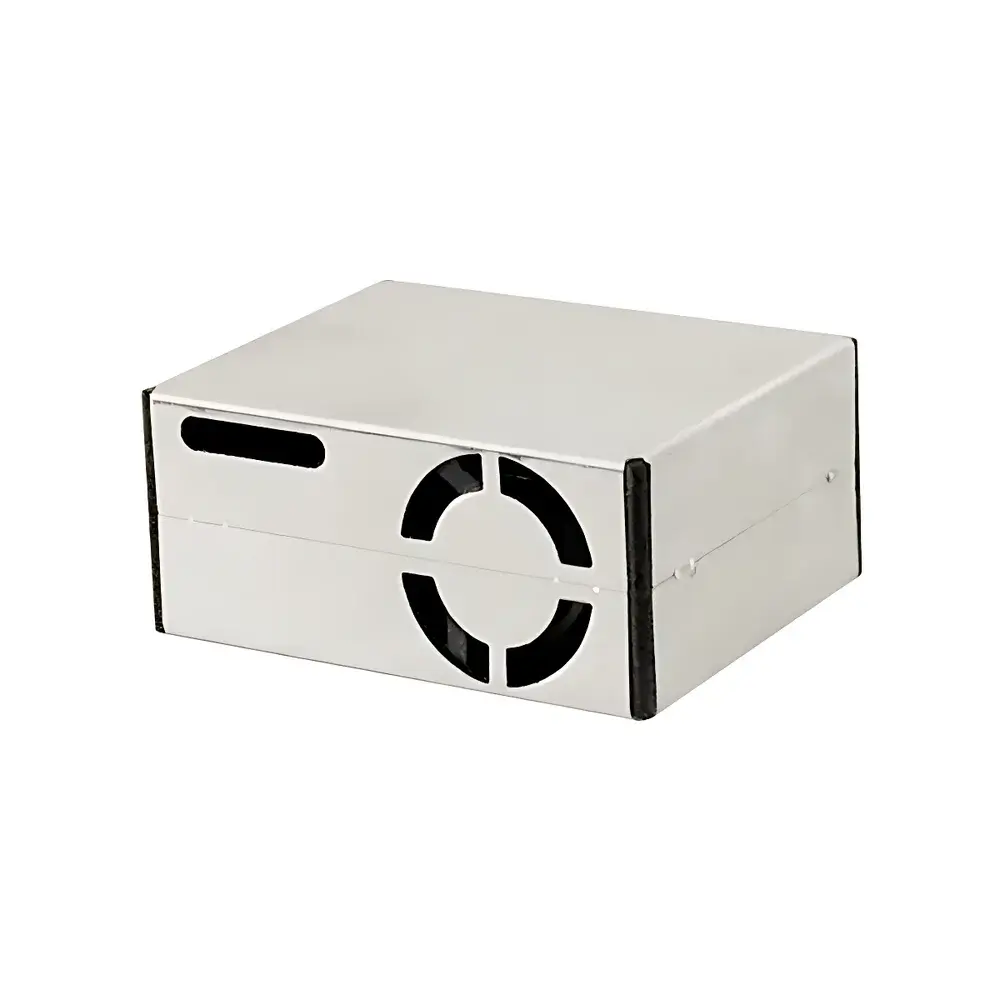
Cubic PM2009 Laser-Based Particulate Matter Sensor
| Brand | Cubic |
|---|---|
| Origin | Hubei, China |
| Manufacturer Type | Authorized Distributor |
| Country of Origin | China |
| Model | PM2009 |
| Pricing | Available Upon Request |
| Detection Principle | Laser Light Scattering |
| PM2.5 Range | 0–1000 μg/m³ (extendable to PM1.0 and PM10) |
| Warm-up Time | ≤8 s |
| Data Update Interval | 1 s |
| Accuracy | ±10 μg/m³ or ±10% of reading (at 25°C±2°C, 50%±10% RH |
| Operating Temperature | −10°C to +60°C |
| Operating Humidity | 5–95% RH (non-condensing) |
| Storage Conditions | −30°C to +70°C, 0–95% RH (non-condensing) |
| Supply Voltage | DC 5.0 V ±0.1 V (ripple <100 mV) |
| Operating Current | ≤100 mA |
| Standby Current | <25 mA |
| Output Interfaces | UART TTL (3.3 V / 5 V logic), I²C (reserved), PWM (reserved) |
| Dimensions | 50 × 38 × 21 mm (W × H × D) |
| Enclosure | Metal-shielded housing |
| Structural Feature | Integrated self-cleaning mechanism with co-located inlet/outlet airflow path |
Overview
The Cubic PM2009 is a compact, high-stability laser-based particulate matter (PM) sensor engineered for continuous, real-time monitoring of airborne aerosols in indoor air quality (IAQ), HVAC control, smart home systems, and environmental instrumentation. It operates on the principle of Mie scattering: a collimated 650 nm laser diode illuminates particles drawn through an optimized airflow channel; scattered light is captured by a photodetector array and converted into pulse signals proportional to particle size and concentration. Through proprietary dust-source intelligent recognition algorithms and factory traceable calibration against NIST-traceable reference instruments (e.g., TSI AM510 and 8530), the PM2009 delivers quantitative mass concentration outputs for PM1.0, PM2.5, and PM10—each derived from particle number distribution histograms via empirically validated density and shape factor assumptions. Its optical architecture is designed to minimize Mie resonance artifacts at sub-micron diameters and maintain linearity across dynamic ranges without requiring user recalibration.
Key Features
- Optimized optical path with dual-lens collimation and low-noise photodiode detection for high signal-to-noise ratio (SNR) and stable baseline performance
- Integrated self-cleaning mechanical structure that periodically agitates the sensing chamber using controlled airflow reversal—reducing long-term drift caused by dust accumulation on optical surfaces
- Co-located inlet and outlet configuration enables simplified integration into space-constrained enclosures without external ducting or flow straighteners
- Full metal electromagnetic shielding (aluminum alloy housing) ensures robust immunity to EMI from switching power supplies, motors, and RF sources common in industrial and building automation environments
- Rapid thermal stabilization (<8 s) and 1 Hz data output rate support responsive feedback loops in demand-controlled ventilation (DCV) and real-time alarm triggering
- Low-power design: ≤100 mA active current draw and <25 mA standby consumption—compatible with battery-backed or energy-harvesting edge nodes
Sample Compatibility & Compliance
The PM2009 is validated for ambient and recirculated air sampling under ISO 16000-26 (indoor air quality — measurement of PM), EN 15251 (indoor environmental input parameters), and ASTM D6245 (standard guide for measuring indoor air quality). It meets CE marking requirements for EMC Directive 2014/30/EU and RoHS 2011/65/EU. While not certified as a regulatory-grade reference monitor per EPA EQVM or EU MCERTS protocols, its accuracy specification (±10 μg/m³ or ±10% of reading under controlled lab conditions) aligns with performance expectations for Class II IAQ sensors defined in ISO 16000-33 Annex B. The device undergoes 100% functional burn-in and humidity cycling validation prior to shipment.
Software & Data Management
The sensor communicates via UART TTL (3.3 V/5 V compatible) with a fixed ASCII protocol supporting both passive polling and active streaming modes. Raw particle count data per size bin (e.g., >0.3 μm, >0.5 μm, >1.0 μm, >2.5 μm, >5.0 μm, >10 μm) is accessible alongside calculated PM mass concentrations. Firmware supports over-the-air (OTA) updates via UART. For system integrators, Cubic provides a comprehensive SDK including C/C++ drivers for ARM Cortex-M and Linux-based platforms, Python wrappers for Raspberry Pi and edge gateways, and JSON schema definitions for MQTT/HTTP telemetry ingestion. Audit-ready data logging—including timestamp, temperature, RH, and checksum—is supported when paired with host firmware compliant with FDA 21 CFR Part 11 electronic record requirements.
Applications
- Real-time PM monitoring in residential and commercial HVAC systems for demand-controlled ventilation optimization
- OEM integration into portable air purifiers, wearable exposure monitors, and smart thermostats
- Indoor air quality dashboards for green building certification (LEED, WELL, BREEAM)
- Urban micro-environmental sensing networks for hyperlocal pollution mapping
- Industrial hygiene assessments in manufacturing facilities with low-to-moderate aerosol generation (e.g., printing, woodworking, packaging)
- Research-grade particle emission characterization in laboratory-scale combustion or material processing studies
FAQ
Does the PM2009 require periodic zero calibration or field recalibration?
No. The sensor employs factory-applied, multi-point gravimetric calibration against traceable reference aerosols (e.g., PSL, Arizona Test Dust) and does not require user-performed zero or span adjustments under normal operating conditions.
Can the PM2009 distinguish between PM2.5 from combustion versus mechanical abrasion?
No. It reports total mass concentration based on optical equivalence; particle composition identification requires complementary techniques such as SEM-EDS or online mass spectrometry.
Is the self-cleaning function user-configurable?
Yes. Activation interval and duration are programmable via UART command set; default cycle is every 2 hours for 5 seconds.
What is the expected operational lifetime under continuous use?
Rated for ≥30,000 hours of cumulative operation (≈3.4 years at 100% duty cycle), assuming ambient conditions within specified temperature/humidity limits and nominal dust loading (<100 μg/m³ average).
Related Products







