
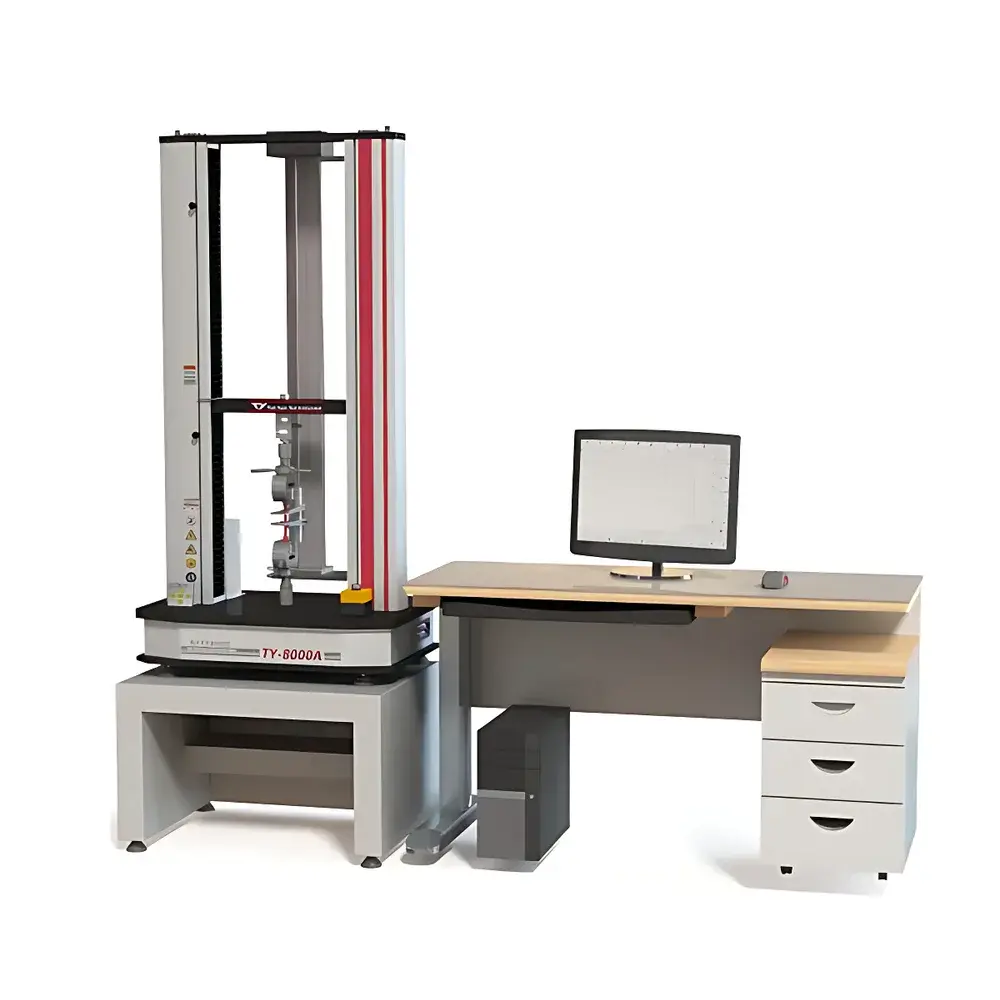
TianYuan TY8000-A5000N Electronic Universal Testing Machine
| Brand | TianYuan |
|---|---|
| Origin | Jiangsu, China |
| Manufacturer Type | Manufacturer |
| Product Category | Domestic |
| Model | TY8000-A5000N |
| Instrument Type | Electronic Universal Testing Machine |
| Load Capacity | 5000 N |
| Force Resolution | 1/500000 FS |
| Force Measurement Range | 0.4–100% FS |
| Deformation Measurement Range | 0.2–100% FS |
| Force Control Rate Range | 0.01–5% FS/s |
| Deformation Control Rate Range | 0.02–5% FS/s |
| Stroke (without fixtures) | 1000 mm |
| Effective Width | 420 mm |
| Test Speed | 0.001–1000 mm/min |
| Speed Accuracy | ≤ ±0.3% |
| Displacement Resolution | 0.001 mm |
| Sampling Frequency (optional) | up to 1000 Hz |
| Power Supply | 220 V ±10%, 500 W |
| Dimensions (W×D×H) | 800 × 500 × 1600 mm |
| Weight | 260 kg |
| Accuracy Class | 0.5 |
Overview
The TianYuan TY8000-A5000N Electronic Universal Testing Machine is a high-precision servo-controlled mechanical testing system engineered for static tensile, compressive, flexural, shear, tear, peel, and puncture testing of metallic and non-metallic materials. It operates on the principle of electromechanical force application via a closed-loop controlled servo motor–planetary gearbox–ball screw actuation architecture, enabling precise displacement, load, and strain control in accordance with ISO 7500-1, ASTM E4, and GB/T 16491-2008 verification standards. Designed for laboratory and quality control environments, the system delivers repeatable mechanical property quantification—including tensile strength, yield strength, elongation at break, Young’s modulus, bending modulus, energy absorption (net, return, total), and hold-force behavior—under constant-rate or cyclic loading profiles (low-cycle load, deformation, or displacement control).
Key Features
- Servo-driven actuation using Panasonic industrial-grade AC servo motor and Taiwan Liming planetary gearbox—ensuring high rigidity, minimal backlash (<5 arcmin), exceptional positioning accuracy (±0.01 mm), and maintenance-free operation over extended service life.
- Full-digital triple-closed-loop control architecture integrating DSP + MCU real-time processing, enabling simultaneous independent regulation of force, displacement, and strain with dynamic response times <10 ms.
- High-fidelity data acquisition with standard 100 Hz sampling rate; optional upgrade to 1000 Hz for transient event capture (e.g., brittle fracture initiation, impact-like loading transitions).
- Intuitive Windows-based software interface supporting real-time multi-curve plotting (load vs. displacement, stress vs. strain, load vs. time), customizable test templates, and programmable step sequences including ramp-hold-ramp, cyclic fatigue, and creep protocols.
- Post-test graphical analysis module enabling curve re-scaling, peak detection, tangent modulus calculation, offset yield determination (0.2% proof stress), and region-specific integration for energy metrics.
- Comprehensive reporting engine generating audit-ready PDF or Excel-formatted reports compliant with GLP documentation requirements—including operator ID, timestamp, environmental metadata, raw data traceability, and digital signature fields.
Sample Compatibility & Compliance
The TY8000-A5000N accommodates specimens ranging from thin polymer films (via pneumatic or screw-action grips) to structural steel coupons (with wedge-action or hydraulic clamps), as well as elastomers, composites, textiles, adhesives, and biomedical implants. Standard configurations support ASTM D638 (tensile plastics), ASTM D790 (flexural rigidity), ISO 527, ISO 178, EN 10002-1, and GB/T 228.1. All force transducers are calibrated per ISO 376 Class 0.5 requirements, and system validation includes traceable verification against national metrology institute (NIM)-certified reference standards. The instrument meets electromagnetic compatibility (EMC) requirements per IEC 61326-1 and is designed for installation in ISO/IEC 17025-accredited laboratories.
Software & Data Management
The embedded control and analysis suite supports 21 CFR Part 11-compliant user access levels (administrator, technician, reviewer), electronic audit trails logging all parameter changes, test starts/stops, and report exports. Raw data files (.tdms or .csv) retain full resolution without compression. Optional network deployment enables centralized data archiving via SQL Server or cloud-based LIMS integration. Software updates are delivered through secure firmware signing, and calibration coefficients are digitally sealed to prevent unauthorized modification.
Applications
- Materials R&D: Quantitative evaluation of stress–strain behavior across temperature and strain-rate domains.
- Quality Assurance: Batch release testing per ISO 9001 and IATF 16949 requirements for automotive gaskets, battery separators, and aerospace fasteners.
- Regulatory Submissions: Generation of mechanical datasets for FDA 510(k) dossiers (e.g., orthopedic implant fixation strength) or CE marking technical files under MDR Annex II.
- Failure Analysis: Correlation of macroscopic mechanical response with microstructural features observed via SEM or XRD.
- Educational Use: Undergraduate and graduate mechanics labs requiring NIST-traceable force measurement education modules.
FAQ
What international standards does this system comply with for calibration and verification?
It conforms to ISO 7500-1 (static calibration), ISO 376 (load cell verification), ASTM E4 (verification of force-measuring instruments), and GB/T 16491-2008 (Chinese national standard for electronic UTM performance).
Is the system suitable for cyclic fatigue testing?
Yes—it supports low-cycle fatigue (LCF) protocols with programmable load/deformation/position waveforms (sine, triangle, trapezoidal) and closed-loop amplitude control down to 0.5% FS.
Can the software generate reports compliant with FDA 21 CFR Part 11?
Yes—when configured with role-based authentication, electronic signatures, and immutable audit logs, it satisfies Part 11 requirements for regulated pharmaceutical and medical device environments.
What is the maximum recommended ambient temperature for continuous operation?
The specified operating range is 5 °C to 35 °C; sustained operation above 30 °C requires active ventilation to maintain thermal stability of the servo amplifier and load cell signal conditioning circuitry.
Are third-party extensometers supported?
Yes—the system provides analog and digital interfaces (LVDT, strain gauge, video extensometry) compliant with ASTM E83 and ISO 9513 specifications, with automatic recognition and scaling of connected devices.



