
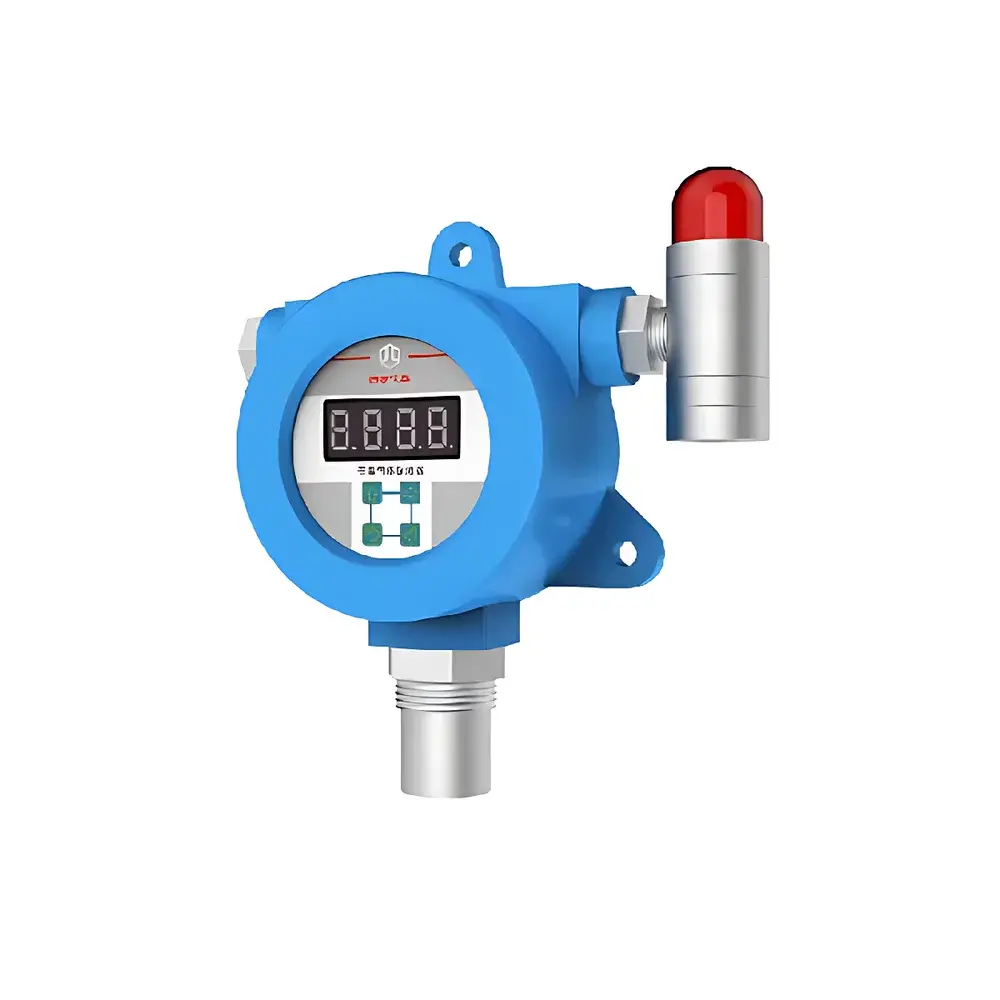
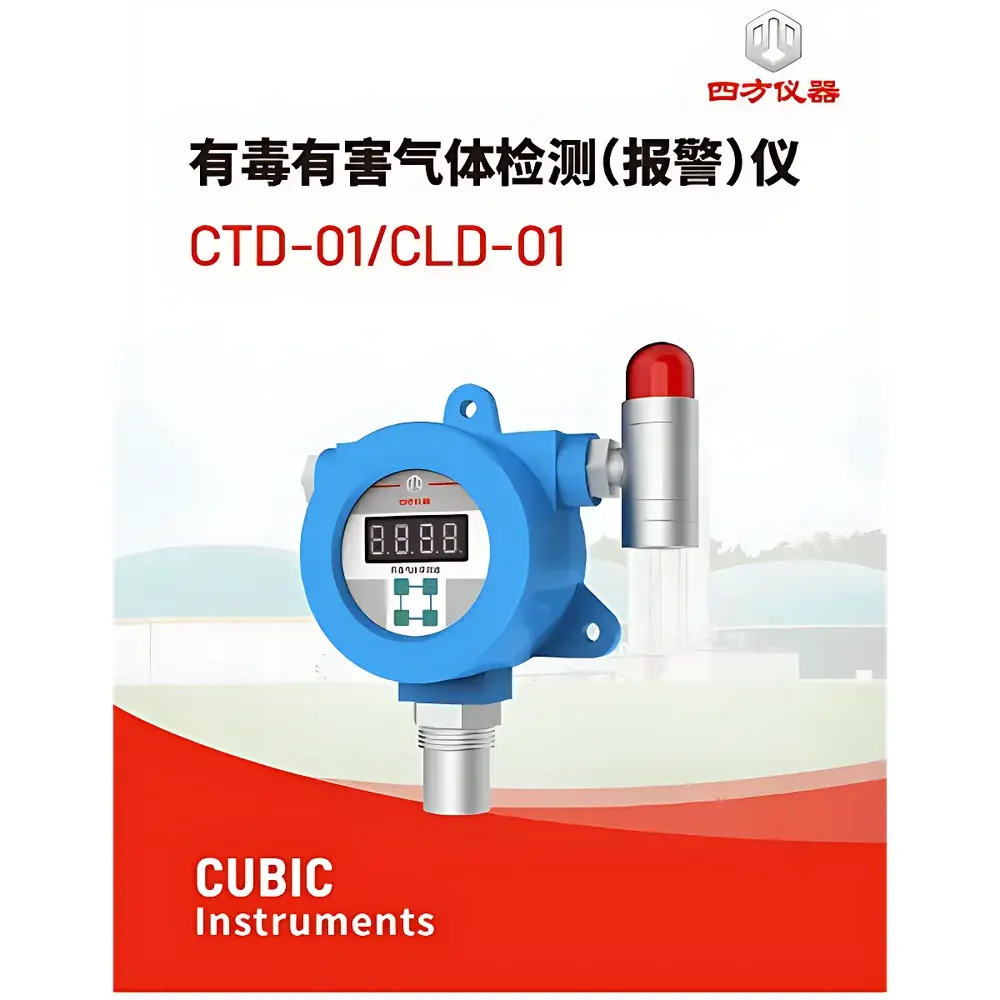
CUBIC INSTRUMENTS CTD-01/CLD-01 Toxic & Hazardous Gas Detector (Alarm)
| Brand | CUBIC INSTRUMENTS |
|---|---|
| Origin | Hubei, China |
| Manufacturer Type | Authorized Distributor |
| Country of Origin | China |
| Model | CTD-01/CLD-01 |
| Detection Principle | Electrochemical (ECD) |
| Target Gases | CO, H₂S |
| Measurement Range | CO: 0–1000 ppm |
| H₂S | 0–100 ppm |
| Accuracy | ±2 µmol/mol or ±10% of reading |
| Resolution | 1 ppm |
| Response Time (T90) | <30 s |
| Warm-up Time | 30 s |
| Sampling Method | Diffusion |
| Explosion Protection Rating | Ex d II C T6 Gb |
| Certifications | CPA (China Metrology Accreditation), Ex Certificate |
| Output Signals | RS-485 digital interface, 2× SPST relay (NO), 1× 4–20 mA analog output |
| Operating Temperature | −20 to +60 °C |
| Storage Temperature | −40 to +85 °C |
| Relative Humidity | ≤95% RH (non-condensing) |
| Power Supply | DC 12–24 V |
| Display | LCD |
Overview
The CUBIC INSTRUMENTS CTD-01/CLD-01 is a fixed-mount or portable toxic gas detection and alarm instrument engineered for continuous, reliable monitoring of carbon monoxide (CO) and hydrogen sulfide (H₂S) in industrial and environmental safety-critical applications. It employs electrochemical detection (ECD) technology — a well-established, selective, and stable sensing methodology widely adopted in occupational health and process safety systems. Unlike catalytic bead or metal oxide semiconductor sensors, ECD cells operate via controlled redox reactions at electrode surfaces, delivering high specificity, low cross-sensitivity, and consistent performance across variable oxygen concentrations — enabling operation even in hypoxic or inert atmospheres common in biogas plants, landfill gas extraction, anaerobic digesters, and wastewater treatment facilities. The device is designed for integration into facility-wide gas safety architectures, supporting both local audible/visual alarms and remote supervisory control via standardized industrial interfaces.
Key Features
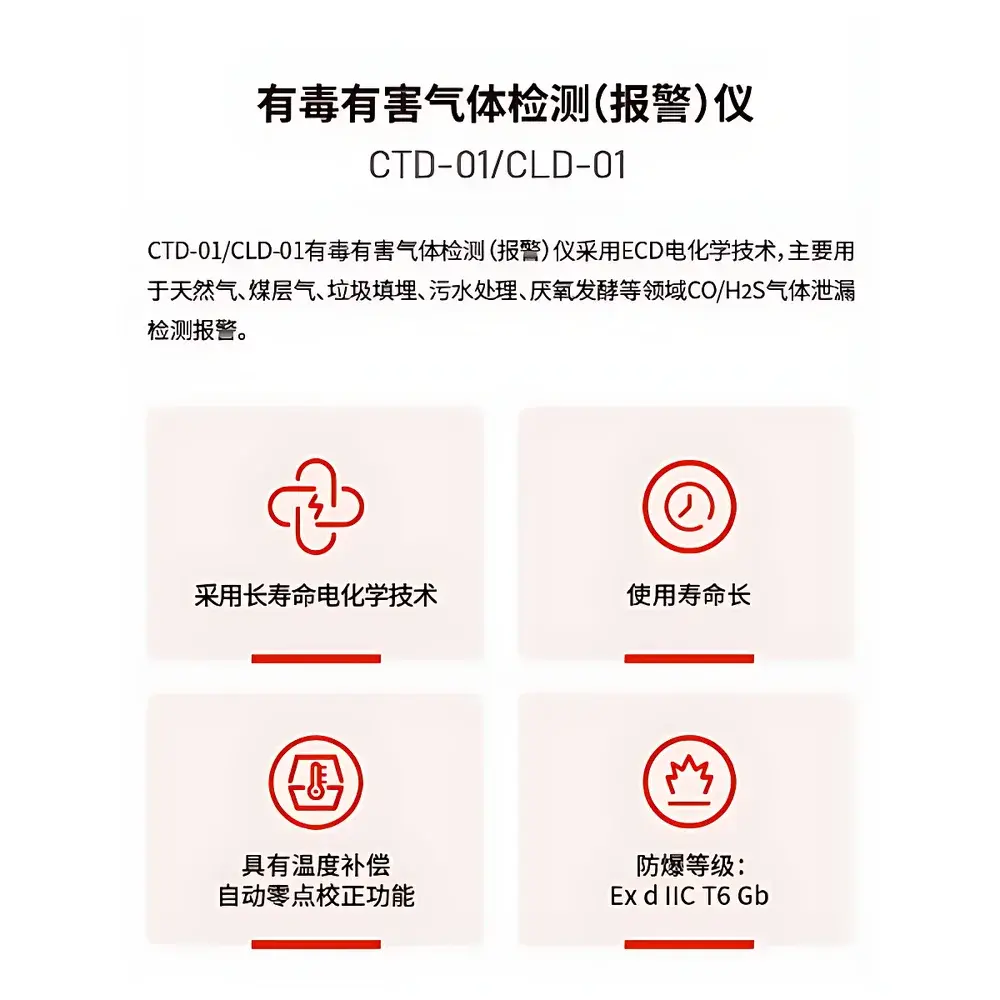
- Electrochemical sensor architecture with extended operational lifetime (>24 months typical), resistant to poisoning by silicones, sulfides, or halogenated compounds — eliminating frequent sensor replacement and calibration drift associated with conventional metal-oxide sensors.
- Integrated temperature compensation and automatic zero-point correction algorithms ensure measurement stability across ambient fluctuations from −20 °C to +60 °C without manual intervention.
- Robust flameproof enclosure certified to Ex d II C T6 Gb per GB 3836.1–2010 / IEC 60079-0:2017, suitable for Zone 1 hazardous areas handling Group II C gases including hydrogen, acetylene, and ethylene.
- Dual independent gas channel capability: simultaneous real-time detection of CO and H₂S with configurable alarm thresholds, hysteresis, and latching behavior per channel.
- Multi-protocol signal output: RS-485 Modbus RTU for SCADA integration, isolated 4–20 mA analog output (HART-compatible wiring), and two programmable relay outputs (SPST, NO) rated for 250 VAC / 3 A — compliant with SIL 2 functional safety requirements when used in conjunction with certified logic solvers.
- CPA-certified (China Metrology Accreditation) design ensures traceability to national standards and suitability for regulatory reporting in Chinese environmental and occupational safety frameworks.
Sample Compatibility & Compliance
The CTD-01/CLD-01 is validated for use in gaseous matrices containing CO and H₂S at ambient pressure and non-condensing humidity conditions (≤95% RH). It is not intended for use in corrosive, particulate-laden, or high-velocity gas streams without appropriate pre-filtration or sampling probe integration. The instrument meets the electromagnetic compatibility (EMC) requirements of GB/T 18268.1–2010 (IEC 61326-1:2012) and environmental protection standards per GB 12358–2006 for toxic gas detectors. Its explosion-proof certification aligns with international directives applicable to equipment deployed in petrochemical, biogas, and municipal infrastructure environments. While not FDA- or ISO 13485-certified (as it is not a medical device), its metrological traceability supports GLP-aligned data integrity in environmental monitoring programs.
Software & Data Management
The detector operates autonomously without embedded firmware requiring PC-based configuration; however, optional configuration software (available under NDA) enables parameter setup via USB-to-RS485 adapter. All alarm events — including gas concentration exceedance, sensor fault, power loss, and relay activation — are timestamped and stored in non-volatile memory (1000-event capacity). RS-485 communication supports Modbus RTU register mapping for integration into third-party DCS, PLC, or centralized gas monitoring platforms. Audit trails comply with basic data integrity principles: each event includes UTC timestamp, gas channel ID, measured value, alarm level, and source flag (e.g., “relay output triggered”). No cloud connectivity or proprietary cloud services are implemented — ensuring full data sovereignty and alignment with industrial OT security policies.
Applications
- Biogas upgrading and compression stations: continuous monitoring of CO and H₂S ingress in raw biogas prior to desulfurization units.
- Landfill gas collection systems: early warning of H₂S breakthrough in leachate wells or extraction header pipes.
- Municipal wastewater treatment plants: safeguarding maintenance personnel in sludge digestion tanks, pump stations, and confined entry zones.
- Coal mine ventilation shafts and coalbed methane recovery sites: detecting CO accumulation indicative of spontaneous combustion or incomplete oxidation.
- Emergency response vehicles: rapid-deployment configuration for hazmat teams conducting leak assessment in industrial or residential districts.
FAQ
Can the CTD-01/CLD-01 operate in oxygen-deficient environments?
Yes — its electrochemical sensors do not require atmospheric oxygen to generate signal, making it suitable for inerted vessels, nitrogen-purged enclosures, or underground utility tunnels where O₂ levels may fall below 19.5%.
Is calibration required before initial deployment?
A factory baseline calibration is performed prior to shipment; however, field zero calibration using certified zero air is recommended upon installation and at intervals defined by site-specific risk assessment (typically every 3–6 months). Span calibration with certified gas standards is advised annually or after sensor exposure to extreme contamination.
Does the device support Modbus TCP or Ethernet communication?
No — only RS-485 physical layer with Modbus RTU protocol is supported. Ethernet or wireless gateways must be added externally if IP-based integration is required.
What is the expected service life of the electrochemical sensors?
Under normal operating conditions (25 °C, ≤70% RH, no exposure to solvent vapors or high-concentration acid gases), the CO and H₂S sensors maintain specified accuracy for ≥24 months. Sensor replacement kits are available with pre-calibrated modules and serial-number-matched calibration certificates.
Is the unit compliant with international explosion protection standards beyond China’s GB 3836?
The Ex d II C T6 Gb marking indicates conformance with IEC 60079-0 and IEC 60079-1, permitting acceptance in ATEX (EU), UKEX, and many APAC jurisdictions subject to local notified body validation. Full ATEX certification documentation is available upon request for export compliance.
Related Products







