
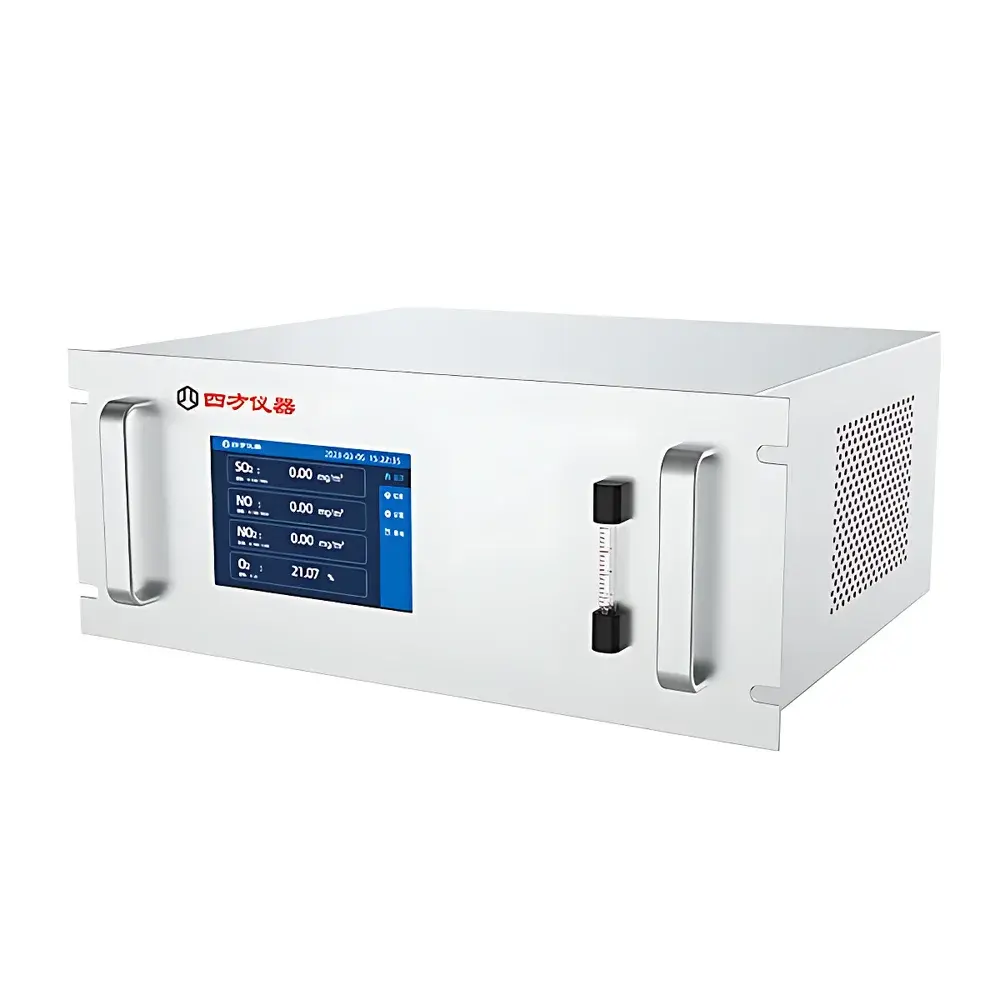
CUBIC INSTRUMENTS Gasboard-3000UV UV Differential Optical Absorption Spectroscopy (DOAS) Flue Gas Analyzer
| Brand | CUBIC INSTRUMENTS |
|---|---|
| Origin | Hubei, China |
| Model | Gasboard-3000UV |
| Measurement Principle | UV-DOAS (SO₂, NO, NO₂) |
| Measured Gases | SO₂, NO, NO₂, O₂ |
| Range | SO₂/NO/NO₂: 0–100 mg/m³ |
| O₂ | 0–25% (selectable) |
| Accuracy | ±2% F.S. |
| Repeatability | ≤2% |
| Response Time (T₉₀) | ≤30 s |
| Stability | ≤±2% F.S./24 h |
| Linearity Error | ≤±2% F.S. |
| Sample Requirements | Liquid-free, particulate filtration <1 µm |
| Operating Humidity | 5–85% RH |
| Ambient Pressure | 86–108 kPa |
| Power Supply | AC 220 V, 50 Hz |
| Max Power Consumption | 200 W |
| Communication | Dual RS-232/RS-485, Modbus RTU or customizable protocol |
Overview
The CUBIC INSTRUMENTS Gasboard-3000UV is an online ultraviolet differential optical absorption spectroscopy (UV-DOAS) flue gas analyzer engineered for continuous, high-fidelity monitoring of sulfur dioxide (SO₂), nitrogen monoxide (NO), and nitrogen dioxide (NO₂) in industrial exhaust streams—particularly those generated during non-ferrous metal smelting, roasting, and refining processes. Designed to meet stringent ultra-low emission standards mandated by China’s GB 16297–1996 and EU Industrial Emissions Directive (IED) Annex VI, the instrument employs a long-path, multi-reflection gas cell coupled with high-stability xenon pulsed light source and precision optical detection. The UV-DOAS methodology enables selective quantification of target gases based on their unique spectral absorption fingerprints in the 190–400 nm range, minimizing cross-sensitivity from water vapor, CO₂, and other common flue gas interferents. Oxygen concentration is concurrently measured via an electrochemical sensor (ECD), ensuring full stoichiometric context for desulfurization (FGD) and denitrification (SCR/SNCR) process evaluation.
Key Features
- UV-DOAS core measurement technology with dual-beam optical path design for enhanced signal-to-noise ratio and long-term baseline stability
- Multi-pass gas cell with effective optical path length >1.2 m, enabling sub-5 mg/m³ detection limits for SO₂, NO, and NO₂
- Thermostatically controlled optical module (±0.1 °C) to suppress thermal drift and maintain spectral resolution across ambient temperature fluctuations
- Proprietary interference compensation algorithm calibrated against NIST-traceable reference gas mixtures, reducing cross-sensitivity between NO₂ and NO by >90%
- Industrial-grade xenon flash lamp (rated lifetime ≥10⁹ flashes) with integrated intensity monitoring and automatic gain adjustment
- Standard 4U rack-mount chassis (482.6 mm W × 177.8 mm H × 450 mm D) compliant with IEC 60297-3-100 for panel integration in CEMS cabinets
- Dual isolated RS-232 and RS-485 interfaces supporting Modbus RTU protocol—fully compatible with national environmental monitoring platforms (e.g., China MEP Data Acquisition System)
Sample Compatibility & Compliance
The Gasboard-3000UV is validated for use with hot, humid, and particulate-laden flue gases typical of copper, lead, zinc, and aluminum production facilities. Integrated sample conditioning requires external filtration (<1 µm absolute rating) and condensate removal prior to inlet; the analyzer itself does not include built-in cooling or dilution systems. It complies with technical requirements outlined in HJ 1045–2019 (China’s Technical Specification for Online Monitoring Systems of Flue Gas Pollutants from Thermal Power Plants), and its measurement uncertainty profile aligns with EN 15267–3:2017 (Performance certification of automated measuring systems). All firmware and data handling routines support audit-ready operation under GLP principles, including timestamped calibration logs, zero/span verification records, and uneditable event history.
Software & Data Management
Embedded Linux-based firmware provides local configuration, real-time trend visualization, and alarm management via a 7-inch capacitive touchscreen interface. Data output supports both analog (4–20 mA) and digital protocols (Modbus RTU over RS-485), enabling seamless integration into distributed control systems (DCS) and centralized environmental information platforms. Raw spectral data and processed concentration values are stored internally for ≥30 days (circular buffer), with optional USB export for offline QA/QC review. Remote diagnostics and firmware updates are supported via secure SSH tunneling—no cloud dependency or proprietary vendor software required. Calibration certificates, spectral validation reports, and linearity test records are exportable in PDF format meeting ISO/IEC 17025 documentation requirements.
Applications
- Continuous emissions monitoring (CEM) at sintering machines, flash smelters, and electrolytic refining furnaces in non-ferrous metallurgy
- Performance verification of wet limestone FGD scrubbers and selective catalytic reduction (SCR) units operating under low-load or transient conditions
- Stack testing and regulatory compliance reporting per GB 13223–2011 and local provincial emission standards
- Process optimization studies requiring high-temporal-resolution (10 s interval) correlation between SO₂/NOₓ ratios and furnace operating parameters
- Research applications involving speciation of reactive nitrogen compounds in complex flue gas matrices containing Cl⁻, F⁻, and heavy metal vapors
FAQ
What gas species does the Gasboard-3000UV measure, and how are they differentiated?
It measures SO₂, NO, and NO₂ using UV-DOAS—each resolved by distinct absorption features in the ultraviolet spectrum—and O₂ via an electrochemical sensor.
Is the instrument certified for regulatory CEMS use in China?
Yes, it meets HJ 1045–2019 requirements for accuracy, stability, and data transmission when deployed with certified sample conditioning systems and routine QA/QC procedures.
Can the measurement ranges be extended beyond 100 mg/m³?
Custom configurations with optical attenuation filters or dual-range ECD O₂ sensors are available upon request, subject to factory recalibration and metrological validation.
Does the analyzer support remote calibration verification?
It supports automated zero/span checks using external gas cylinders; full calibration verification requires manual introduction of certified reference gases per HJ 75–2017 Annex D.
What maintenance intervals are recommended for field operation?
Optical window cleaning every 3 months, xenon lamp replacement every 24 months (under typical duty cycle), and annual full-system performance verification per ISO 14064-3 guidelines.







