
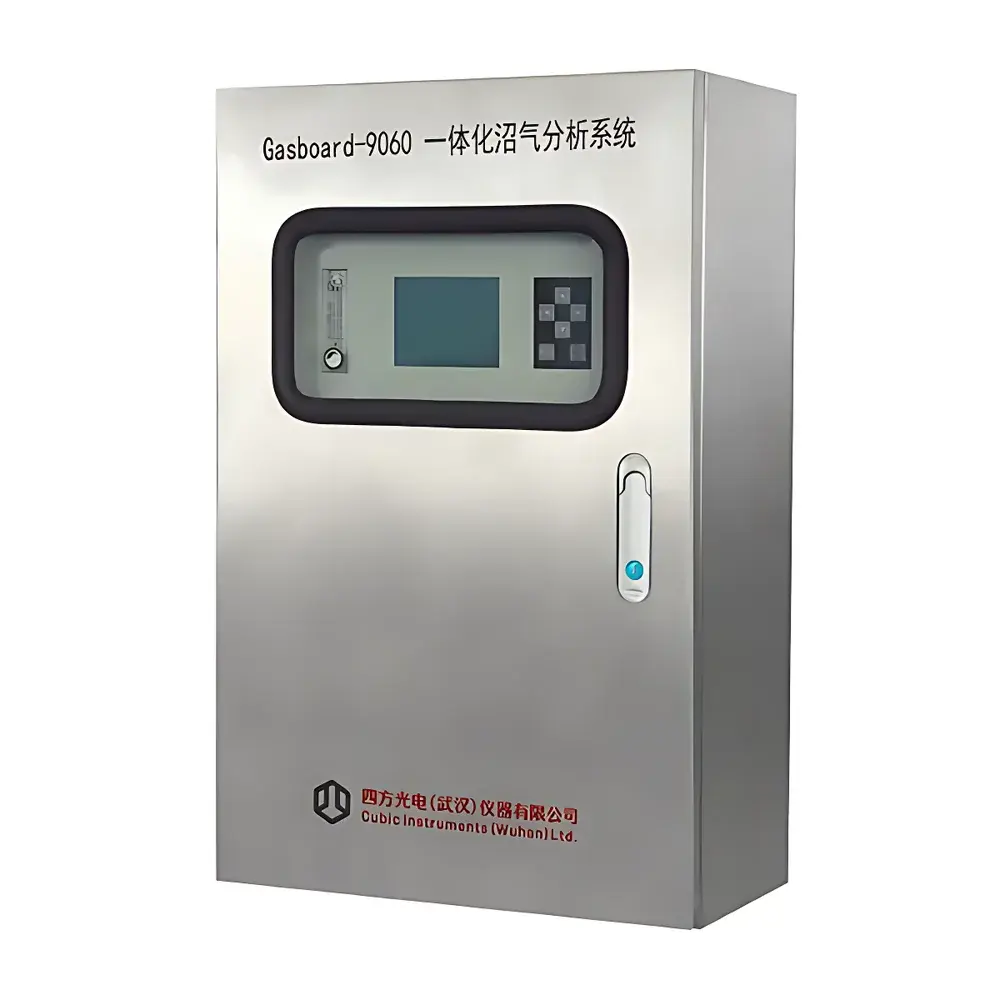
CUBIC INSTRUMENTS Gasboard-9060 Integrated Biogas Analysis System
| Brand | CUBIC INSTRUMENTS |
|---|---|
| Origin | Hubei, China |
| Model | Gasboard-9060 |
| Measurement Range | CH₄: (0–100)% |
| CO₂ | (0–50)% |
| H₂S | (0–9999) ppm |
| O₂ | (0–25)% |
| Resolution | CH₄/CO₂/O₂: 0.01% |
| H₂S | 1 ppm |
| Response Time | T₉₀ ≤ 60 s (NDIR) |
| Principle | NDIR + Electrochemical Detection (ECD) |
| Accuracy | CH₄/CO₂: ±1% FS |
| H₂S/O₂ | ±2% FS |
| Repeatability | CH₄/CO₂: 0.5% FS |
| H₂S/O₂ | 1% FS |
| Optimal Flow Rate | 0.7–1.2 L/min |
| Sample Pressure | 2–50 kPa |
| Sample Requirements | Dust-free, dry, oil-free |
| Electrical Interface | RS-485 / RS-232 / 4–20 mA |
| Power Supply | AC 220 V, 50 Hz |
| Enclosure | Stainless steel cabinet with corrosion-resistant components and integrated thermal management |
Overview
The CUBIC INSTRUMENTS Gasboard-9060 Integrated Biogas Analysis System is an engineered solution for continuous, real-time compositional monitoring of biogas streams in anaerobic digestion facilities and industrial biogas upgrading plants. It employs dual-sensing architecture: non-dispersive infrared (NDIR) spectroscopy for quantitative determination of methane (CH₄) and carbon dioxide (CO₂), and electrochemical detection (ECD) for hydrogen sulfide (H₂S) and oxygen (O₂). This hybrid principle ensures high selectivity, minimal cross-sensitivity between analytes, and long-term stability under variable biogas matrix conditions—including fluctuating moisture content, trace siloxanes, and particulate load. The system operates without consumables or carrier gases, distinguishing it from GC-based or Orsat-type analyzers. Its design complies with fundamental requirements for process analytical technology (PAT) in biogas-to-energy applications, supporting regulatory alignment with ISO 13833 (biogas quality), EN 16723-1 (upgraded biomethane specifications), and EU Directive 2009/28/EC on renewable energy.
Key Features
- Multi-component simultaneous analysis of CH₄, CO₂, H₂S, and O₂ with independent sensor channels—eliminating spectral interference and enabling true volumetric concentration reporting.
- Patented H₂S sensor protection module that actively filters acidic condensates and mitigates electrode poisoning, extending operational lifetime beyond 24 months under typical digester off-gas conditions.
- Dual-channel ECD architecture for O₂ and H₂S, incorporating temperature-compensated signal processing to maintain accuracy across ambient ranges from −20 °C to +50 °C.
- Integrated sample conditioning unit featuring automatic condensate drainage, heated sampling line (optional), and particulate filtration—configured to meet ISO 8573-1 Class 4 purity requirements for inlet gas.
- Self-diagnostic firmware that continuously monitors sensor zero drift, span stability, and internal pressure integrity, generating diagnostic logs compliant with GLP audit trails.
- Zero-air calibration pump with programmable auto-zero cycles (user-definable interval), eliminating manual calibration interventions during unattended operation.
Sample Compatibility & Compliance
The Gasboard-9060 accepts raw or pre-conditioned biogas within specified physical limits: inlet pressure 2–50 kPa (gauge), flow rate 0.7–1.2 L/min, and dew point ≤ 5 °C post-drying. It is validated for use with biogas derived from agricultural digesters, wastewater treatment plants, food waste co-digestion facilities, distilleries, pulp & paper mills, and pharmaceutical fermentation units. All wetted components—including stainless-steel sample manifold, PTFE-lined filters, and corrosion-resistant ECD electrodes—meet ASTM B117 salt-spray resistance standards. The enclosure conforms to IP65 ingress protection and UL 61010-1 safety certification for industrial control environments. Data integrity protocols align with FDA 21 CFR Part 11 requirements when interfaced with validated SCADA or DCS platforms via RS-485 Modbus RTU.
Software & Data Management
The system supports native integration into plant-wide automation infrastructures through three standardized communication layers: analog 4–20 mA outputs (per gas channel), serial RS-232/RS-485 (Modbus RTU), and optional Ethernet/IP gateway (firmware upgrade). All measurement data include timestamped metadata (UTC), sensor health flags, and environmental compensation parameters. Local storage retains 30 days of 1-minute averaged data onboard; external logging is enabled via OPC UA or MQTT brokers. Configuration and diagnostics are accessible via web-based GUI (HTTPS-secured) or dedicated Windows utility software, both supporting CSV export, alarm threshold setting, and audit-log review. Firmware updates are performed over-the-air (OTA) with SHA-256 signature verification to ensure traceability.
Applications
- Real-time feedstock optimization in municipal and farm-scale anaerobic digesters by correlating CH₄/CO₂ ratio trends with organic loading rate (OLR) and hydraulic retention time (HRT).
- Process safety monitoring at biogas upgrading stations—detecting O₂ ingress (>1% v/v) or H₂S breakthrough (>500 ppm) prior to membrane separation or amine scrubbing units.
- Compliance reporting for biomethane injection into natural gas grids per EN 16723-1 Annex A (H₂S ≤ 5 mg/m³, O₂ ≤ 0.2% v/v, CH₄ ≥ 95% v/v).
- Performance benchmarking of desulfurization systems (e.g., iron sponge, biological filters) through longitudinal H₂S removal efficiency calculations.
- Remote asset management for EPC contractors deploying distributed biogas plants—leveraging cloud-based dashboards for predictive maintenance scheduling based on sensor degradation models.
FAQ
What sample preparation is required before gas enters the analyzer?
Minimal preparation is needed if the optional integrated conditioning unit is installed. It provides automatic water removal, particulate filtration, and pressure regulation. For raw biogas with high moisture or particulate load, a primary cyclonic separator and refrigerated dryer upstream are recommended.
Can the Gasboard-9060 be calibrated using certified gas standards?
Yes—span calibration is supported using NIST-traceable multi-component biogas standards (e.g., CH₄/CO₂/N₂ blends with certified H₂S and O₂). Calibration intervals are configurable but typically recommended every 3–6 months depending on H₂S exposure history.
Is the system suitable for outdoor installation in sub-zero climates?
Yes—the cabinet includes thermostatically controlled heating elements maintaining internal temperature above 5 °C, and all electronics are rated for −20 °C ambient operation. Optional heated sampling lines prevent condensation in cold ambient runs.
How does the system handle interference from volatile organic compounds (VOCs) or siloxanes?
NDIR channels use narrow-band optical filters centered on CH₄ (3.3 µm) and CO₂ (4.26 µm) absorption peaks, minimizing VOC overlap. ECD sensors feature selective catalytic membranes that reject common siloxanes (e.g., D4, D5) while retaining H₂S sensitivity.
Does the analyzer support MODBUS TCP for integration with Siemens S7 PLCs?
The base model supports MODBUS RTU over RS-485. MODBUS TCP requires an external protocol converter or optional Ethernet gateway module (part number GB-9060-ETH), which is CE-certified and supports TLS 1.2 encryption.





