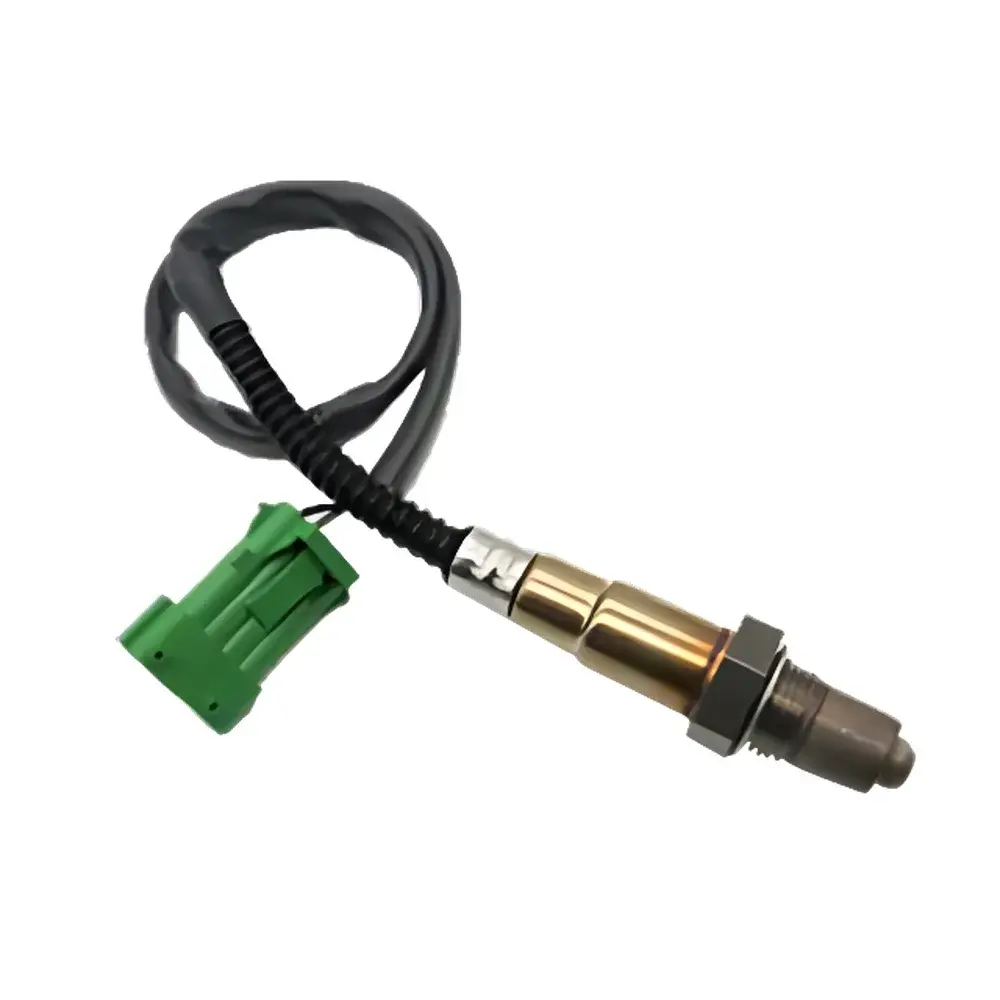
Cubic ZS-ST-01 Zirconia-Based Limit-Current Oxygen Sensor for Automotive Exhaust Lambda Control
| Brand | Cubic |
|---|---|
| Origin | Hubei, China |
| Model | ZS-ST-01 |
| Operating Principle | Zirconia Solid Electrolyte (Nernst Potential) |
| Supply Voltage | DC 12 V |
| Storage Temperature | −40 °C to +90 °C |
| Exhaust Gas Operating Temperature Range | 150 °C to 930 °C |
| Mounting Thread | M18×1.5 |
| Signal Output | Binary λ-switching voltage (≥750 mV at λ = 0.93–0.97 |
| Internal Resistance | ≤1 kΩ (at 150–930 °C) |
| Response Time (600 → 300 mV) | <150 ms |
| Response Time (300 → 600 mV) | <100 ms |
| Light-off Time | <15 s |
| Environmental Robustness | High tolerance to condensate, soot, and hydrocarbon fouling |
Overview
The Cubic ZS-ST-01 is a high-reliability, zirconia-based limit-current oxygen sensor engineered for closed-loop air–fuel ratio control in gasoline-powered internal combustion engines. It operates on the Nernst principle, leveraging a stabilized zirconium dioxide (ZrO₂) solid electrolyte element fabricated via HTCC (High-Temperature Co-fired Ceramic) technology. At elevated exhaust temperatures (>350 °C), the sensor generates a sharp, binary voltage transition across the stoichiometric point (λ = 1.0), enabling precise discrimination between fuel-rich (λ 1) conditions. This electrochemical response serves as the primary feedback signal for engine control units (ECUs), facilitating real-time adjustment of fuel injection duration to maintain optimal combustion efficiency and minimize tailpipe emissions of CO, HC, and NOx. Designed for direct integration into OEM exhaust manifolds and aftertreatment systems, the ZS-ST-01 meets the thermal, mechanical, and chemical durability requirements of modern Tier 3 and Euro 6-compliant powertrains.
Key Features
- HTCC-integrated sensing chip with proprietary zirconia electrolyte formulation — ensures consistent Nernst potential generation and long-term stability under thermal cycling
- Robust mechanical design with M18×1.5 stainless-steel housing and hermetically sealed ceramic-to-metal interface — rated for continuous operation up to 930 °C exhaust gas temperature
- Fast light-off performance (<15 s at 850 °C) and rapid bidirectional response (<100 ms rise time, <150 ms fall time) — critical for transient engine load tracking
- Enhanced resistance to water condensation, oil ash deposition, and unburned hydrocarbon fouling — validated per SAE J1127 and ISO 22797 test protocols
- Low internal resistance (≤0.5 kΩ at operating temperature) and stable output impedance — minimizes signal drift and improves ECU analog-to-digital conversion accuracy
- Compliance-ready signal characteristics: defined high-state (>750 mV) and low-state (50 ± 30 mV) voltages aligned with OBD-II and EOBD diagnostic thresholds
Sample Compatibility & Compliance
The ZS-ST-01 is calibrated and validated for use with standard unleaded gasoline (RON 91–98) and ethanol-blended fuels (E10, E15). It is compatible with three-way catalytic converters (TWCs) and functions reliably in both upstream (pre-catalyst) and downstream (post-catalyst) exhaust locations. The sensor conforms to key automotive regulatory frameworks including U.S. EPA Tier 3 certification requirements, EU Regulation (EU) 2017/1151 (RDE testing), and China’s GB 18352.6–2016 light-duty vehicle emission standards. Its electrical interface adheres to ISO 15031-4 (OBD communication) and supports standardized diagnostic trouble codes (DTCs) such as P0130–P0135. No calibration or configuration is required upon installation — plug-and-play compatibility with mainstream ECU platforms (Bosch ME/MED, Continental SIM, Denso ECU families).
Software & Data Management
While the ZS-ST-01 is an analog, self-powered sensor requiring no external excitation or digital firmware, its output integrates seamlessly into OEM diagnostic and calibration ecosystems. Raw voltage signals are sampled by the ECU’s 12-bit ADC channel with programmable gain and filtering. OEM calibration files (A2L/ODX format) define lambda threshold mapping, hysteresis compensation, and aging compensation algorithms. For validation and bench testing, the sensor is fully supported in ETAS INCA, Vector CANoe, and dSPACE SCALEXIO environments using standard XCP-on-CAN or CCP protocols. All production units undergo 100% functional screening per IATF 16949 process controls, including traceable temperature-voltage characterization across the full operational range and GLP-aligned shelf-life verification (−40 °C to +90 °C storage).
Applications
- Primary oxygen feedback for closed-loop fuel control in port fuel injection (PFI) and gasoline direct injection (GDI) engines
- OBD-II and EOBD compliance monitoring — detection of catalyst efficiency degradation, misfire events, and sensor circuit faults
- Real-time lambda estimation in hybrid powertrain energy management strategies
- Engine development and durability testing on dynamometer cells and chassis rollers
- Aftermarket ECU tuning and performance calibration where stoichiometric reference is required
- On-board diagnostics subsystems for fleet telematics and predictive maintenance analytics
FAQ
What measurement principle does the ZS-ST-01 employ?
It utilizes the Nernst potential generated across a heated zirconia electrolyte membrane, producing a voltage step-change at λ = 1.0 — characteristic of binary (switch-type) oxygen sensors.
Is this sensor suitable for diesel exhaust applications?
No — it is specifically designed for gasoline engine exhaust with narrow lambda excursions around stoichiometry; diesel applications require wideband or NOx-tolerant sensors.
Does the sensor require a dedicated heater controller?
Yes — while integrated with a built-in heating element, it must be driven by an ECU-provided PWM-controlled 12 V heater supply meeting ISO 16750-2 pulse load specifications.
What is the typical service life under normal driving conditions?
Rated for ≥160,000 km or 10 years (whichever occurs first) when installed per OEM torque specifications and exposed to non-contaminated fuel and lubricants.
Can the ZS-ST-01 be used in conjunction with wideband oxygen sensors?
Yes — commonly deployed upstream as the primary switching sensor, while a wideband unit (e.g., Bosch LSU 4.9) is used downstream for catalyst efficiency monitoring.