
CUBIC INSTRUMENTS Gasboard-6000 Transmissive Opacity Meter
| Brand | CUBIC INSTRUMENTS |
|---|---|
| Origin | Hubei, China |
| Model | Gasboard-6000 |
| Instrument Type | Portable |
| Measurement Principle | Transmissometry (Light Attenuation) |
| Measured Parameter | Visible Particulate Emissions from Compression-Ignition Engines |
| N Range | 0–99.99% |
| K Range | 0–16 m⁻¹ |
| Resolution | N ±0.1%, K ±0.01 m⁻¹ |
| Max Permissible Error | ±2.0% |
| Compliance | GB 3847–2018 |
| Temperature Control | Constant-Temperature Measurement Chamber |
| Output Interface | RS-232 / RS-485 |
| Power Supply | AC 220 V ±10%, 50 Hz ±1 Hz |
Overview
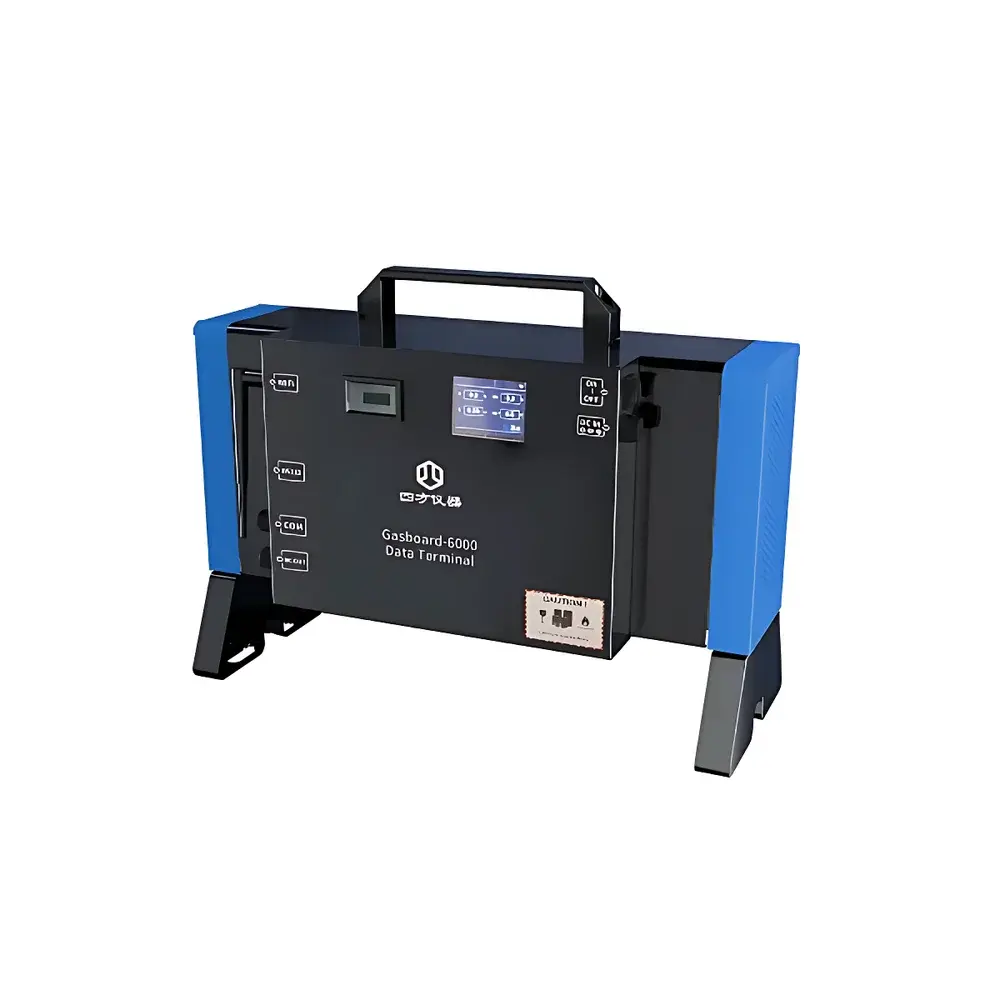
The CUBIC INSTRUMENTS Gasboard-6000 is a portable transmissive opacity meter engineered for regulatory-grade measurement of visible particulate emissions from compression-ignition (diesel) engines. It operates on the principle of transmissometry—quantifying the attenuation of collimated light (typically at 550–570 nm wavelength) as it passes through an exhaust gas plume. The instrument calculates two standardized optical parameters: opacity (N, expressed as a percentage) and the light absorption coefficient (K, in m⁻¹), both defined in ISO 11614 and mandated under China’s national standard GB 3847–2018 for diesel vehicle emission testing. Unlike filter-based or scattering-based methods, transmissometry provides direct, real-time assessment of soot-laden exhaust without sample conditioning or dilution, making it suitable for both free-acceleration and loaded-mode testing protocols. Its optical path is protected by a分流-style (split-flow) sampling architecture that diverts a portion of the exhaust stream away from the measurement chamber—minimizing soot deposition on optical windows and ensuring long-term photometric stability.
Key Features
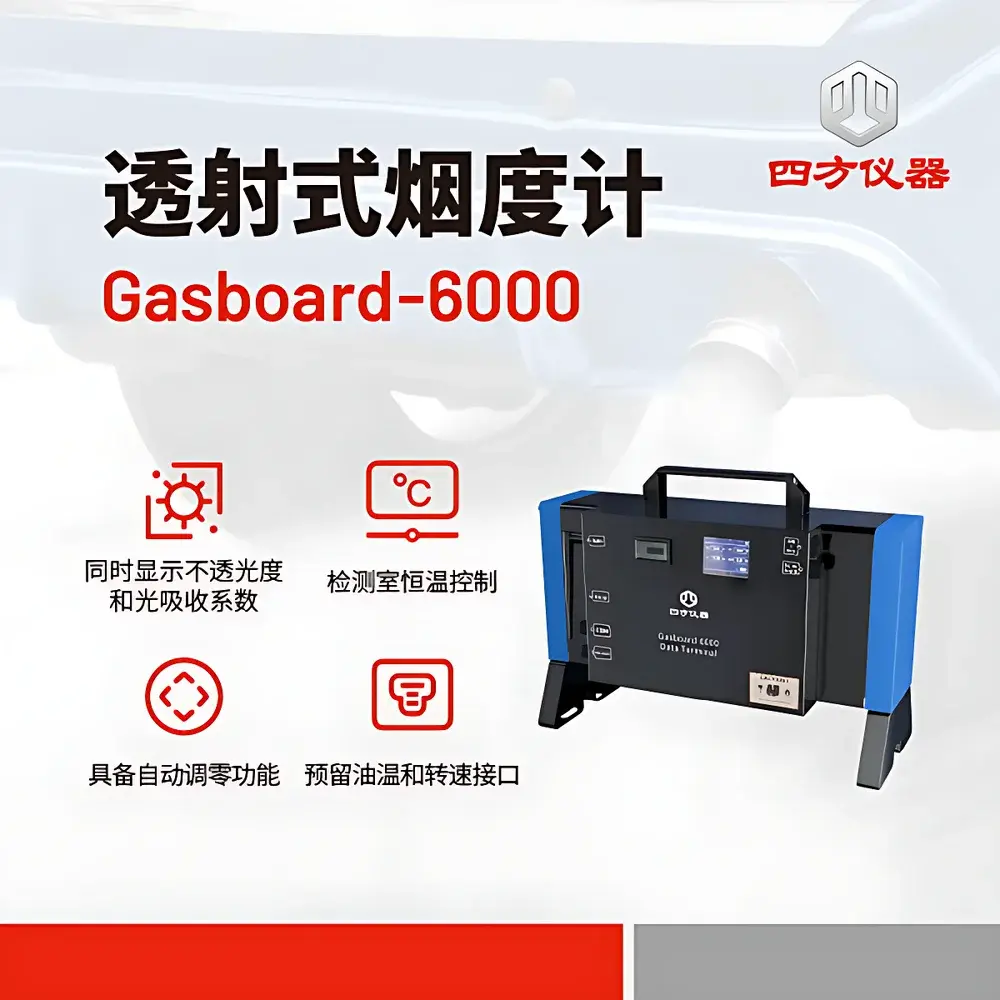
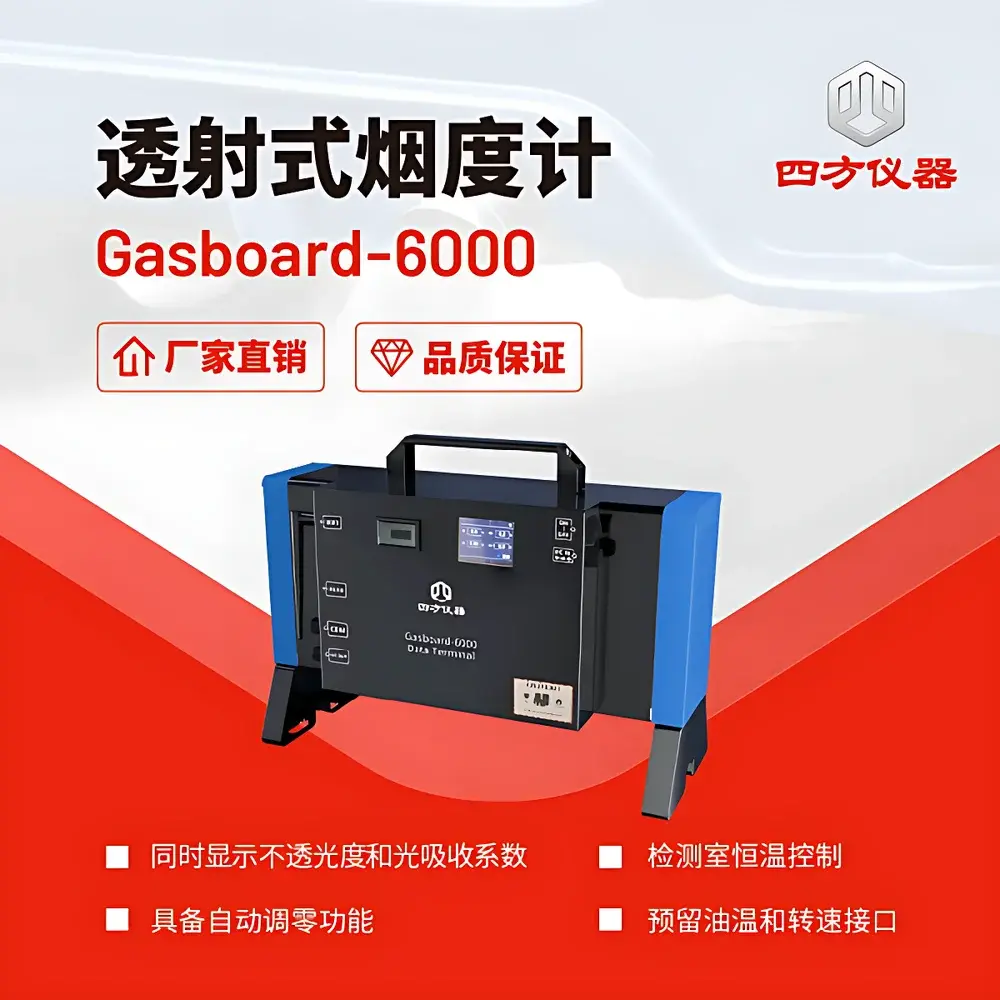
- Simultaneous real-time display of opacity (N) and light absorption coefficient (K), with automatic unit conversion per GB 3847–2018 requirements
- Constant-temperature measurement chamber to eliminate thermal drift and ensure repeatability across ambient conditions (−10 °C to +40 °C operating range)
- Automated zero calibration routine using clean air purging—performed before each test sequence to maintain baseline integrity
- Dedicated analog interfaces for optional integration with engine oil temperature and rotational speed sensors, enabling synchronized emission evaluation during dynamic test cycles
- Ruggedized portable enclosure with IP54-rated ingress protection, shock-absorbing mounting brackets, and integrated carrying handle for field deployment
- Optical system featuring high-stability tungsten-halogen source and silicon photodiode detector, calibrated traceably to NIST-traceable reference standards
Sample Compatibility & Compliance
The Gasboard-6000 is validated for use with undiluted raw exhaust from compression-ignition engines meeting Euro III–VI, China IV–VI, and equivalent regulatory tiers. It accommodates exhaust duct diameters from 50 mm to 200 mm via adjustable flange adapters and supports both fixed-position bench testing and mobile roadside inspection setups. All measurement algorithms and data logging routines comply with GB 3847–2018 Annexes B (Free Acceleration Test) and C (Loaded Mode Test), including mandatory averaging intervals, response time specifications (<1.0 s for 95% step response), and data retention requirements. The device meets electromagnetic compatibility (EMC) Class B per GB/T 18655 and carries CCC certification for domestic market compliance. While not inherently 21 CFR Part 11 compliant, its audit-ready data export (via RS-232/485) supports integration into LIMS environments configured for GLP/GMP-aligned quality assurance workflows.
Software & Data Management
The Gasboard-6000 communicates via ASCII protocol over RS-232 or RS-485 serial links, enabling seamless integration with third-party test management software (e.g., AVL PUMA, Horiba EXAM, or custom LabVIEW/HALO platforms). Raw output includes timestamped N and K values, instrument status flags (zero error, flow fault, temperature deviation), and optional analog inputs (RPM, oil temp). Internal non-volatile memory stores up to 10,000 test records with metadata (date/time, operator ID, vehicle plate placeholder). Data export supports CSV and TXT formats; no proprietary drivers or cloud dependencies are required. Firmware updates are performed via UART interface using vendor-provided configuration utilities—ensuring full control over calibration constants and regulatory parameter sets without remote connectivity.
Applications
- Periodic inspection of in-use diesel vehicles at authorized motor vehicle inspection stations (MVIS) under national I/M programs
- Pre-delivery emission verification in OEM assembly lines and Tier-1 component supplier labs
- Field diagnostics and troubleshooting at heavy-duty repair facilities, particularly for DPF regeneration efficiency validation
- Research-grade black carbon quantification in atmospheric science studies involving mobile source contributions
- Third-party conformity assessment for aftermarket exhaust aftertreatment systems (e.g., DOC, SCR, DPF retrofit kits)
- Training and accreditation programs for technical inspectors requiring hands-on exposure to GB 3847–2018–compliant instrumentation
FAQ
Does the Gasboard-6000 require periodic factory recalibration?
Yes—annual traceable recalibration against certified neutral density filters and reference smoke generators is recommended to maintain metrological validity per GB 3847–2018 Clause 7.3.2.
Can it be used for gasoline direct injection (GDI) engines?
No. The Gasboard-6000 is specifically designed and validated for compression-ignition combustion products. GDI engines fall outside its scope of compliance and measurement uncertainty budget.
Is the split-flow sampling system user-serviceable?
Yes—the bypass flow controller and particulate trap are accessible via front-panel service ports and require only standard hex tools; maintenance intervals are specified at 500 operational hours or per visible soot accumulation.
Does it support wireless data transmission?
Not natively. Wireless capability requires external RS-232-to-WiFi gateways compatible with Modbus RTU or ASCII streaming protocols.
How is measurement uncertainty verified during field use?
Built-in diagnostic mode performs end-to-end optical path verification using internal shutter and reference photodiode feedback, logging pass/fail status with timestamped audit trail.
Related Products







