
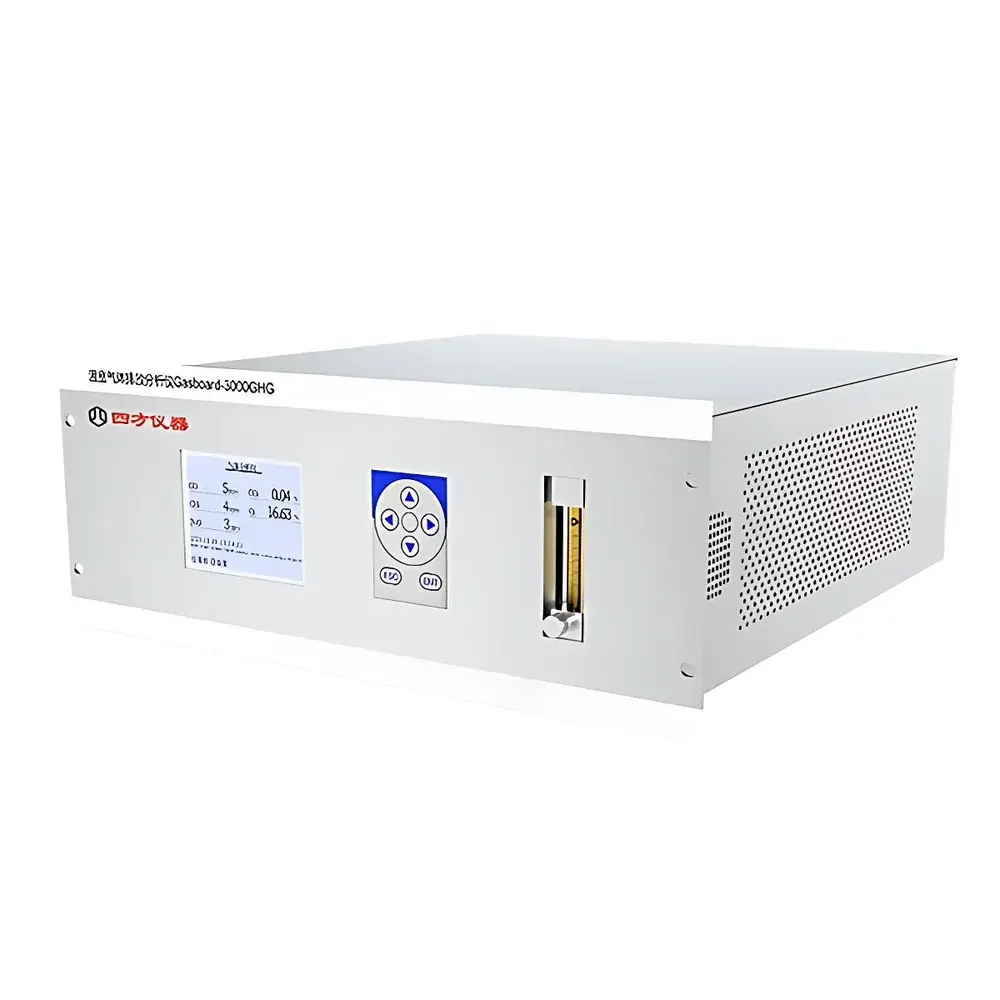
CUBIC INSTRUMENTS Gasboard-3000GHG Multi-Gas Greenhouse Gas Analyzer
| Brand | CUBIC INSTRUMENTS |
|---|---|
| Origin | Hubei, China |
| Model | Gasboard-3000GHG |
| Instrument Type | Online Analyzer |
| Detection Targets | CO₂, CH₄, N₂O, CO, O₂ |
| Measurement Principle | Micro-flow NDIR (CO₂/CH₄/N₂O/CO), Dual-beam NDIR (CO₂/CO), Electrochemical (O₂) |
| Range (CO₂, micro-flow) | 0–500 ppm / 0–20% |
| Range (CH₄/N₂O) | 0–1000 ppm |
| Range (CO, micro-flow) | 0–200 ppm / 0–5000 ppm |
| Range (CO, dual-beam) | 0–1% / 0–5% |
| Range (O₂) | 0–25% |
| Resolution | 1 ppm (low-range gases), 0.01% (high-range gases), 0.001% (CO dual-beam) |
| Accuracy | ±1% F.S. (micro-flow NDIR), ±2% F.S. (dual-beam NDIR & ECD) |
| Repeatability | ≤±1% |
| Response Time (T90) | <25 s |
| Optimal Flow Rate | 0.7–1.2 L/min |
| Inlet Pressure | 2–50 kPa |
| Sample Conditioning | Water removal (no condensation), particulate filtration (<1 µm) |
| Output | RS-485 / RS-232, (4–20) mA |
| Power Supply | 100–240 VAC, max. 300 W (heating), 100 W (steady-state) |
| Diagnostic Function | Real-time sensor health monitoring |
Overview
The CUBIC INSTRUMENTS Gasboard-3000GHG is an online, multi-component greenhouse gas analyzer engineered for continuous, real-time quantification of CO₂, CH₄, N₂O, CO, and O₂ in industrial flue gas and ambient emission streams. It integrates three complementary sensing modalities—micro-flow non-dispersive infrared (NDIR), dual-beam NDIR, and electrochemical detection—within a single, unified platform to deliver high-fidelity, cross-interference-resilient measurements across wide dynamic concentration ranges. The core innovation lies in its patented micro-flow NDIR architecture (PCT/CN2018100767), which employs a half-cell reference chamber design to enable differential absorption measurement using a single infrared source and detector assembly. This eliminates drift induced by thermal fluctuations, optical aging, and humidity-induced baseline shifts—common limitations of conventional single-beam or dual-chamber NDIR systems. The analyzer operates on the physical principle that heteronuclear diatomic and polyatomic gases (e.g., CO₂, CH₄, N₂O, CO) exhibit characteristic vibrational absorption bands in the mid-infrared region (2–14 µm). Incident IR radiation is modulated via an optical chopper and directed into a measurement cell; absorbed energy causes localized gas expansion in paired micro-flow detection chambers, generating a pressure differential sensed as an AC voltage signal proportional to analyte concentration. This physics-based, calibration-stable methodology supports long-term unattended operation in demanding stack environments.
Key Features
- Simultaneous, continuous measurement of up to five gases: CO₂, CH₄, N₂O, CO, and O₂—each optimized for its respective concentration regime.
- Patented micro-flow NDIR technology (certified under CN Patent No. 201710720122.1) delivering sub-ppm resolution (1 ppm) and ±1% F.S. accuracy for low-concentration greenhouse gases (e.g., 0–500 ppm CO₂, 0–1000 ppm CH₄/N₂O).
- Dual-beam NDIR configuration available for high-concentration CO₂ (0–100%) and CO (0–5%), providing enhanced stability against optical contamination and source intensity drift.
- Electrochemical O₂ sensor with ±2% F.S. accuracy and 0.01% resolution over 0–25% range, compliant with ISO 7504 and ASTM D6216 for oxygen-in-gas applications.
- Robust sample conditioning interface: integrated water trap and <1 µm particulate filter ensure reliable operation with wet, dusty flue streams without external pre-treatment units.
- Comprehensive diagnostics: onboard self-check routines monitor detector responsivity, heater status, flow integrity, and signal-to-noise ratio—enabling predictive maintenance and GLP-compliant audit trails.
- Flexible I/O architecture: isolated RS-485 (Modbus RTU), RS-232, and 4–20 mA analog outputs support integration into DCS, SCADA, and EPA-certified CEMS platforms.
Sample Compatibility & Compliance
The Gasboard-3000GHG is validated for use with hot, humid, and particulate-laden sample streams typical of combustion sources—including coal-fired power plants, cement kilns, steel sintering belts, nitric acid production lines, and municipal waste incinerators. Its inlet specification (2–50 kPa pressure, 0.7–1.2 L/min flow, dew point <5 °C, <1 µm particulates) aligns with EN 15267-3 and US EPA Method 3A requirements for extractive CEMS. While not certified to EN 14181 QAL1/QAL2 out-of-the-box, the instrument’s traceable calibration protocol, documented uncertainty budget (±1% F.S. at 95% confidence), and built-in zero/span validation capability facilitate third-party QAL3 verification. All firmware and data logging functions comply with 21 CFR Part 11 electronic record controls when deployed with optional secure audit-log software modules.
Software & Data Management
The analyzer ships with CUBIC’s proprietary GasView™ PC software (Windows 10/11 compatible), supporting real-time waveform visualization, multi-gas trend logging (CSV/Excel export), automatic calibration scheduling, and alarm threshold configuration. Raw sensor outputs—including micro-flow detector voltage, thermistor temperature, and flow sensor ADC counts—are accessible via Modbus register mapping for custom SCADA integration. Data storage supports ≥30 days of second-level timestamped records internally; external USB or network-attached storage enables extended archival. Audit logs capture all user-initiated actions (calibration, parameter changes, reset events) with operator ID and UTC timestamps—fully traceable per ISO/IEC 17025 clause 7.9 and EU 2017/1463 reporting mandates.
Applications
- Continuous Emission Monitoring Systems (CEMS) for regulatory GHG reporting under EU ETS, US EPA GHGRP, and China’s National Carbon Market (NCM) protocols.
- Process optimization in nitric acid plants (N₂O abatement control), cement clinker coolers (CO combustion efficiency), and fluidized bed combustors (CH₄ slip monitoring).
- Carbon capture, utilization, and storage (CCUS) facility inlet/outlet stream analysis—particularly for CO₂ purity verification (≥99.5%) and trace CO/CH₄ impurity detection.
- Research-grade flux measurements in eddy covariance towers and soil respiration chambers requiring sub-ppm CH₄/N₂O sensitivity.
- Boiler tune-up and combustion diagnostics in commercial heating systems, where simultaneous CO/CO₂/O₂ analysis informs air-fuel ratio optimization per ASHRAE Guideline 1.
FAQ
What calibration standards are required for routine operation?
Certified gas mixtures traceable to NIST or BIPM standards are recommended: CO₂-in-N₂ (500 ppm, 10%, 50%), CH₄-in-air (100 ppm, 1000 ppm), N₂O-in-N₂ (100 ppm, 1000 ppm), CO-in-N₂ (200 ppm, 1%), and O₂-in-N₂ (5%, 21%). Zero gas must be CO₂/CH₄/N₂O/CO-free synthetic air.
Can the analyzer operate without active sample conditioning?
No. The instrument requires dry, particle-free sample gas. An external heated line and permeation dryer or chiller-condenser system is mandatory if inlet dew point exceeds 5 °C or particulate load exceeds ISO 12103-1 A4 dust levels.
Is remote firmware update supported?
Yes—via secure HTTPS-enabled web interface or Modbus TCP. Updates include version-signed binaries, rollback capability, and post-installation diagnostic verification.
Does the system meet explosion-proof requirements for Zone 1 installations?
Not natively. For hazardous area deployment, the analyzer must be housed in an IS-rated enclosure (e.g., ATEX II 2G Ex d IIB T4) with intrinsically safe signal isolators for analog outputs.
How often is span calibration recommended under EPA Method 3A compliance?
Daily zero/span checks are advised for CEMS applications; full multi-point linearity verification every 7 days per 40 CFR Part 75 Appendix A.







