
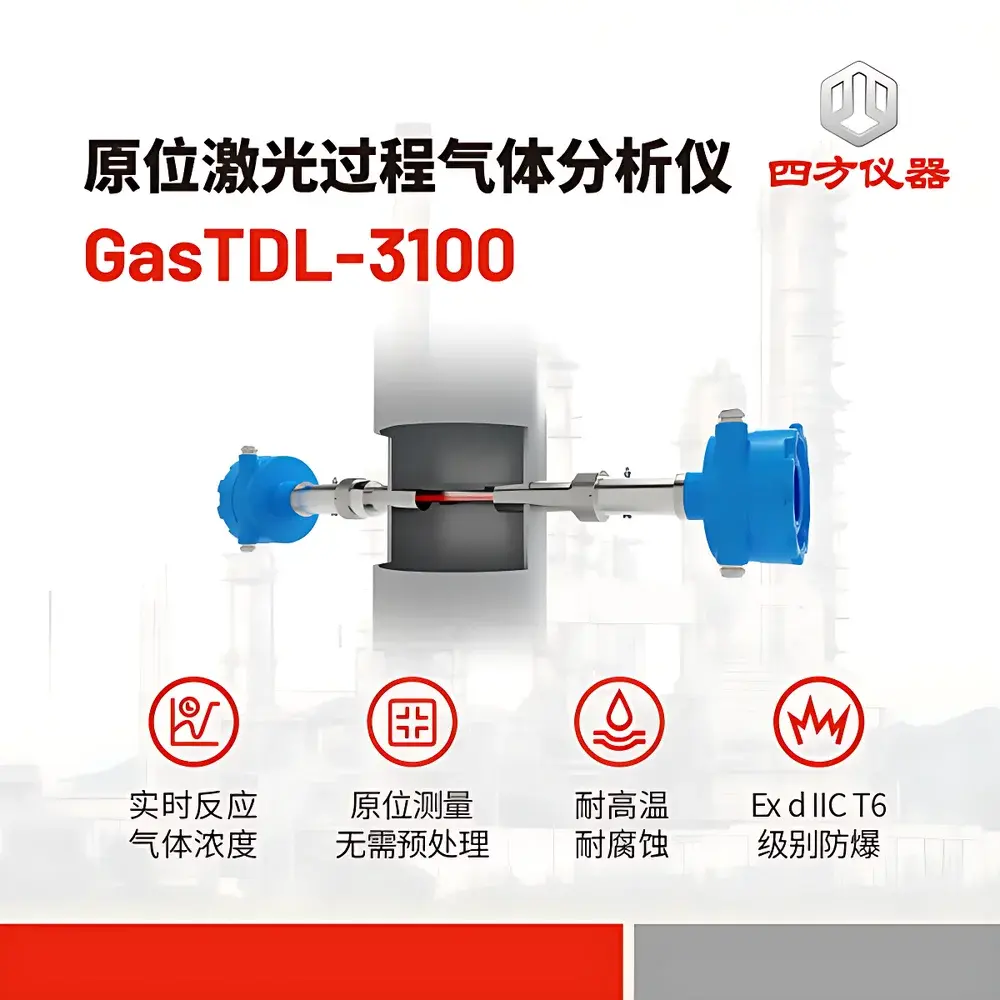
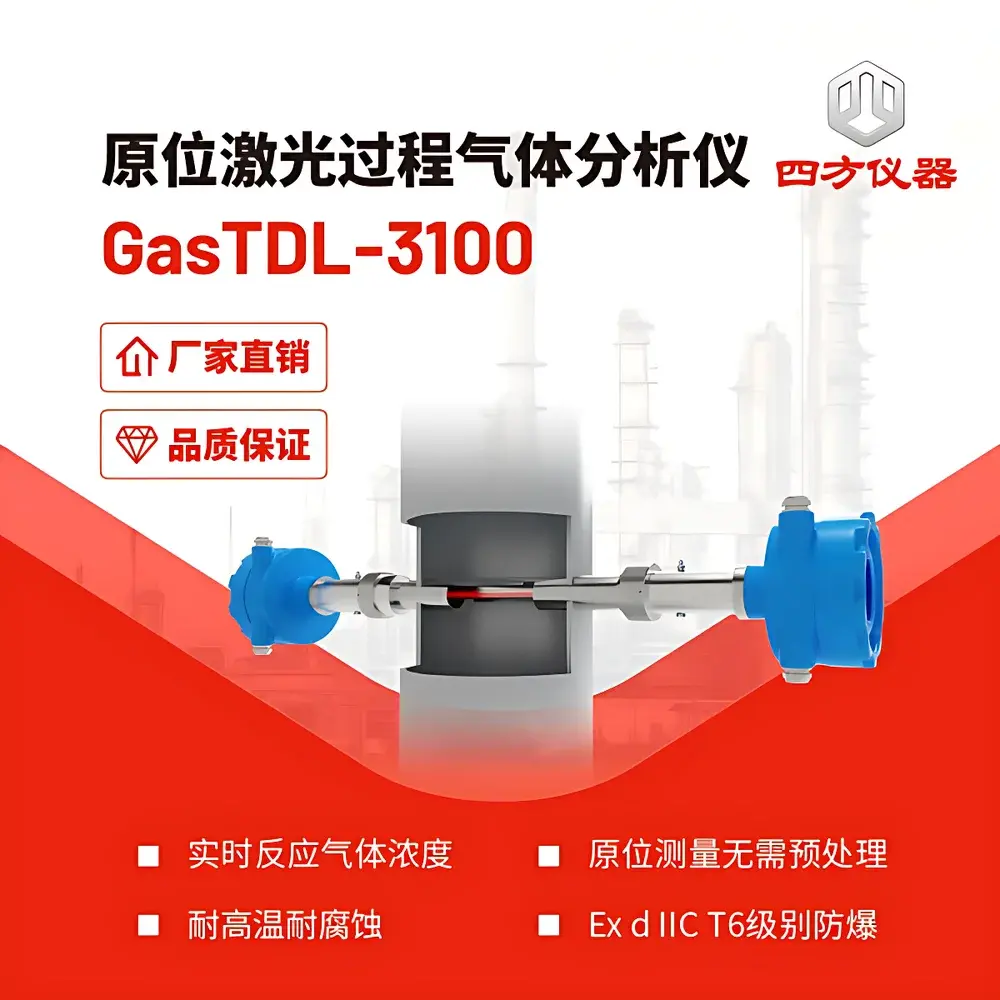
CUBIC INSTRUMENTS GasTDL-3100 In-Situ Tunable Diode Laser Absorption Spectroscopy (TDLAS) Gas Analyzer – Transmittance Configuration
| Brand | CUBIC INSTRUMENTS |
|---|---|
| Origin | Hubei, China |
| Model | GasTDL-3100 |
| Measurement Principle | Tunable Diode Laser Absorption Spectroscopy (TDLAS) |
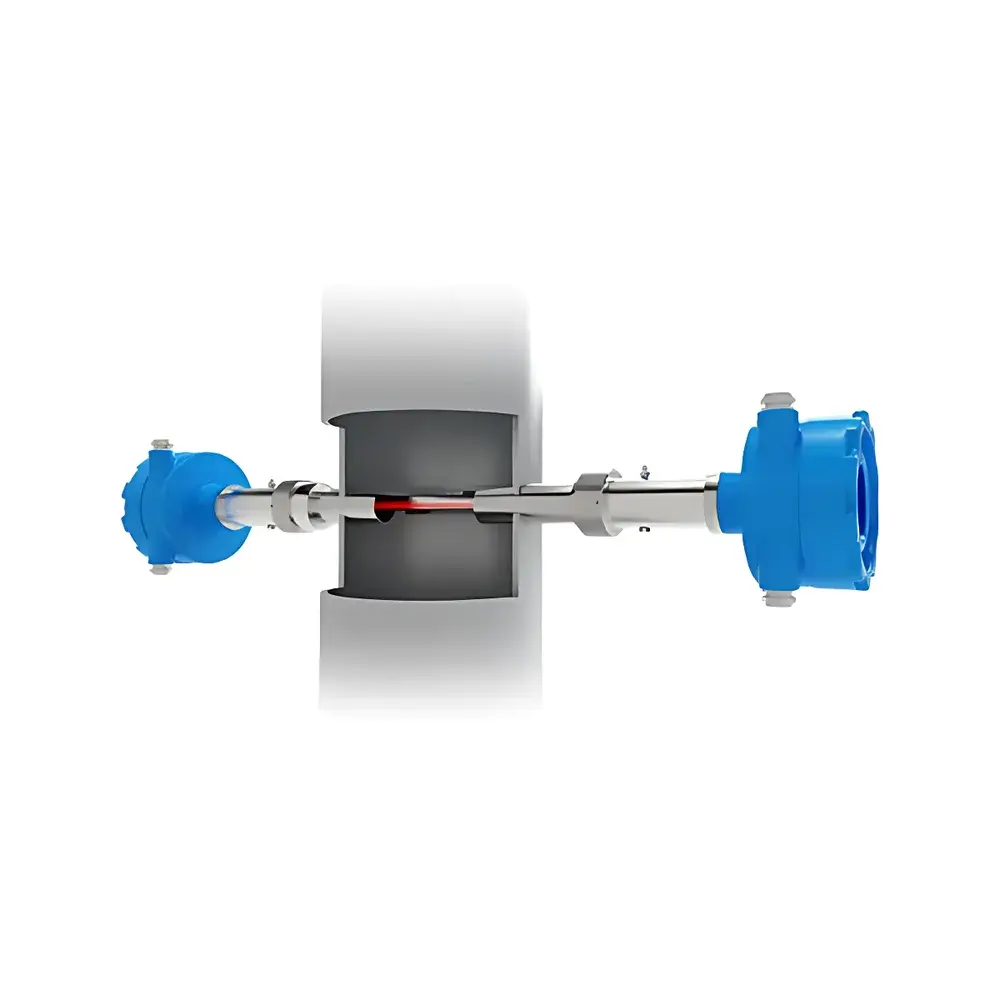
| Installation Type | In-situ transmittance (line-of-sight) |
| Measured Gases | H₂S, O₂, CO, CO₂, CH₄ |
| O₂ Range | 0–5 %vol (customizable to 0–100 %vol) |
| Response Time | T90 ≤ 1 s |
| Repeatability | ≤ ±1 %FS |
| Accuracy | ≤ ±1 %FS |
| Zero/ Span Drift | ≤ ±1 %FS per 30 days |
| Resolution | 0.01 %vol (O₂), 0.01 ppm (H₂S) |
| Explosion Protection | Exd II CT6 Gb / Ex tb IIIC T80°C Db |
| Operating Temperature | −20 to +60 °C |
| Power Supply | 24 V DC, 24 W |
| Purge Gas | Industrial nitrogen, 0.3–0.8 MPa |
| Output | 2 × 4–20 mA, 3 × relay |
| Communication | RS485, RS232 |
Overview
The CUBIC INSTRUMENTS GasTDL-3100 is an in-situ, transmittance-mode gas analyzer engineered for continuous, real-time monitoring of key process gases—including H₂S, O₂, CO, CO₂, and CH₄—in demanding industrial environments. It employs Tunable Diode Laser Absorption Spectroscopy (TDLAS), a quantitative optical technique that exploits the unique near-infrared absorption fingerprints of target molecules. Unlike extractive systems requiring sample conditioning, the GasTDL-3100 performs direct line-of-sight measurement across the process stream—eliminating transport delay, condensation artifacts, and catalytic surface losses. Its robust transmittance configuration enables high signal-to-noise ratio detection even under high-temperature, high-dust, high-moisture, or corrosive conditions typical of combustion flue ducts, syngas lines, biogas upgrading units, and chemical reactor off-gas streams. The instrument delivers sub-second response (T90 ≤ 1 s), enabling closed-loop control integration and rapid fault detection in safety-critical applications.
Key Features
- TDLAS-based optical detection ensures inherent selectivity—minimal cross-sensitivity to background gases such as N₂, H₂O vapor, or CO₂ when measuring H₂S or CO.
- True in-situ installation: no sampling probe, heated line, filter, or chiller required—reducing maintenance burden and eliminating calibration drift from sample conditioning artifacts.
- Optically stable transmittance path with integrated alignment verification; no moving parts, no consumables, and no optical windows exposed to process media.
- Explosion-proof enclosure rated Exd II CT6 Gb / Ex tb IIIC T80°C Db—certified for Zone 1 and Zone 21 hazardous areas per IEC 60079 series standards.
- Real-time compensation for temperature, pressure, and optical path attenuation using on-board sensors and embedded spectral fitting algorithms.
- Modular optical head design allows field adaptation to duct diameters from 0.3 m to 6 m via adjustable mounting brackets and collimated beam optics.
Sample Compatibility & Compliance
The GasTDL-3100 is validated for continuous operation in gas streams with particulate loadings up to 10 g/m³, moisture content up to 40 %v/v (non-condensing), and temperatures ranging from ambient to 300 °C (with optional high-temp optical head). It complies with electromagnetic compatibility requirements per IEC 61326-1 (industrial environment) and meets mechanical robustness standards per IEC 60068-2 for vibration and shock resistance. While not pre-certified to SIL-2, its architecture supports functional safety integration per IEC 61511 when deployed with external safety PLCs. Data integrity protocols align with GLP/GMP principles: all measurements are timestamped, and configuration changes are logged with user ID and audit trail metadata.
Software & Data Management
The analyzer includes embedded firmware supporting Modbus RTU over RS485/RS232 and analog 4–20 mA outputs with HART-compatible digital superimposition. Optional Ethernet interface enables integration with DCS/SCADA systems via OPC UA or MQTT. CUBIC’s proprietary GasView™ desktop software provides spectral visualization, baseline correction tools, and multi-point calibration management—including zero/span validation reports compliant with ISO 14064-3 and EPA Method 205 guidelines. All data exports support CSV and XML formats with ISO 8601 timestamps. Audit logs retain full traceability of parameter modifications, calibration events, and alarm triggers—supporting FDA 21 CFR Part 11 compliance when deployed with validated user access controls.
Applications
- Combustion optimization and NOₓ/SO₂ precursor monitoring in utility and waste-to-energy boiler flues.
- H₂S and CO tracking in biogas desulfurization and upgrading skids prior to CHP or grid injection.
- O₂ and CH₄ concentration profiling in anaerobic digesters and landfill gas collection networks.
- CO and CO₂ monitoring in syngas streams from gasification reactors for stoichiometric control.
- Leak detection and purge gas verification in inerted chemical reactors and distillation columns.
- Environmental compliance reporting per EU Industrial Emissions Directive (IED) and China’s GB 13223–2011 standard.
FAQ
Can the GasTDL-3100 measure multiple gases simultaneously in a single optical path?
No. Each unit is configured for one target gas species. Multi-component analysis requires parallel optical channels or sequential wavelength scanning—neither supported by the standard GasTDL-3100. For multi-gas applications, multiple analyzers or a custom multi-laser platform must be deployed.
Is calibration traceable to NIST or other national standards?
Yes. Factory calibration uses certified gas standards traceable to NIM (China National Institute of Metrology) and can be re-traceable to NIST upon request. On-site span calibration employs certified reference gases meeting ISO 6141 specifications.
What maintenance is required beyond periodic optical window cleaning?
None. The system contains no consumables, no pumps, no filters, and no electrochemical cells. Annual verification of laser wavelength stability and photodetector linearity is recommended—but not mandatory—for long-term metrological confidence.
Does the analyzer support remote diagnostics and firmware updates?
Yes. Firmware updates and diagnostic logs can be retrieved remotely via RS485 or Ethernet. Secure OTA updates require authenticated access and SHA-256 signature verification to prevent unauthorized modification.
How is dust accumulation on transmitter/receiver optics mitigated?
The optical heads incorporate purge gas nozzles delivering tangential nitrogen flow across lens surfaces. Flow rate (0.3–0.8 MPa) is monitored via integrated pressure sensor, and low-flow alarms trigger DCS notifications per ISA-84.01 logic solver requirements.







