
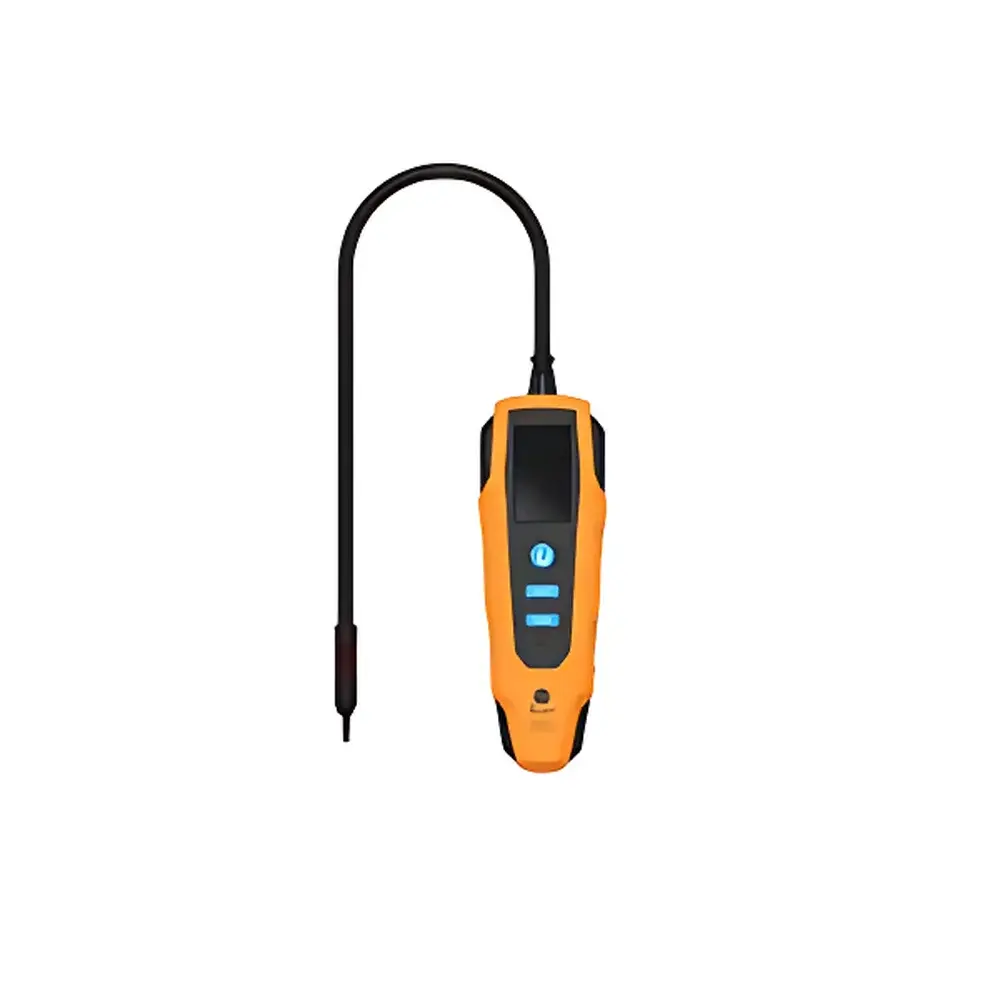
Cubic AM4209 Portable Refrigerant Leak Detector
| Brand | Cubic |
|---|---|
| Origin | Hubei, China |
| Manufacturer Type | Authorized Distributor |
| Country of Origin | Domestic (China) |
| Model | AM4209 |
| Pricing | Available Upon Request |
| Detection Principle | Non-Dispersive Infrared (NDIR) |
| Maximum Sensitivity | 1 g/year (static), 3 g/year (dynamic) |
| Refrigerant Compatibility | HFOs (e.g., 1234yf, 1234ze), A2L-class refrigerants, and common blends (R-134a, R-410A, R-32) |
| Alarm Output | Visual (red LED + LCD bar graph + numeric display), Audible (buzzer), Tactile (vibration) |
| Response Time | <1 second |
| Power Source | Rechargeable Lithium-ion Battery / 10-hour runtime |
| Display | Backlit LCD with real-time concentration readout |
| Operating Environment | 0°C to 40°C (32°F to 104°F), <75% RH (non-condensing) |
| Ingress Protection | IP54 |
| Key Features | High measurement accuracy, long-term stability, rapid response, poison-resistant sensor architecture, electromagnetic interference (EMI) robustness |
Overview
The Cubic AM4209 Portable Refrigerant Leak Detector is an engineered field instrument designed for quantitative, real-time detection of low-concentration refrigerant leaks in HVAC/R systems, industrial chillers, and mobile air conditioning units. Built around Cubic Photonics’ proprietary non-dispersive infrared (NDIR) sensing module, the AM4209 leverages wavelength-specific absorption spectroscopy to selectively identify and quantify fluorinated refrigerants—including next-generation low-GWP compounds such as 1234yf, 1234ze, and R-32—without cross-sensitivity to ambient CO₂, water vapor, or common hydrocarbons. Unlike catalytic bead or heated diode sensors, the NDIR platform delivers inherent immunity to silicon poisoning, halogen contamination, and humidity-induced drift, making it suitable for repeated use in maintenance-intensive environments where sensor longevity and calibration stability are critical operational requirements.
Key Features
- Proprietary NDIR optical cell with dual-wavelength reference compensation for enhanced baseline stability and reduced zero drift over extended deployment cycles
- Sub-second response time (<1 s T90) enabling rapid leak localization during pressure decay tests or sniffer-mode scanning
- Triple-alert system: red status LED, dynamic LCD bar graph with numeric ppm/v concentration readout, audible alarm (85 dB @ 30 cm), and tactile vibration feedback for noisy or visually constrained workspaces
- IP54-rated enclosure providing protection against dust ingress and water splashes encountered during rooftop unit inspections or under-vehicle diagnostics
- Lithium-ion battery supporting up to 10 hours of continuous operation; USB-C rechargeable with state-of-charge indication on startup and low-battery warning
- Field-calibratable design compliant with ASTM D6420-22 Annex A1 guidelines for portable refrigerant leak detectors used in service verification
Sample Compatibility & Compliance
The AM4209 is validated for detection of A2L-class refrigerants (including 1234yf, R-454B, R-452B) and legacy blends (R-134a, R-410A, R-404A, R-22), meeting the functional performance criteria outlined in AHRI Standard 750-2023 for portable leak detection equipment. Its NDIR spectral bandpass is optimized for C–F bond vibrational absorption signatures, minimizing false positives from alcohols, ketones, or silicone-based sealants commonly present in service environments. The device operates within ISO 16000-23 environmental testing conditions (0–40°C, ≤75% RH non-condensing) and conforms to IEC 61000-4-2/3/4/6 for electromagnetic compatibility in industrial settings. While not intrinsically safe (IEC 60079-0), its low-power electronics and absence of ignition sources render it appropriate for non-hazardous zone applications per NEC Class I, Division 2 guidelines.
Software & Data Management
The AM4209 operates as a standalone instrument with no embedded Bluetooth or cloud connectivity. All measurement data—including timestamped peak concentration events, alarm triggers, and battery status logs—are retained in non-volatile memory (1,000-event capacity) and accessible via USB-C interface using Cubic’s free PC utility (Windows/macOS compatible). The software exports CSV-formatted reports compatible with enterprise CMMS platforms (e.g., IBM Maximo, Fiix) and supports audit-trail generation per GLP/GMP documentation standards. Firmware updates are delivered through signed binary packages to ensure integrity and traceability—a requirement aligned with FDA 21 CFR Part 11 principles for regulated maintenance records.
Applications
- HVAC/R technician field diagnostics during commissioning, retrofit, or preventive maintenance
- Automotive AC system leak verification post-repair, in compliance with SAE J2788 and EPA Section 609 certification protocols
- Industrial refrigeration plant safety sweeps prior to personnel entry into machinery rooms
- Manufacturing QA checks on hermetic compressor assemblies and brazed joint integrity
- Educational laboratory use for teaching refrigerant thermodynamics and environmental impact assessment (GWP, ODP)
FAQ
Does the AM4209 require periodic calibration? How often?
Yes—annual calibration is recommended per ASTM D6420-22 and manufacturer specifications. Field zeroing using ambient air is supported daily; span calibration requires certified R-134a or 1234yf gas standard (100 ppmv).
Can the sensor detect R-744 (CO₂) or ammonia (R-717)?
No—the NDIR optical filter is tuned exclusively for fluorocarbon absorption bands (8–12 µm range); CO₂ and NH₃ fall outside this spectral window and are not detected.
Is the device suitable for use inside refrigerated cold rooms below 0°C?
Operation below 0°C is not specified; condensation risk and LCD response latency increase significantly below the rated 0°C lower limit. External probe extension kits are not available.
What does the IP54 rating mean for practical field use?
It certifies protection against limited dust ingress (no harmful deposits) and water splashes from any direction—adequate for outdoor rooftop units or garage bays, but not submersion or high-pressure washdown.
How is sensor poisoning resistance achieved?
The NDIR detection method eliminates catalytic surfaces vulnerable to siloxane or sulfur compound fouling; optical path contamination is mitigated by hydrophobic lens coating and sealed optical chamber design.
Related Products







