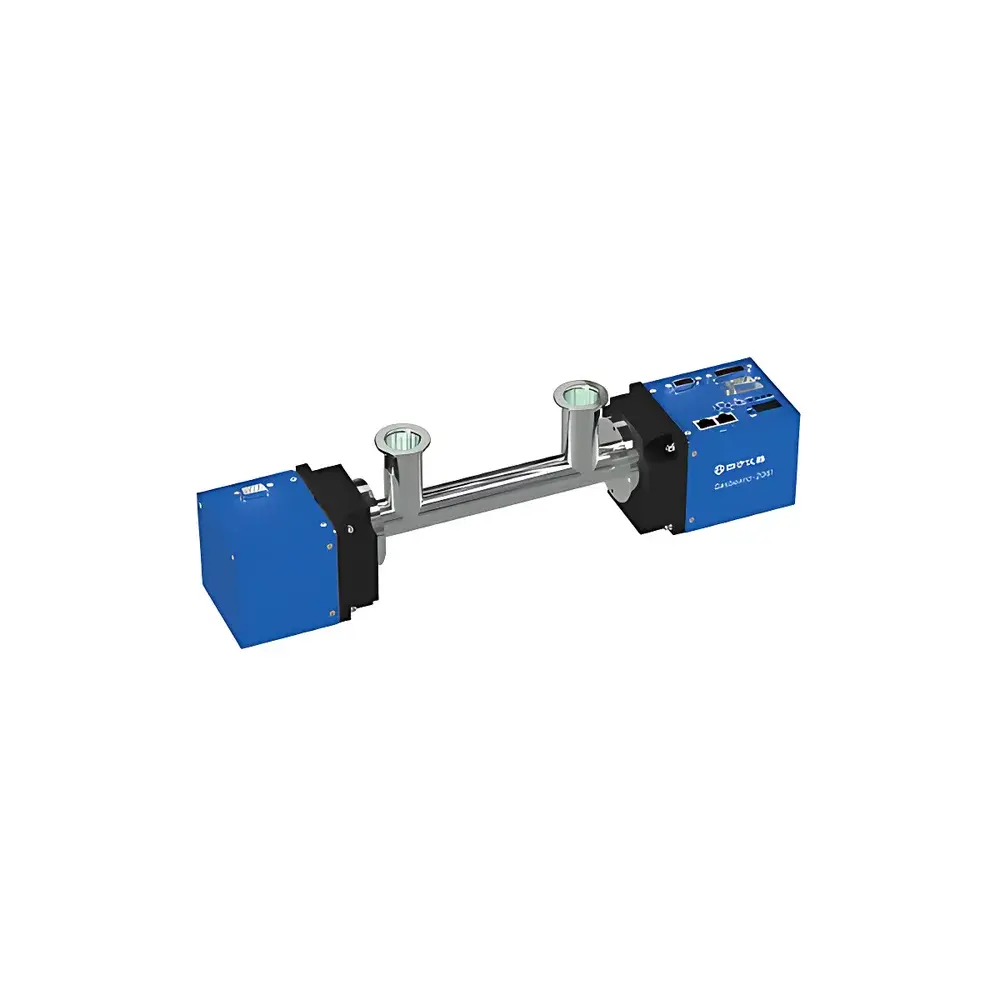
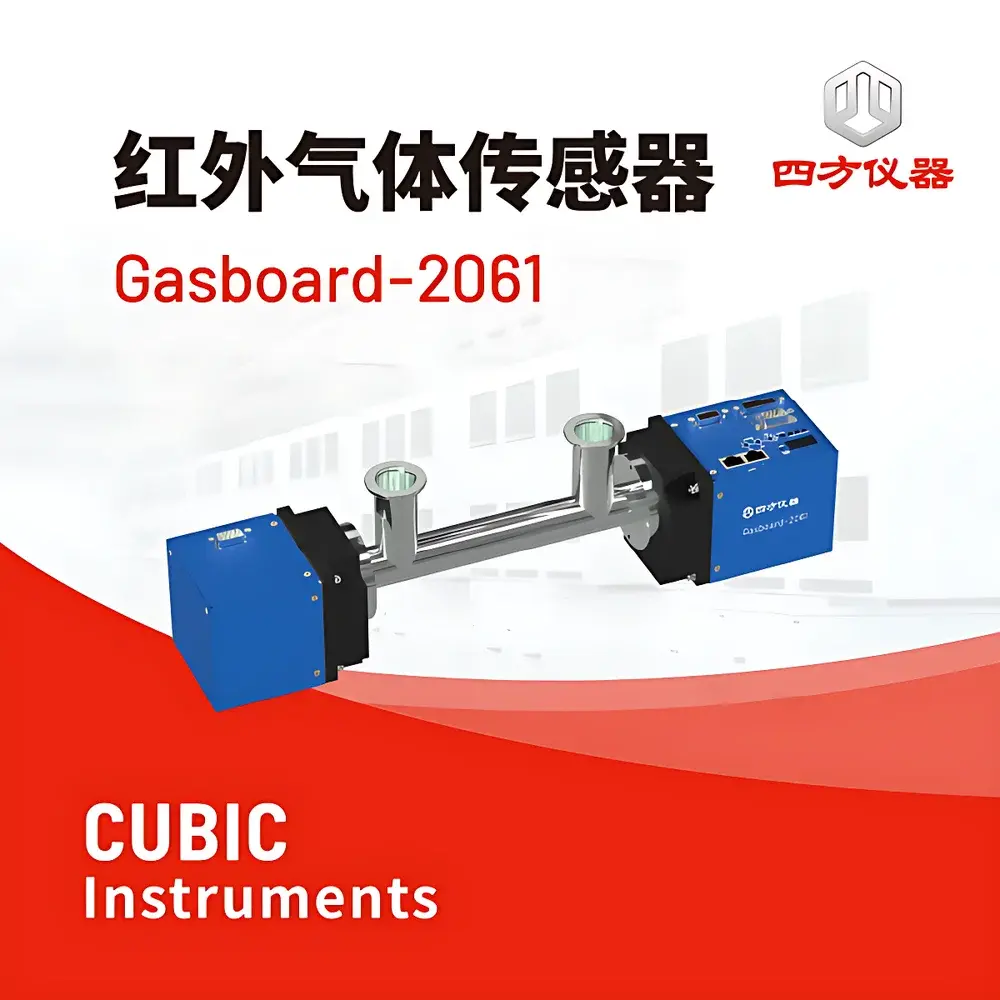
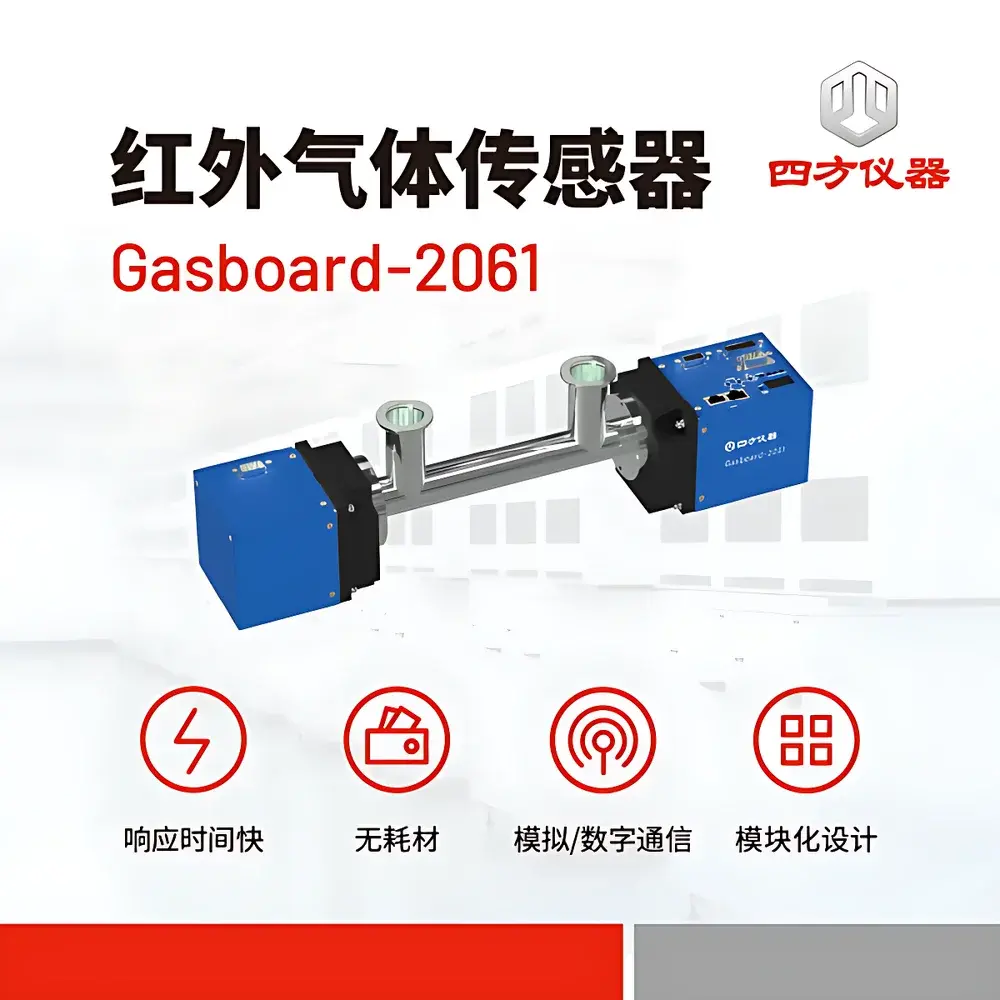
CUBIC INSTRUMENTS Gasboard-2061 NDIR-Based Endpoint Detection Sensor for Semiconductor CVD Process Monitoring
| Brand | CUBIC INSTRUMENTS |
|---|---|
| Origin | Hubei, China |
| Model | Gasboard-2061 |
| Detection Principle | Non-Dispersive Infrared (NDIR) |
| Target Gases | WF₆, CF₄, SF₆, NF₃, CO₂ |
| Measurement Range | 1–264 ppm (0–200 mTorr) |
| Repeatability | ±0.5% |
| Linearity | ±1% F.S. |
| Detection Limit | 1 ppm |
| Output Interface | Analog (4–20 mA) and Digital (RS485/Modbus RTU) |
| Housing Material | 316L Stainless Steel |
| Process Connection | CF-35 or ISO-KF40 Flange Compatible |
| Operating Temperature | 0–50 °C |
| Pressure Rating | Up to 200 mTorr (absolute) |
Overview
The CUBIC INSTRUMENTS Gasboard-2061 is an industrial-grade, non-dispersive infrared (NDIR) gas sensor engineered specifically for endpoint detection (EPD) in semiconductor thin-film deposition and plasma cleaning processes. Designed for integration into chemical vapor deposition (CVD), plasma-enhanced CVD (PECVD), and etch chamber platforms, the sensor enables real-time, in-situ monitoring of process-critical gases—including tungsten hexafluoride (WF₆), carbon tetrafluoride (CF₄), sulfur hexafluoride (SF₆), nitrogen trifluoride (NF₃), and carbon dioxide (CO₂)—during film growth and chamber conditioning cycles. Unlike electrochemical or catalytic bead sensors, the NDIR principle offers inherent selectivity, long-term stability, and immunity to poisoning—critical attributes in high-purity, ultra-low-part-per-trillion (ppt) cleanroom environments. The Gasboard-2061 operates on absorption spectroscopy: each target gas exhibits a unique mid-infrared absorption fingerprint (e.g., WF₆ at 10.7 µm, NF₃ at 9.7 µm), which the sensor quantifies via dual-wavelength referencing to compensate for optical drift, window fouling, and thermal noise. Its calibrated range of 1–264 ppm (equivalent to 0–200 mTorr partial pressure) aligns with typical process windows for fluorinated precursor decomposition and byproduct evolution, supporting precise endpoint identification without requiring mass spectrometry-level infrastructure.
Key Features
- Multi-gas NDIR detection platform optimized for semiconductor process gases: WF₆, CF₄, SF₆, NF₃, and CO₂
- Sub-second response time (T₉₀ < 1.5 s) enabling dynamic EPD during rapid plasma transitions
- No consumables or reagents—optical path sealed with sapphire windows; lifetime > 5 years under continuous operation
- Modular mechanical design: compact 316L stainless-steel housing with standard CF-35 or ISO-KF40 vacuum flange interface
- Dual-output communication: isolated 4–20 mA analog signal + RS485 Modbus RTU digital protocol for seamless OEM integration
- On-board temperature and pressure compensation algorithms ensure measurement integrity across variable chamber conditions
- Factory-calibrated traceable to NIST-certified gas standards; calibration verification supported via zero/span gas ports
Sample Compatibility & Compliance
The Gasboard-2061 is qualified for direct installation in Class 100 cleanrooms and compatible with standard semiconductor tool architectures including Applied Materials Centura®, Lam Research Kiyo®, and Tokyo Electron P-12™ platforms. It meets SEMI S2-0217 safety guidelines for semiconductor manufacturing equipment and complies with IEC 61000-6-2 (EMC immunity) and IEC 61000-6-4 (EMC emission) standards. While not intrinsically safe per ATEX/IECEx, its low-power optical architecture (< 5 W) and passive sensing principle eliminate ignition risk in controlled vacuum environments. For regulatory traceability, the device supports audit-ready calibration logs and can be configured to generate timestamped measurement records compliant with FDA 21 CFR Part 11 when interfaced with validated host SCADA systems.
Software & Data Management
The sensor operates autonomously but integrates transparently with industry-standard automation frameworks via Modbus RTU over RS485. CUBIC provides a Windows-based configuration utility (Gasboard ConfigTool v3.2) for setting gas-specific span values, alarm thresholds, and linearization coefficients—without requiring firmware updates. All measurements are timestamped with microsecond resolution and support CSV export for offline trend analysis in JMP, MATLAB, or Python-based SPC modules. When deployed in cluster tools, multiple Gasboard-2061 units can be daisy-chained on a single bus, reducing cabling complexity and enabling synchronized EPD across parallel chambers. Optional OPC UA gateway modules allow native interoperability with Siemens Desigo, Rockwell FactoryTalk, and Yokogawa CENTUM VP DCS environments.
Applications
- Endpoint detection during WF₆-based tungsten CVD: monitoring WF₆ depletion and WCl₆ byproduct rise to terminate deposition precisely
- NF₃ plasma cleaning of PECVD chambers: detecting NF₃ consumption and HF/NOₓ evolution to optimize clean cycle duration
- CF₄/SF₆ etch endpoint control in silicon nitride patterning: tracking fluorocarbon fragment ratios for profile uniformity
- In-line CO₂ monitoring during low-k dielectric cure steps to verify solvent removal completeness
- Real-time gas purity verification upstream of critical mass flow controllers (MFCs) to prevent wafer contamination
FAQ
Is the Gasboard-2061 certified for use in Class 10 cleanrooms?
Yes—the sensor housing and internal optics meet ISO 14644-1 Class 5 (Class 100) particulate requirements; surface finish Ra ≤ 0.4 µm and electropolished 316L construction minimize particle shedding.
Can it detect multiple gases simultaneously within one optical path?
No—it employs sequential multi-channel NDIR with dedicated optical filters; however, up to five gases are supported via field-selectable configurations and require no hardware change.
Does it require periodic recalibration in production environments?
Calibration stability is verified at 6-month intervals per SEMI E10; drift remains within ±0.3% F.S. over 12 months when operated within specified T/P ranges.
What vacuum compatibility does it offer?
Rated for continuous operation from atmospheric pressure down to 1 × 10⁻³ Torr; optional bake-out capability up to 120 °C for high-vacuum chamber integration.
How is cross-sensitivity to water vapor managed?
Integrated humidity-compensated reference channel and proprietary spectral deconvolution algorithm suppress H₂O interference below 0.2% relative error at 50% RH.