
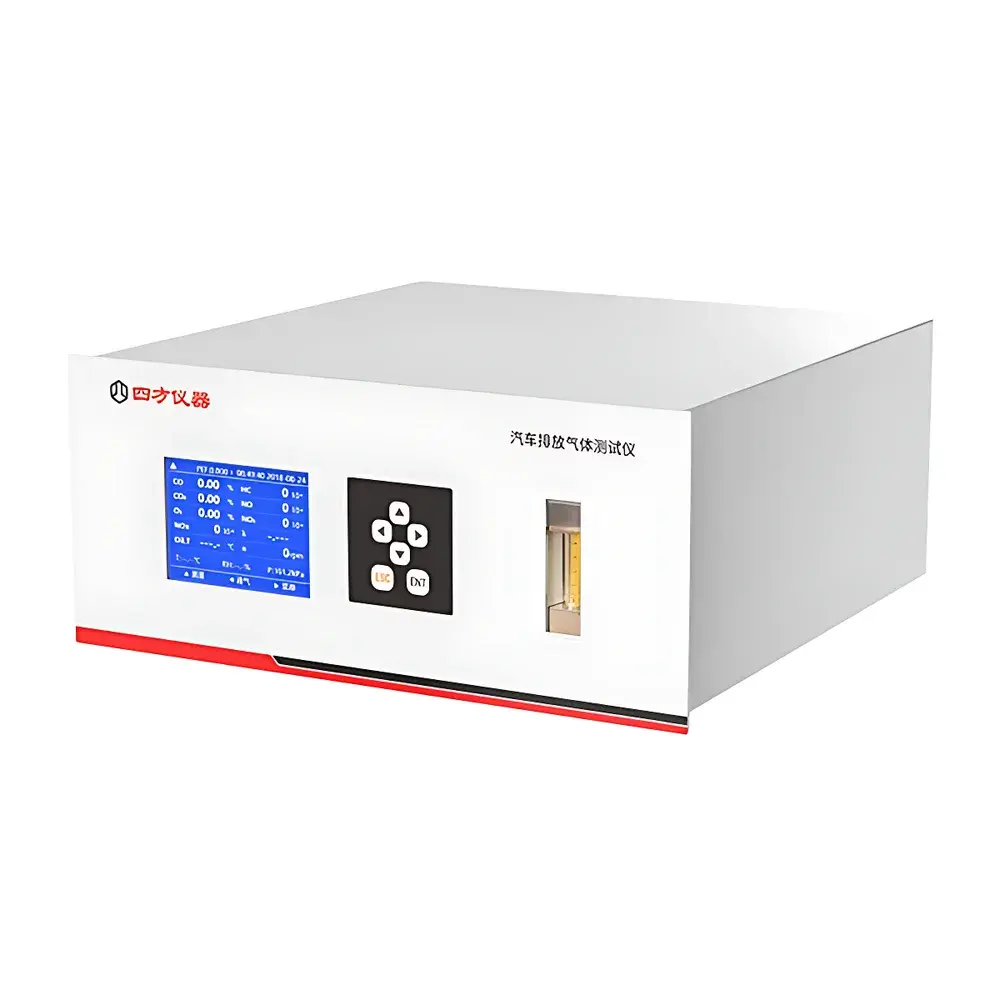
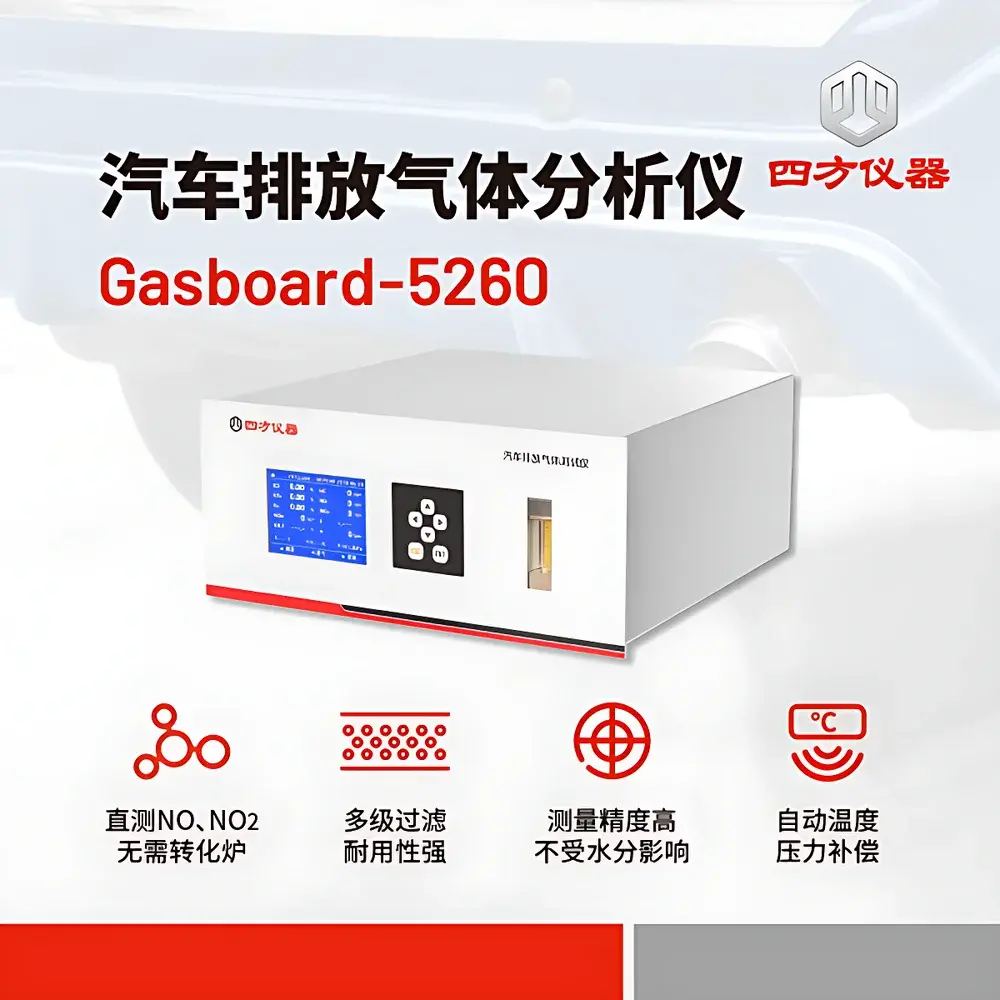
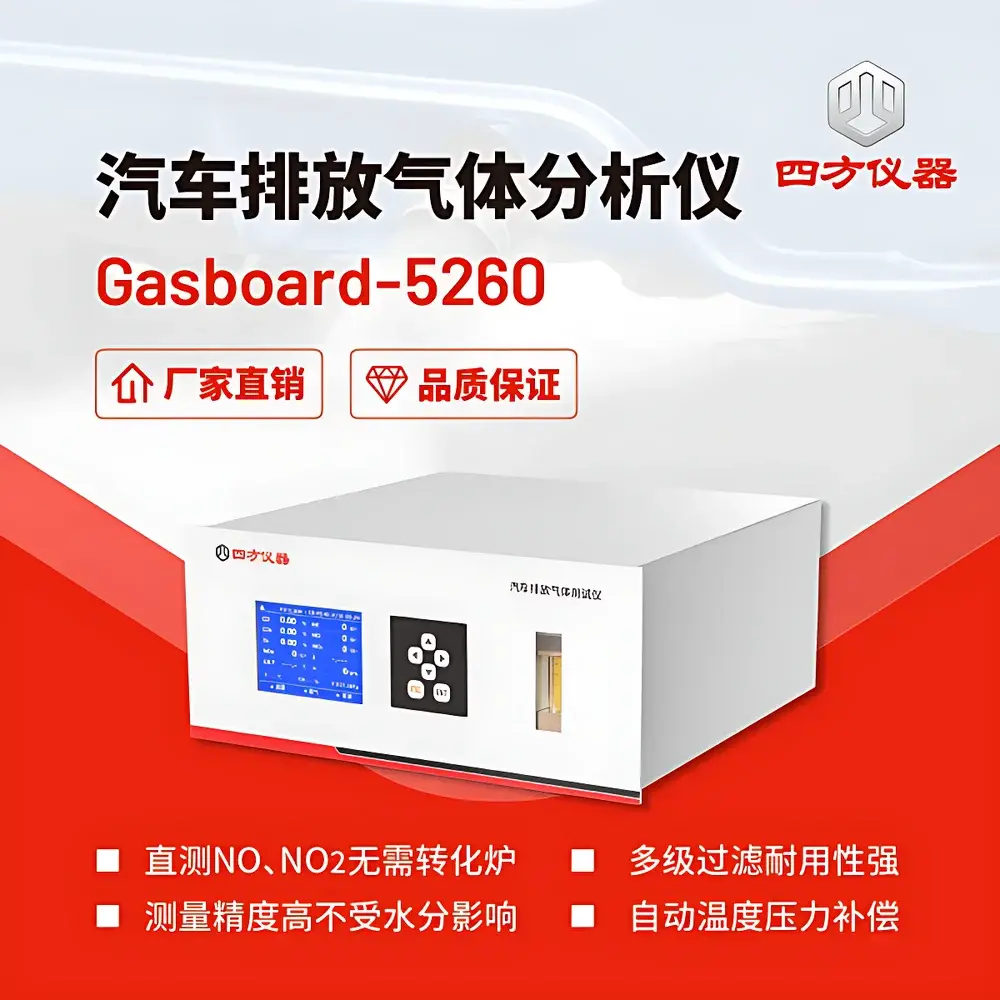
CUBIC INSTRUMENTS Gasboard-5230 Automotive Exhaust Gas Analyzer for Research Laboratories
| Brand | CUBIC INSTRUMENTS |
|---|---|
| Origin | Hubei, China |
| Model | Gasboard-5230 |
| Instrument Type | Online Analyzer |
| Measurement Principles | Microflow Dual-Chamber NDIR (CO₂), PCT-Patented Microflow Infrared (NO), NDUV Absorption (NO₂) |
| Measured Gases | CO₂, NO, NO₂ |
| CO₂ Range | (0.0–16.0) × 10⁻² vol% (±0.3 × 10⁻² vol% or ±3%), (16.01–18.0) × 10⁻² vol% (±5%) |
| NO Range | (0–4000) × 10⁻⁶ vol% (±25 × 10⁻⁶ vol% or ±4%), (4001–5000) × 10⁻⁶ vol% (±8%) |
| NO₂ Range | (0–1000) × 10⁻⁶ vol% (±25 × 10⁻⁶ vol% or ±4%) |
| Resolution | CO₂: 0.01% vol |
| NO/NO₂ | 1 ppm |
| Response Time (T₉₀) | CO₂ ≤ 8 s |
| Warm-up Time | 30 min |
| Communication Interface | RS-485 / RS-232 |
| Power Supply | 100–240 VAC, 150 W |
Overview
The CUBIC INSTRUMENTS Gasboard-5230 is an online automotive exhaust gas analyzer engineered for high-precision, regulatory-compliant measurement of CO₂, NO, and NO₂ in diesel vehicle emissions. Designed specifically for research laboratories, environmental monitoring agencies, and third-party testing facilities, the instrument integrates three distinct optical detection principles within a single robust platform: non-dispersive infrared (NDIR) spectroscopy for CO₂, patented microflow dual-chamber infrared sensing (PCT/CN2018100767) for NO, and non-dispersive ultraviolet (NDUV) absorption for NO₂. This multi-principle architecture eliminates reliance on NO-to-NO₂ catalytic converters—reducing system complexity, maintenance frequency, and long-term calibration drift. The dual-chamber infrared sensor for NO employs temperature-compensated optical filtering and differential signal processing to mitigate interference from ambient thermal fluctuations and electronic aging, ensuring stable baseline performance over extended operational cycles. All core measurements comply with Chinese national standards GB 3847–2018 (Emission Limits and Measurement Methods for Pollutants from Diesel Vehicles) and JJG 688–2017 (Verification Regulation for Automotive Exhaust Gas Analyzers, Class 00 accuracy grade), making it suitable for accredited laboratory workflows requiring traceable metrological validation.
Key Features
- Direct, simultaneous quantification of CO₂, NO, and NO₂—no NOx converter required
- PCT-international patent-protected microflow dual-chamber infrared sensor for NO, delivering enhanced thermal stability and reduced zero drift
- NDUV-based NO₂ detection enabling selective, water-vapor-insensitive measurement without chemical conversion
- Multi-stage particulate and moisture filtration system extending sensor lifetime and maintaining optical path integrity under real-world exhaust conditions
- Embedded linearization algorithms correcting for nonlinearity across full dynamic ranges, improving accuracy at low- and high-concentration extremes
- Compact, rack-mountable industrial chassis with front-panel status indicators and intuitive local display interface
Sample Compatibility & Compliance
The Gasboard-5230 is optimized for continuous sampling of hot, humid, and particulate-laden diesel exhaust streams. Its inlet conditioning system accommodates gas temperatures up to 180 °C (with optional dilution probe), dew point variations, and transient flow rates typical of chassis dynamometer and roadside testing environments. All measurement uncertainties are defined per JJG 688–2017 Class 00 specifications—including absolute and relative error thresholds across calibrated concentration ranges—and are fully traceable to national metrological standards. While not certified to ISO 17025 as a standalone device, the analyzer supports integration into ISO/IEC 17025-accredited laboratory quality systems through documented calibration records, audit-ready firmware logs, and configurable data export formats compliant with GLP data integrity requirements.
Software & Data Management
The analyzer operates via embedded firmware supporting RS-485 (Modbus RTU) and RS-232 serial protocols for seamless integration into centralized emission test benches or LIMS environments. Host software (provided separately) enables real-time waveform visualization, batch export in CSV/Excel format, and automated report generation aligned with GB 3847–2018 test protocols. Audit trail functionality records all configuration changes, calibration events, and user-initiated actions with timestamped metadata. Firmware supports remote diagnostics and parameter updates via secure UART interface—facilitating preventive maintenance scheduling and regulatory version control. Data storage includes internal non-volatile memory retaining ≥30 days of second-by-second concentration logs (configurable), meeting minimum retention expectations for QA/QC review under institutional GLP frameworks.
Applications
- Regulatory compliance testing of diesel-powered vehicles using free-acceleration and loaded-mode (e.g., ASM, IM240) protocols
- Fundamental combustion research in university and national lab settings investigating NOₓ formation pathways and aftertreatment efficiency
- Validation of SCR catalyst performance and urea dosing strategies under transient engine load profiles
- Field-deployable mobile emission monitoring units integrated with Gasboard-6000 opacity meters for combined gaseous + particulate assessment
- Reference-grade verification of lower-cost portable analyzers in inter-laboratory comparison studies
- Development and calibration of AI-driven predictive models for real-driving emissions (RDE) using high-fidelity time-synchronized datasets
FAQ
Does the Gasboard-5230 require periodic NOx converter replacement?
No. NO and NO₂ are measured independently using NDUV and patented microflow IR technologies—eliminating consumable converters and associated recalibration intervals.
Is the instrument compatible with international emission standards such as EU Stage V or US EPA 40 CFR Part 1065?
While calibrated and verified per Chinese national standards (GB 3847–2018, JJG 688–2017), its fundamental measurement principles and uncertainty budgets align with the technical requirements of ISO 8714, ISO 16183, and EPA 40 CFR Part 1065 Annexes for NO/NO₂/CO₂ quantification—subject to site-specific validation per local accreditation body.
Can raw sensor output be accessed for custom algorithm development?
Yes. The RS-485 Modbus register map provides access to uncorrected detector voltages, temperature-compensated digital counts, and intermediate linearization coefficients—enabling advanced users to implement proprietary correction models.
What is the recommended calibration frequency under continuous laboratory operation?
Per JJG 688–2017, full verification is required every 6 months; however, daily zero/span checks using certified calibration gases (NIST-traceable) are mandatory for GLP-compliant operation.
Does the analyzer support analog voltage outputs for PLC integration?
Not natively. Analog output requires external signal conditioning modules interfaced via RS-485 Modbus mapping to standard 4–20 mA transmitters—a configuration supported by CUBIC’s system integration documentation.







