
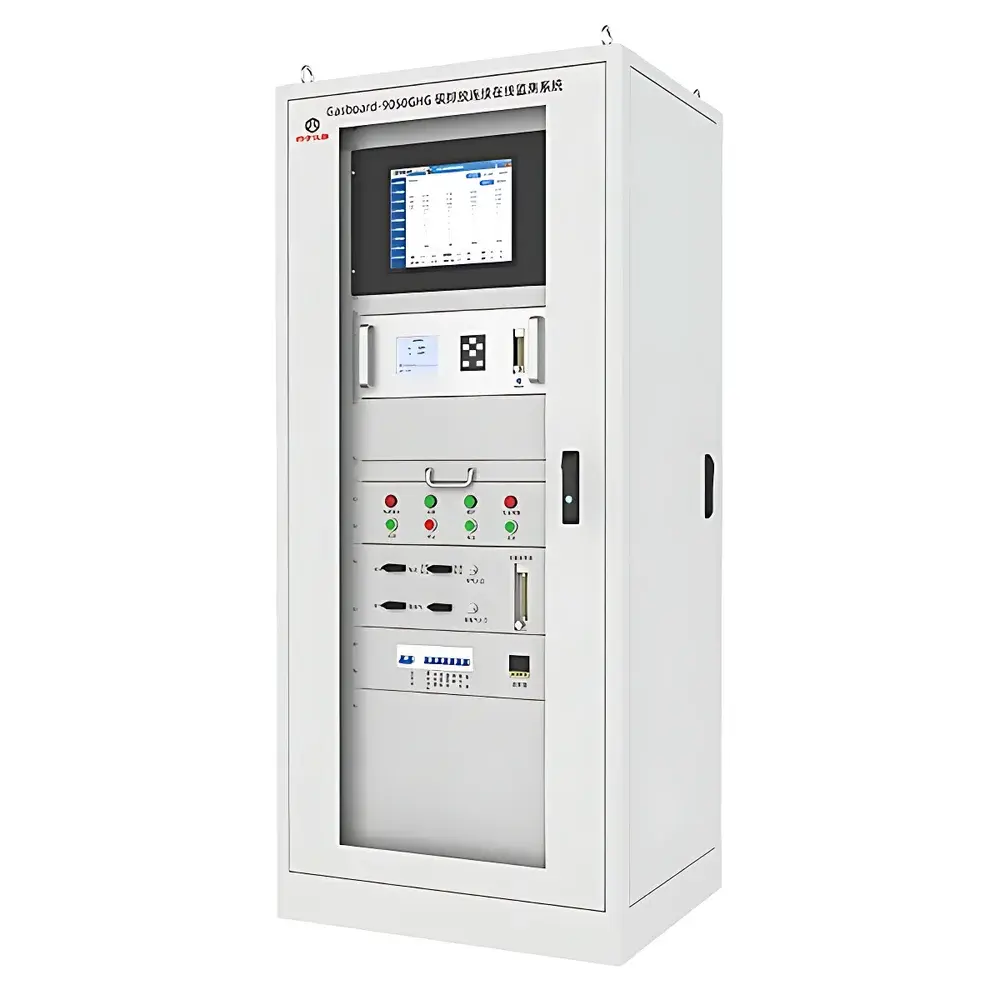
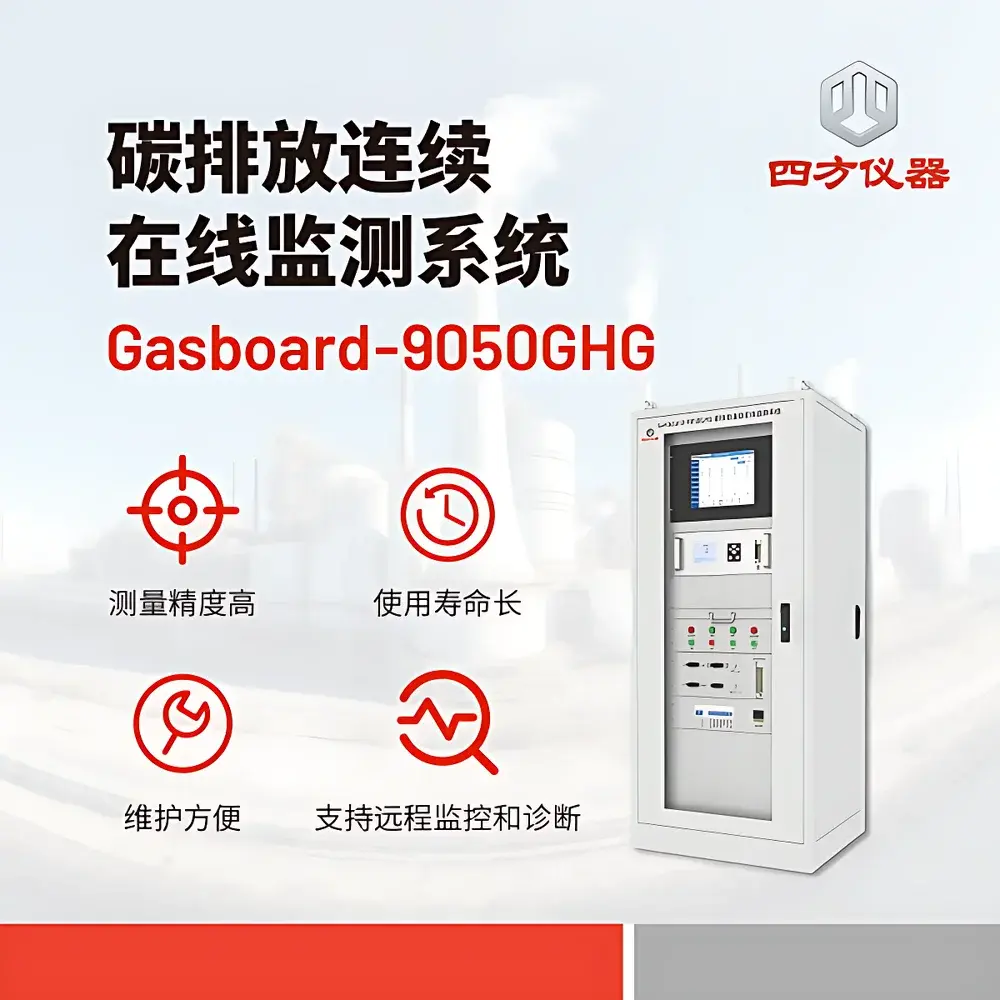
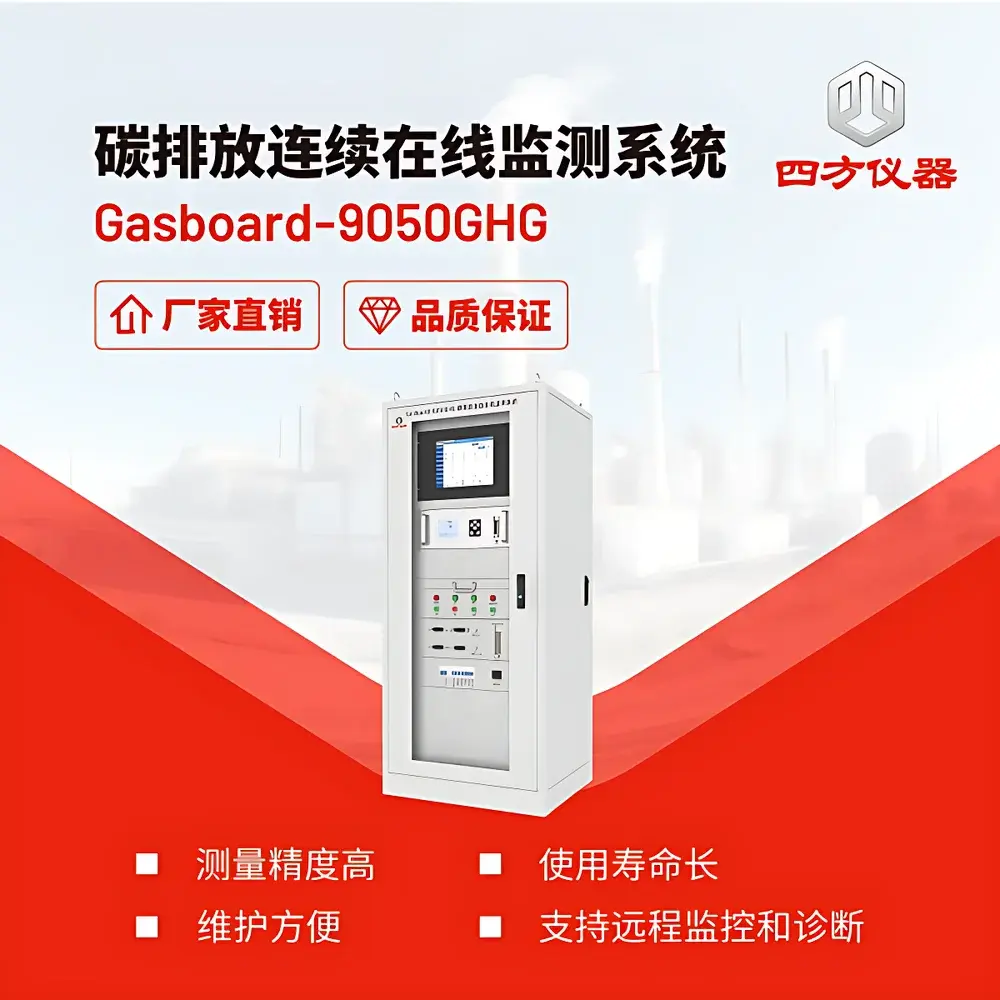
CUBIC INSTRUMENTS Gasboard-9050GHG Continuous Emission Monitoring System (CEMS) for Greenhouse Gases
| Brand | CUBIC INSTRUMENTS |
|---|---|
| Origin | Hubei, China |
| Model | Gasboard-9050GHG |
| Instrument Type | Online CEMS |
| Measured Gases | CH₄, CO₂, CO, N₂O, O₂ |
| Measurement Principle | NDIR (CH₄/CO₂/CO/N₂O), Electrochemical Detection (O₂) |
| Range | CH₄/CO/N₂O: 0–1000 ppm |
| CO₂/O₂ | 0–25% vol |
| Accuracy | ≤±1% F.S. (CH₄/CO₂/CO/N₂O), ≤±2% F.S. (O₂) |
| Repeatability | ≤±1% F.S. |
| Resolution | CH₄/CO/N₂O: 1 ppm |
| CO₂/O₂ | 0.01% vol |
| Response Time (T90) | <25 s |
| Linearity Error | ≤±1% F.S. (CH₄/CO₂/CO/N₂O), ≤±2% F.S. (O₂) |
| Sample Temperature Limit | 0–300 °C |
| Heated Sampling Line & Probe Temp | 120–180 °C |
| Enclosure Rating | IP54 |
| Dimensions (L×W×H) | 800 × 760 × 1800 mm |
| Ambient Temp | −20 to +50 °C |
| Ambient Humidity | <95% RH (non-condensing) |
| Power Supply | 220 V AC ±10%, >3000 W |
| Compressed Air Requirement | 0.4–0.8 MPa, oil-free, dust-free, dry |
| Max. Air Consumption | 2.2 m³/h |
| Avg. | 0.45 m³/h |
| Max. Sample Flow | 2 L/min |
| Avg. | 1.5 L/min |
| Communication Interfaces | RS-485, RS-232, 4–20 mA, Ethernet |
| Diagnostic Features | Real-time sensor health monitoring, automatic zero calibration via integrated air pump |
Overview
The CUBIC INSTRUMENTS Gasboard-9050GHG is a certified continuous emission monitoring system (CEMS) engineered for regulatory-grade, multi-component greenhouse gas (GHG) measurement in industrial flue gas streams. Designed to meet the technical requirements of national and international emissions reporting frameworks—including China’s HJ 75–2017 and HJ 76–2017 standards, as well as alignment with ISO 14064-1 and EU MRV principles—the system integrates non-dispersive infrared (NDIR) spectroscopy for CH4, CO2, CO, and N2O quantification with electrochemical detection (ECD) for O2. Its modular architecture comprises four functional subsystems: (1) GHG analysis unit, (2) flue gas parameter monitoring unit (temperature, pressure, velocity, humidity), (3) data acquisition module, and (4) embedded processing and communication unit. The system employs a high-temperature heated extraction method using a ceramic zirconia-based sampling probe and fully trace-heated (120–180 °C) PTFE-lined sampling line to prevent condensation and adsorption losses—critical for maintaining integrity of low-concentration GHG measurements under variable stack conditions.
Key Features
- Multi-technology gas sensing architecture: Combines proprietary NDIR sensors (with optical cross-interference compensation algorithms) and ruggedized electrochemical O2 cells to ensure selective, stable detection across complex combustion matrices.
- Heated, filtration-integrated sampling: Stainless-steel sintered metal filter at the probe inlet provides >99.9% particulate retention; automated reverse-pulse cleaning extends maintenance intervals to ≥3 months under typical coal-fired or cement kiln conditions.
- Corrosion-resistant wet-end components: All gas-contact surfaces—including sample line, condensate trap, and internal valves—are fabricated from 316L stainless steel and fluoropolymer-coated ceramics to withstand acidic condensates (e.g., SOx, HCl) and high-humidity flue gases.
- Embedded self-diagnostics and auto-calibration: Onboard diagnostic routines continuously monitor sensor drift, optical path contamination, and pump performance; integrated zero-air generator enables scheduled or event-triggered automatic zero calibration without external gas cylinders.
- Regulatory-ready data handling: Firmware supports configurable audit trails, timestamped raw signal logging, and dual-channel analog output (4–20 mA) compliant with EN 14181 QAL1/QAL2 requirements for quality assurance level validation.
Sample Compatibility & Compliance
The Gasboard-9050GHG is validated for continuous operation in flue gas environments characterized by temperatures up to 300 °C, particulate loadings ≤50 g/m³, and moisture content up to 25% v/v. It meets electromagnetic compatibility (EMC) per IEC 61326-1 and environmental protection class IP54 for outdoor cabinet installation. While not CE-marked for direct EU deployment, its measurement methodology and uncertainty budget align with ISO 12039 (CO2), ISO 21258 (N2O), and ASTM D6522 (CO) reference methods. For GMP or GLP-regulated facilities, optional firmware upgrades support 21 CFR Part 11-compliant electronic signatures and user-access-controlled configuration locks.
Software & Data Management
The system runs on a Linux-based embedded OS with real-time kernel scheduling to guarantee deterministic data acquisition at 1-second intervals. Local HMI includes a 10.1″ capacitive touchscreen with intuitive navigation for calibration setup, alarm threshold configuration, and historical trend review (72-hour buffer). Data export is supported via Modbus TCP, OPC UA (v1.04), and CSV over Ethernet; all communications are TLS 1.2 encrypted when interfaced with centralized SCADA or EMS platforms. Raw spectral data (for NDIR channels) and sensor diagnostics logs are retained for ≥30 days onboard and can be retrieved remotely via SSH or SFTP. Optional cloud integration enables automated report generation aligned with national GHG inventory templates (e.g., China’s MRV guidelines).
Applications
- Continuous monitoring of CO2, CH4, and N2O emissions from coal-, gas-, or biomass-fired power plants under national carbon trading schemes.
- Process optimization and combustion efficiency analysis in cement clinker kilns, glass melting furnaces, and waste-to-energy incinerators.
- Verification of abatement technology performance (e.g., SCR, SNCR, thermal oxidizers) via simultaneous measurement of CO, NOx (via optional add-on), O2, and residual GHGs.
- Stack testing support for periodic QA/QC audits per HJ/T 397 and EPA Method 3A/7E equivalents.
- Baseline emissions characterization for ISO 50001 energy management systems and science-based target initiative (SBTi) reporting.
FAQ
Does the Gasboard-9050GHG comply with China’s mandatory CEMS certification requirements (HJ 75/76)?
Yes—it has undergone third-party type evaluation per HJ 76–2017 and is listed in the China Environmental Protection Industry Association’s recommended equipment catalog for GHG monitoring.
Can the system measure CO2 at sub-100 ppm levels with reliable accuracy?
The NDIR CO2 channel is optimized for 0–25% range; for low-concentration applications (e.g., ambient air or biogas dilution), optional dual-beam long-path NDIR modules are available with extended sensitivity down to 10 ppm.
Is remote firmware update supported?
Yes—secure OTA updates are enabled via authenticated HTTPS endpoints; rollback capability ensures system stability during version transitions.
What maintenance intervals are recommended for the heated probe and analyzer unit?
Under standard operating conditions (≤150 °C flue gas, <10 g/m³ dust), probe filter cleaning is required every 90 days; optical cell inspection and zero/span verification are recommended quarterly.
Does the system provide native support for MODBUS RTU over RS-485?
Yes—standard firmware includes full MODBUS RTU register mapping (holding registers 40001–40120) for real-time concentration, status flags, and diagnostic codes.
Related Products







