
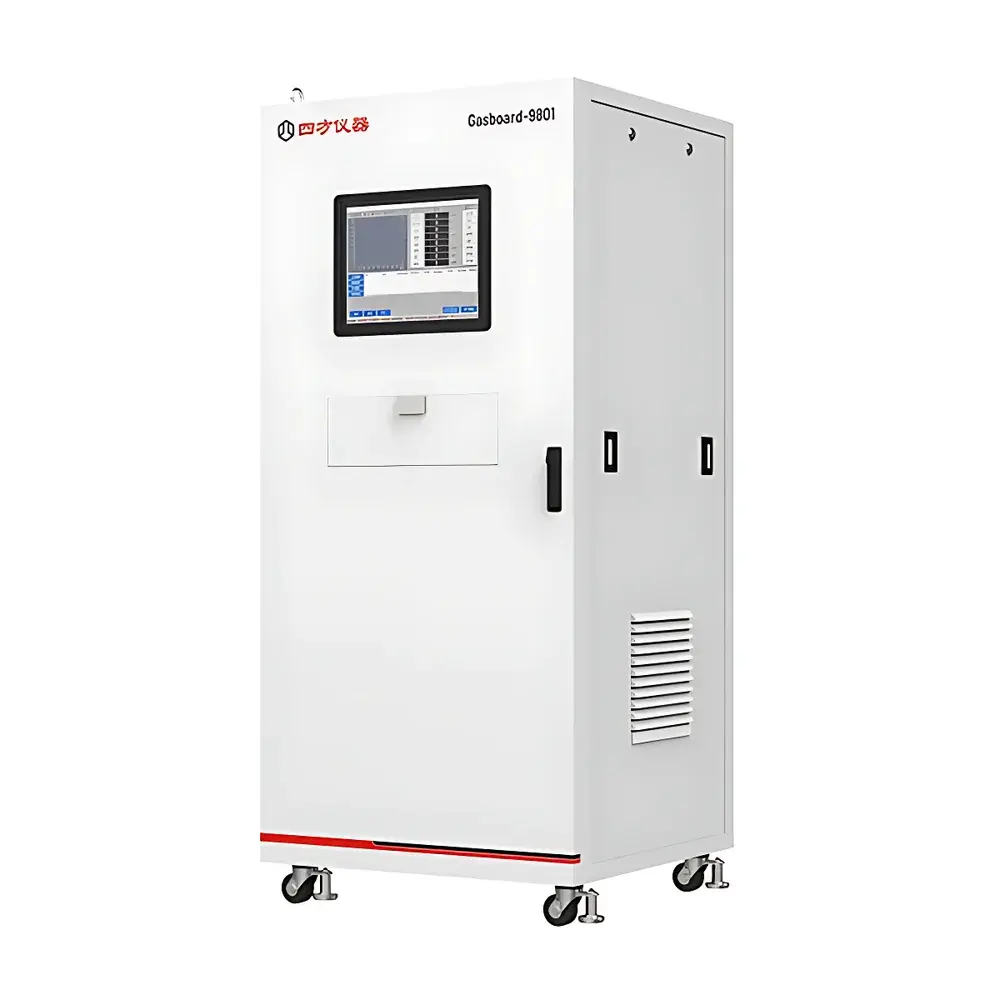
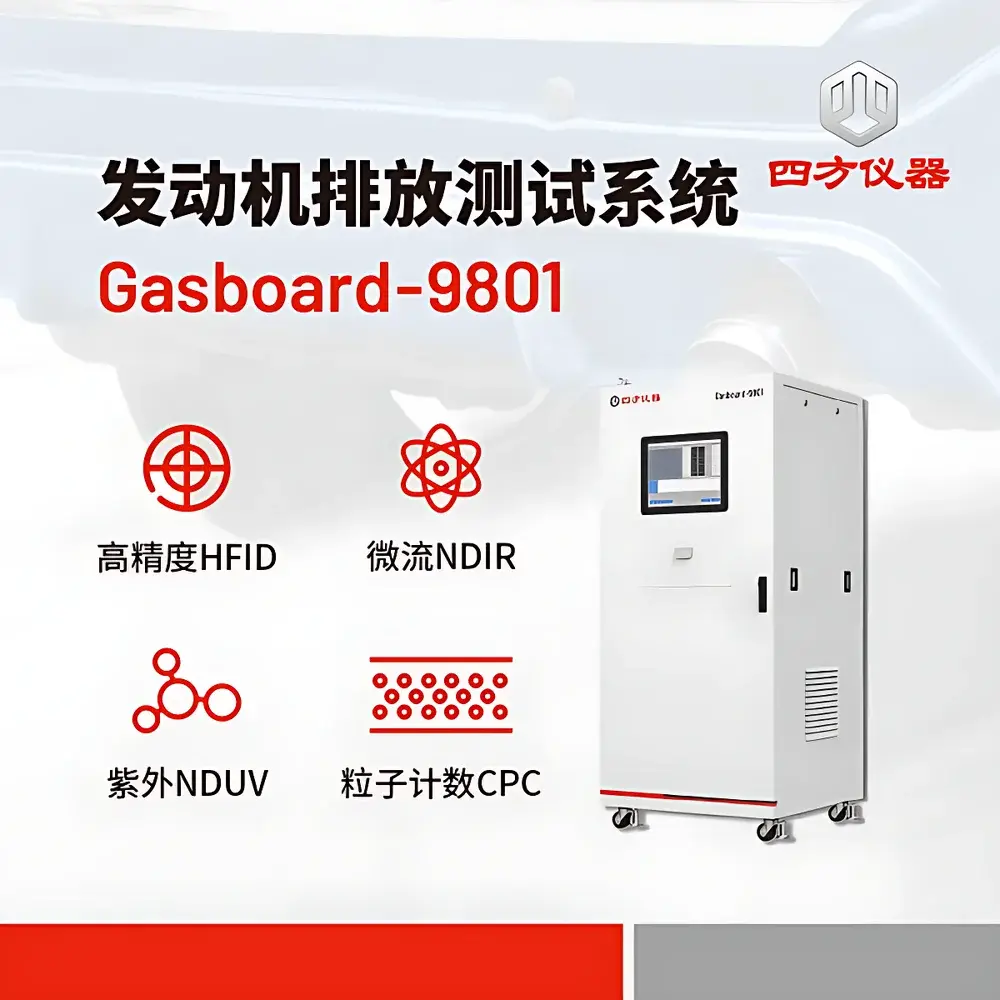
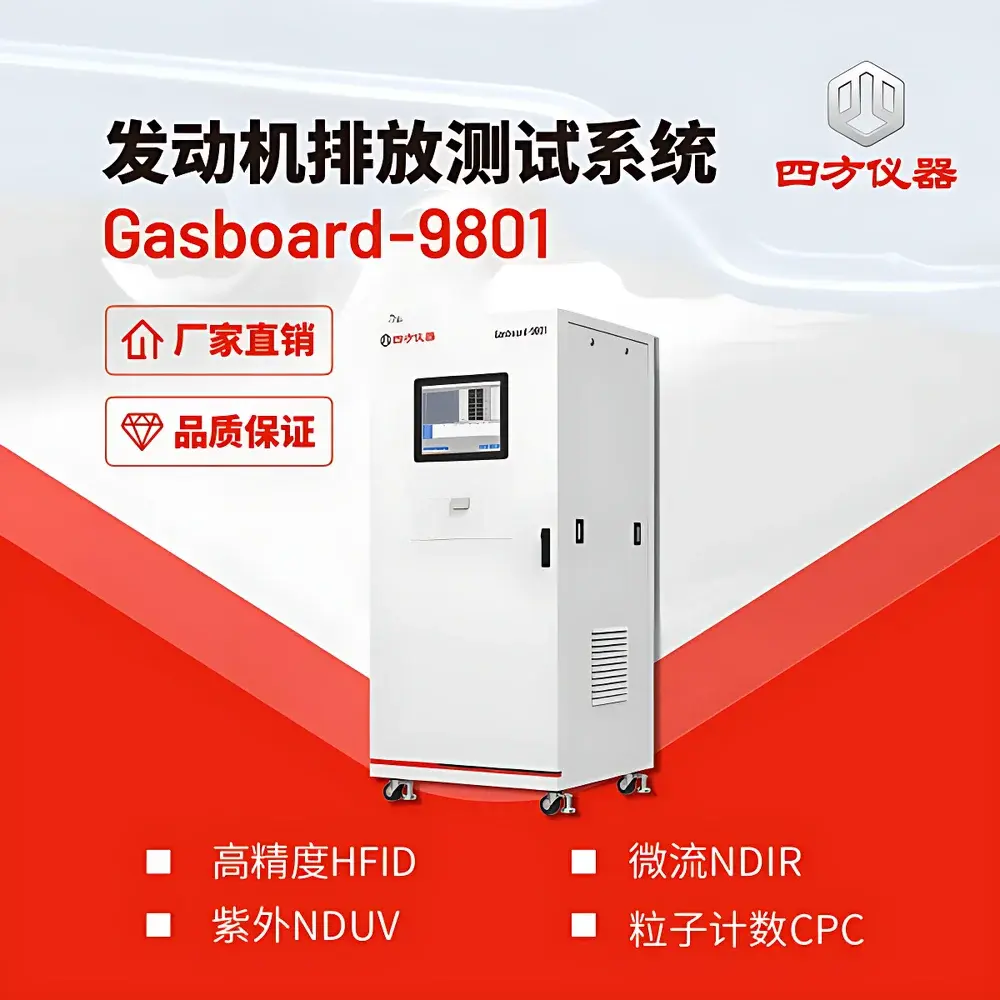
CUBIC INSTRUMENTS Gasboard-9801 Engine Emission Test System
| Brand | CUBIC INSTRUMENTS |
|---|---|
| Origin | Hubei, China |
| Model | Gasboard-9801 |
| Instrument Type | Online Analyzer |
| Detection Principle | Non-Dispersive Infrared (NDIR), Non-Dispersive Ultraviolet (NDUV), Chemiluminescence Detection (CLD), Flame Ionization Detection (FID) |
| Measured Gases | THC, CH₄, NOₓ, CO, CO₂, O₂ |
| Max. Permissible Error | ≤±2.0% of Reading Span (RS) or ≤±0.3% of Full Scale (FS) |
| Zero Drift | ≤±1% FS / 8 h |
| Span Drift | ≤±1% FS / 8 h |
| Repeatability | ≤±0.5% FS |
| Response Time (T₁₀–₉₀) | <2.5 s |
| Linearity | R² ≥ 0.998 |
| Operating Environment | 5–40 °C, ≤80% RH |
Overview
The CUBIC INSTRUMENTS Gasboard-9801 Engine Emission Test System is a fully integrated, online-capable analytical platform engineered for regulatory-grade measurement of gaseous exhaust constituents from internal combustion engines under laboratory-based full-flow dilution or raw exhaust conditions. It operates on multiple complementary spectroscopic and electrochemical detection principles—Non-Dispersive Infrared (NDIR) for CO, CO₂, and CH₄; Non-Dispersive Ultraviolet (NDUV) coupled with Chemiluminescence Detection (CLD) for NOₓ speciation; and Flame Ionization Detection (FID), including heated FID (HFID) and non-methane FID (NMC-FID), for total hydrocarbons (THC) and methane-selective quantification. Designed to meet the stringent metrological requirements of global emissions legislation, the system delivers high reproducibility, low drift, and rapid dynamic response—enabling continuous, real-time monitoring across transient engine cycles and steady-state certification protocols.
Key Features
- Multi-technology gas analysis architecture: Simultaneous NDIR (CO, CO₂, O₂), NDUV/CLD (NO, NO₂, NOₓ), and HFID/NMC-FID (THC, CH₄) modules housed in a single, thermally stabilized chassis.
- Full-scale adaptability: Configurable measurement ranges—from sub-ppm (e.g., 0–10 ppmC for THC) to high-concentration spans (e.g., 0–25% O₂)—supporting both ultra-low-emission vehicle development and legacy engine validation.
- High-fidelity signal integrity: T₁₀–₉₀ response time <2.5 seconds across all channels ensures accurate capture of fast-varying exhaust transients during WLTC, FTP-75, or RDE test cycles.
- Modular sampling interface: Supports multi-point exhaust probing, EGR ratio calculation via dual-stream O₂/CO₂ differential analysis, and integration with constant-volume samplers (CVS) or raw-gas dilution tunnels.
- Robust environmental tolerance: Certified operation within 5–40 °C ambient temperature and ≤80% RH, with internal thermal management to minimize optical path drift and detector baseline instability.
Sample Compatibility & Compliance
The Gasboard-9801 is validated for use with gasoline, diesel, natural gas (CNG/LNG), biofuel-blended, and hydrogen-combustion engine exhaust streams—including particulate-laden raw exhaust when paired with certified heated sample conditioning systems (e.g., heated filter, catalytic converter, and moisture removal). It conforms to the instrumental performance criteria specified in ISO 8178-4 (non-road engines), ISO 20025 (marine engines), UNECE Regulation No. 49 (heavy-duty vehicles), and GB 17691–2018 (China VI). Its calibration traceability aligns with NIST-traceable reference gases and supports audit-ready documentation per ISO/IEC 17025 and GLP-compliant test reporting workflows.
Software & Data Management
The embedded control software provides synchronized acquisition, real-time concentration visualization, and automated data logging at user-defined intervals (1–10 Hz). Raw analog outputs (4–20 mA, 0–10 V) and digital interfaces (RS-232, RS-485, Ethernet TCP/IP) enable seamless integration into third-party test cell controllers (e.g., AVL PUMA, Horiba MEXA) and emissions data acquisition platforms. All measurement records include timestamped metadata (flow rate, temperature, pressure, calibration status), supporting 21 CFR Part 11-compliant electronic signatures and audit trails when deployed with validated LIMS or ELN environments.
Applications
- Regulatory type-approval testing for light-duty (Euro 6d, China 6b, Euro 7), heavy-duty (Euro VI, China 6, Euro 7), and non-road mobile machinery (Stage V, China IV).
- R&D emission mapping across engine speed/load matrices, aftertreatment efficiency evaluation (e.g., SCR, DOC, DPF), and fuel formulation screening.
- Production conformity verification (PCoC) and in-use compliance monitoring per EU Commission Regulation (EU) 2017/1151 and EPA 40 CFR Part 1065.
- Marine engine certification under IMO MARPOL Annex VI Tier III and EPA Tier 4 standards.
- Calibration verification and span-check execution using certified multi-component gas standards per ISO 12039 and ASTM D6522.
FAQ
Does the Gasboard-9801 support simultaneous measurement of all six gases (THC, CH₄, NOₓ, CO, CO₂, O₂) without cross-interference?
Yes—the system employs physically separated optical paths, wavelength-specific filters, and chemically selective detectors (e.g., NMC-FID for non-methane hydrocarbons, CLD with ozone conversion for NO₂) to ensure analyte specificity and minimize spectral overlap or quenching effects.
Can it be integrated into an existing CVS tunnel system?
Yes—its analog/digital I/O architecture and configurable flow compensation algorithms allow direct interfacing with primary dilution tunnels, critical orifice banks, and bag-sampling subsystems per ISO 8178-1 and SAE J1094.
Is factory calibration traceable to international standards?
All factory calibrations are performed using NIST-traceable or equivalent national metrology institute (NMI)-certified gas standards, with full calibration certificates documenting uncertainty budgets and measurement procedures per ISO/IEC 17025 Clause 6.6.
What maintenance intervals are recommended for long-term operational stability?
Optical windows require cleaning every 200 operating hours; HFID flame nozzles and CLD ozone generators should be inspected quarterly; annual full-system verification—including zero/span checks, linearity assessment, and drift monitoring—is advised to maintain compliance with regulatory audit requirements.
Related Products







