
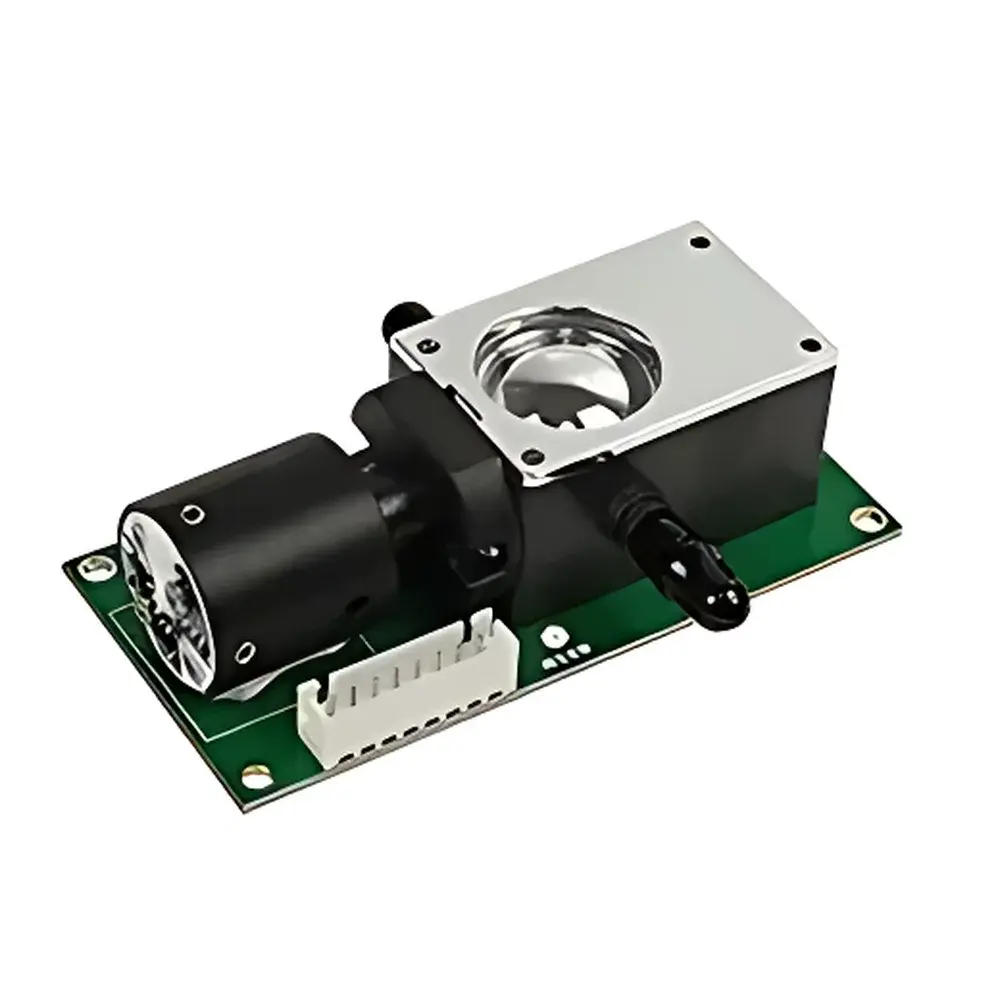
Cubic PM3003SN Laser-Based Airborne Particle Counter Sensor
| Brand | Cubic |
|---|---|
| Origin | Hubei, China |
| Model | PM3003SN |
| Detection Principle | Laser Light Scattering |
| Particle Size Channels | 0.3, 0.5, 1.0, 2.5, 5.0, 10.0 µm |
| Counting Range | 0–10,000,000 pcs/L (equivalent to 0–283,000,000 pcs/ft³) |
| Counting Efficiency | 50% at 0.3 µm |
| Warm-up Time | ≤8 s |
| Data Update Interval | 1 s |
| Operating Temperature | −30°C to +70°C |
| Operating Humidity | 0–95% RH (non-condensing) |
| Storage Temperature | −40°C to +85°C |
| Supply Voltage | DC 5.0 V ±0.1 V (ripple <50 mV) |
| Operating Current | <150 mA |
| Standby Current | <25 mA |
| Communication Interfaces | UART-TTL (3.3 V / 5 V), I²C (3.3 V / 5 V), RS-485 |
| Dimensions | 82 × 40.2 × 26.3 mm (W × H × D) |
| Compliance | JJF 1190–2008 (Calibration Specification for Airborne Particle Counters) |
Overview
The Cubic PM3003SN is a high-stability, industrial-grade laser airborne particle counter sensor engineered for continuous, real-time monitoring of particulate matter concentrations in ambient air, cleanrooms, HVAC ducts, and indoor environmental quality (IEQ) systems. It operates on the principle of single-particle laser light scattering—where particles suspended in an aerosol stream pass through a focused collimated laser beam, generating scattered light pulses proportional to their size and refractive index. These pulses are detected by a high-sensitivity photodiode array and digitally processed to classify and count particles across six discrete size bins: 0.3, 0.5, 1.0, 2.5, 5.0, and 10.0 µm. The sensor employs a linearly stabilized, long-life industrial laser diode with thermal management optimized for operation across extended temperature ranges (−30°C to +70°C), and integrates a vehicle-grade turbo fan delivering consistent volumetric flow—ensuring measurement repeatability and minimizing sampling bias under variable pressure or filter-loading conditions.
Key Features
- Multi-channel particle sizing with simultaneous real-time output for six standard size thresholds per ISO 21501-4 and JJF 1190–2008
- High-fidelity optical design featuring constant-power laser excitation and optimized detection geometry for improved counting efficiency at sub-micron sizes (50% @ 0.3 µm, ≥99% @ ≥0.5 µm)
- Robust mechanical architecture with IP5X-rated internal airflow path and conformal-coated PCBs for reliable operation in high-humidity (up to 95% RH non-condensing) and thermally demanding environments
- Triple communication interface support: UART-TTL (3.3 V / 5 V logic compatible), I²C (address-configurable), and isolated RS-485 for integration into distributed building management systems (BMS) or industrial PLC networks
- Low power envelope (<150 mA active, <25 mA standby) enabling deployment in battery-backed or energy-constrained edge-monitoring nodes
- Fast system readiness: full photometric stabilization achieved within ≤8 seconds after power-on, supporting rapid-response applications such as emergency ventilation control or filter integrity verification
Sample Compatibility & Compliance
The PM3003SN is validated for use with ambient air, filtered supply air, and recirculated indoor air streams. It does not require external dilution or conditioning for typical indoor or light-industrial aerosol matrices. Calibration traceability follows JJF 1190–2008, the national metrological calibration specification for airborne particle counters in China, and aligns with international performance benchmarks defined in ISO 21501-4:2018 (Determination of particle size distribution — Single particle light interaction methods). While not certified to ISO 14644-1 cleanroom classification protocols as a standalone instrument, it meets the minimum sensitivity and counting efficiency requirements for Class 5–8 cleanroom monitoring when integrated into validated OEM systems. The sensor’s electrical design complies with IEC 61000-4 immunity standards for electrostatic discharge (ESD), radiated RF fields, and fast transient bursts.
Software & Data Management
Raw particle count data is delivered via configurable serial frames (UART/I²C) or Modbus RTU over RS-485, enabling seamless ingestion into SCADA platforms, cloud-based IoT dashboards (e.g., AWS IoT Core, Azure IoT Hub), or local embedded controllers. Firmware supports user-defined averaging intervals (1–60 s), channel masking, and alarm threshold registers for autonomous triggering. All communication protocols include CRC error checking and frame synchronization to ensure data integrity in electrically noisy environments. For regulatory traceability, OEM integrators may implement audit-trail logging and timestamped data storage compliant with FDA 21 CFR Part 11 requirements—provided host-system-level security controls (user authentication, electronic signatures, and immutable logs) are implemented externally.
Applications
- Real-time indoor air quality (IAQ) monitoring in smart buildings, schools, hospitals, and office complexes
- Filter performance validation and predictive maintenance in HVAC and air purification systems
- OEM integration into portable air quality monitors, wearable exposure trackers, and unmanned aerial vehicle (UAV)-based atmospheric profiling platforms
- Process air monitoring in pharmaceutical manufacturing (non-sterile zones), electronics assembly, and food packaging facilities
- Environmental research deployments requiring stable, low-drift particle concentration baselines across seasonal temperature and humidity gradients
FAQ
What is the recommended upstream filtration for optimal PM3003SN performance?
A 0.1 µm pore-size pre-filter is advised when sampling from dusty or oil-laden airstreams to prevent optical window contamination and extend recalibration intervals.
Does the sensor support automatic zero-check or background subtraction?
No—zero calibration requires external clean-air purge (e.g., HEPA-filtered N₂ or compressed air) and is performed manually during factory calibration or field service.
Can the PM3003SN be used in outdoor ambient monitoring applications?
Yes, provided it is housed in a weather-resistant enclosure with inlet heating/dehumidification to prevent condensation and particulate deposition on the sensing chamber.
Is firmware update capability available over communication interfaces?
Firmware updates are supported only via UART-TTL using proprietary bootloader protocol; I²C and RS-485 are read-only for operational data streaming.
How does the sensor handle coincidence error at high concentrations?
Coincidence loss correction is applied algorithmically above 500,000 pcs/L based on Poisson statistical modeling embedded in the signal processor—validating linearity up to 10⁷ pcs/L per JJF 1190–2008 Annex B.







