
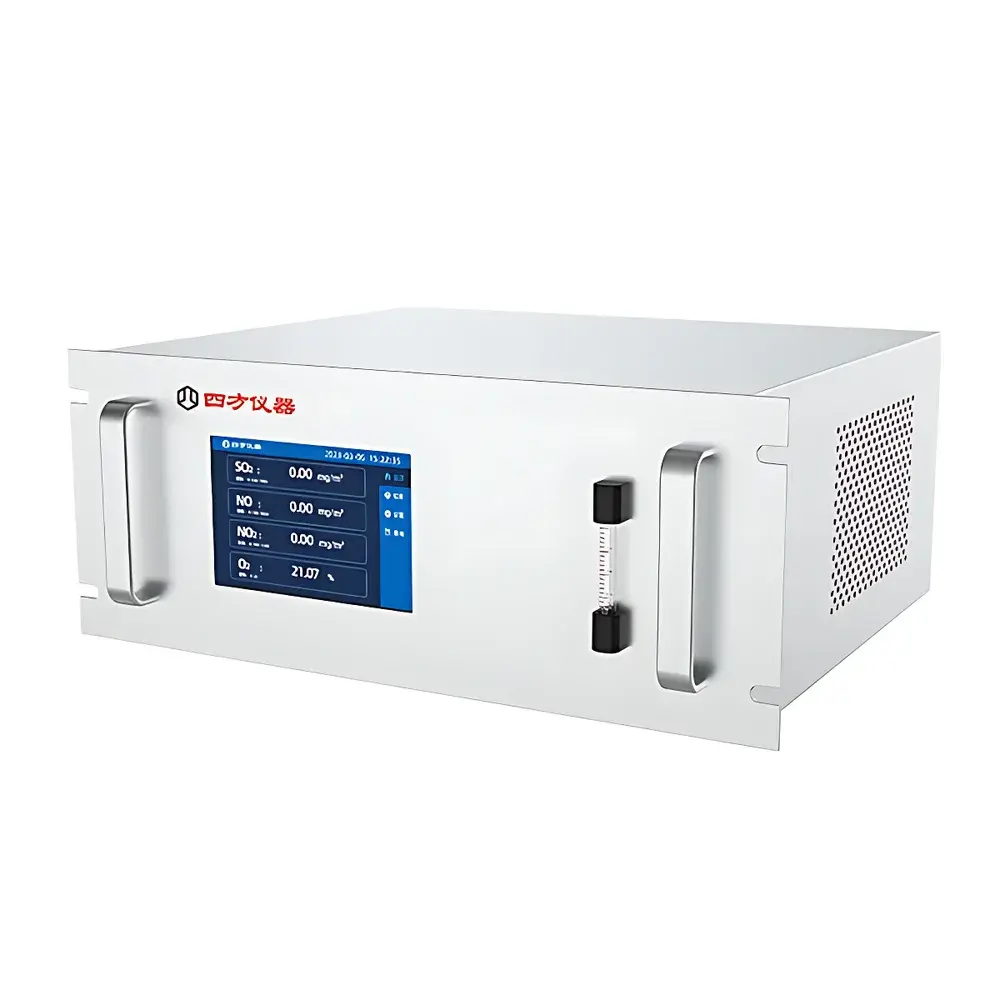

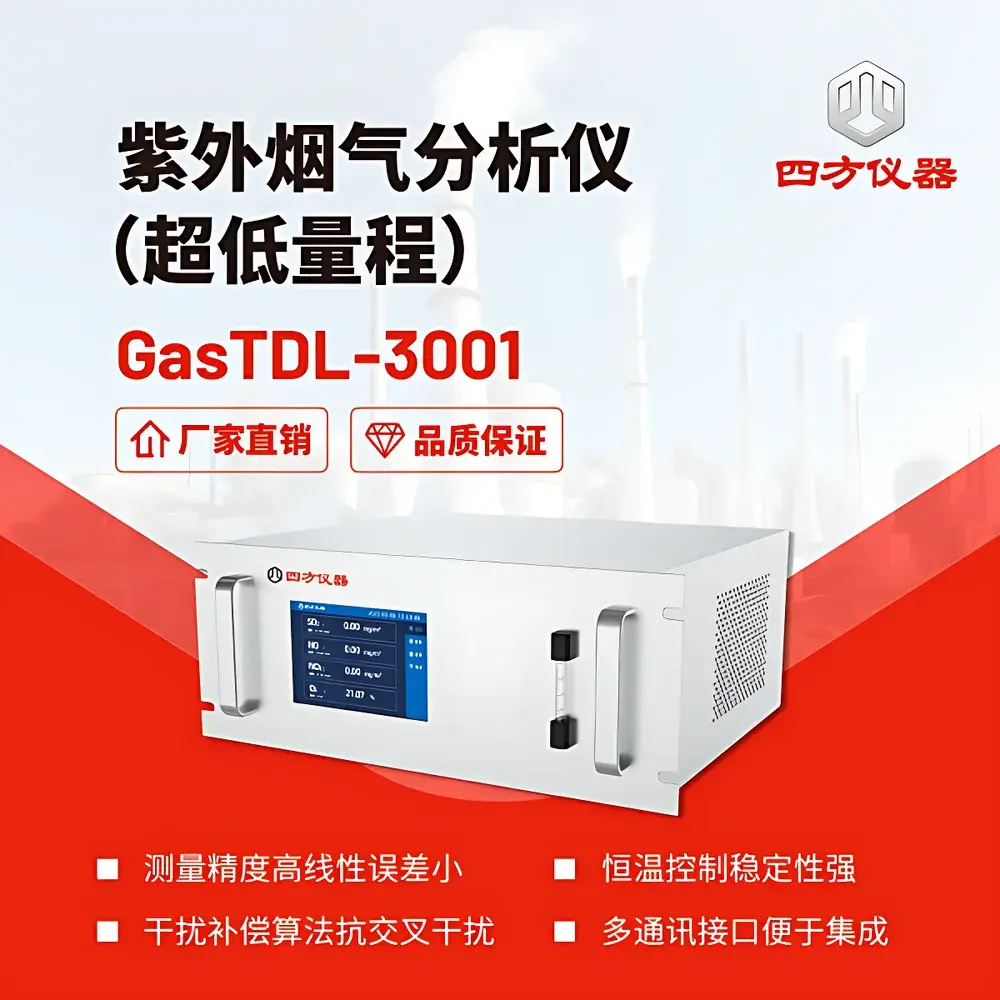
CUBIC Gasboard-3000UV UV-DOAS Flue Gas Analyzer for Desulfurization and Denitrification Monitoring
| Brand | CUBIC INSTRUMENTS |
|---|---|
| Model | Gasboard-3000UV |
| Measurement Principle | UV-Differential Optical Absorption Spectroscopy (UV-DOAS) for SO₂, NO, NO₂ |
| Measurement Range | SO₂/NO/NO₂: 0–100 mg/m³ |
| O₂ | 0–25% (selectable) |
| Accuracy | ±2% F.S. |
| Repeatability | ≤2% |
| Response Time (T₉₀) | ≤30 s |
| Stability | ≤±2% F.S./24 h |
| Linearity Error | ≤±2% F.S. |
| Sample Requirements | Liquid-free, particulate filtered (<1 µm) |
| Operating Humidity | 5–85% RH |
| Ambient Pressure | 86–108 kPa |
| Communication | Dual RS-232/RS-485, Modbus RTU protocol (customizable) |
| Power Supply | AC 220 V, 50 Hz |
| Max Power Consumption | 200 W |
Overview
The CUBIC Gasboard-3000UV is an online ultraviolet differential optical absorption spectroscopy (UV-DOAS) flue gas analyzer engineered for continuous, real-time monitoring of sulfur dioxide (SO₂), nitrogen monoxide (NO), and nitrogen dioxide (NO₂) in high-dust, high-moisture industrial exhaust streams—particularly from iron and steel metallurgical processes. Complementing UV-DOAS with electrochemical detection (ECD) for oxygen (O₂), the instrument delivers simultaneous multi-component analysis under demanding stack conditions. Its core optical architecture employs a long-path, multi-reflection gas cell combined with high-stability xenon lamp excitation and optimized spectral deconvolution algorithms to resolve overlapping absorption features of target gases—enabling sub-10 mg/m³ quantification with robust interference rejection. Designed to meet China’s ultra-low emission standards (e.g., HJ 75–2017, HJ 1045–2019) and compatible with international regulatory frameworks including EU BREF reference methods and EPA Method 6C/7E principles, the Gasboard-3000UV supports compliance-driven data acquisition in desulfurization (FGD) and selective/non-selective catalytic reduction (SCR/SNCR) systems.
Key Features
- UV-DOAS measurement for SO₂, NO, and NO₂ with spectral resolution <0.5 nm and dedicated peak selection to minimize cross-sensitivity between NO₂ and NO
- Integrated ECD sensor for O₂ with temperature-compensated calibration and drift correction over extended operation cycles
- Thermostatically controlled optical bench (±0.1 °C stability) to mitigate thermal-induced baseline shift and wavelength drift
- Multi-pass reflective gas cell (effective path length >1.2 m) enhancing absorbance signal-to-noise ratio and enabling low-concentration detection down to 1 mg/m³
- Dual isolated serial interfaces (RS-232 and RS-485) supporting Modbus RTU protocol for seamless integration with environmental data acquisition systems (DAQ), DCS, and SCADA platforms
- Industrial-grade 4U rack-mount chassis with IP20-rated enclosure, EMI-hardened circuitry, and redundant power filtering for plant-floor deployment
Sample Compatibility & Compliance
The Gasboard-3000UV accepts conditioned flue gas samples meeting standard pre-treatment requirements: particulate filtration to <1 µm, removal of free liquid droplets via coalescing or thermoelectric chillers, and optional heated sample line (up to 180 °C) to prevent condensation. It operates reliably across ambient humidity (5–85% RH) and barometric pressure (86–108 kPa) ranges typical of steel mill stack environments. The analyzer conforms to national verification procedures outlined in JJG 968–2022 (Flue Gas Analyzer Verification Regulation) and supports audit-ready traceability through built-in calibration event logging. Data output meets China’s “Technical Specification for Continuous Emission Monitoring Systems (CEMS)” (HJ 75–2017) for reporting frequency, uncertainty calculation, and zero/span validation intervals. While not certified to EN 15267 or MCERTS, its measurement methodology aligns with ISO 12039 and ASTM D6522 for UV-based gas quantification.
Software & Data Management
Embedded firmware provides local display, manual calibration control, and real-time concentration trending via a 7-inch resistive touchscreen interface. All operational parameters—including lamp intensity, detector gain, spectral baseline, and zero/span history—are logged with UTC timestamps and stored internally for ≥30 days. Raw spectral data and processed results are exportable via USB or serial port in CSV format. Optional CUBIC CEMS-Link software enables remote configuration, diagnostic monitoring, and automated report generation compliant with HJ 212–2017 data transmission protocols. Audit trails include user authentication, parameter changes, and calibration actions—supporting GLP-aligned record integrity where required.
Applications
- Real-time performance evaluation of wet limestone-gypsum FGD scrubbers and circulating fluidized bed (CFB) desulfurization units
- Monitoring NH₃ slip and NOₓ conversion efficiency across SCR/SNCR reactors in sintering machines, blast furnaces, and coke oven batteries
- Stack compliance verification for integrated steelworks subject to GB 16297–1996 and local ultra-low emission thresholds (e.g., ≤35 mg/m³ SO₂, ≤50 mg/m³ NOₓ)
- Process optimization support for combustion air ratio control and reagent dosing feedback loops
- Long-term emissions inventory compilation for corporate sustainability reporting and carbon accounting frameworks
FAQ
What gas components does the Gasboard-3000UV measure, and how are they detected?
SO₂, NO, and NO₂ are measured using UV-DOAS with a xenon lamp source and CCD spectrometer; O₂ is measured independently via electrochemical detection.
Is the instrument suitable for high-dust flue gas without external conditioning?
No—it requires upstream particulate filtration (<1 µm) and liquid removal; it is not designed for raw, unconditioned stack gas.
Can the Gasboard-3000UV be integrated into existing CEMS infrastructure?
Yes—via RS-485 Modbus RTU, it interfaces directly with most Chinese CEMS data acquisition units and supports HJ 212–2017 packet structure.
How often must the system undergo zero and span calibration?
Per HJ 75–2017, automatic or manual zero/span checks are recommended every 24 hours; full verification with certified standard gases is required weekly.
Does the analyzer provide uncertainty estimates per measurement?
Yes—total measurement uncertainty is calculated in real time based on signal noise, calibration gas uncertainty, and environmental drift compensation, and reported alongside each concentration value.







