
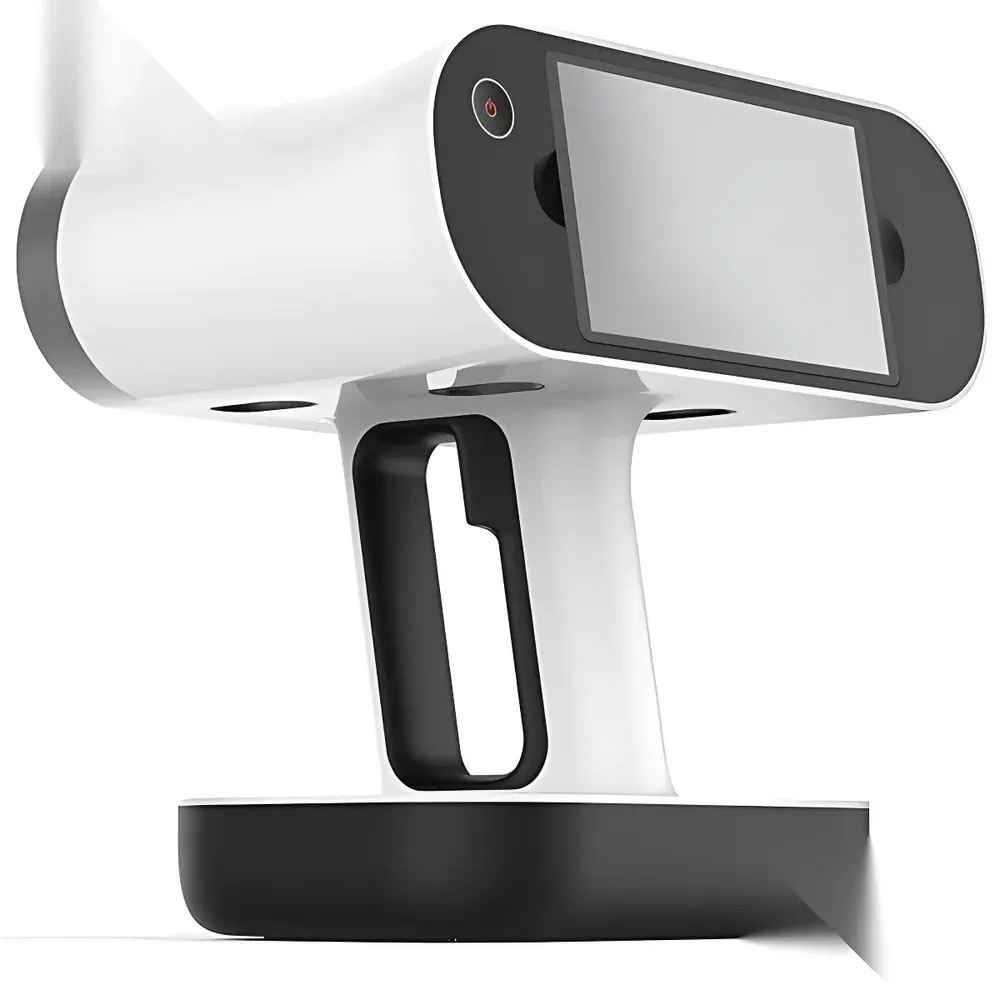

Artec Leo Portable High-Precision Color Handheld 3D Scanner
| Brand | Artec |
|---|---|
| Origin | Imported (Non-China) |
| Manufacturer Type | Authorized Distributor |
| Model | LEO |
| 3D Resolution | 0.25 mm |
| 3D Point Accuracy | ≤0.1 mm |
| Accuracy Drift | ≤0.03% per 100 cm |
| Light Source | Dual-mode — White-light LED Array (12 LEDs) + VCSEL for 3D Structured Light |
| Near-Range FOV | 246 × 153 mm |
| Far-Range FOV | 843 × 527 mm |
| Working Distance | 0.35–1.2 m |
| Texture Capture | Yes |
| Video Frame Rate | ≤80 FPS |
| Data Acquisition Time | 0.0002 s per frame |
| Data Capture Speed | ≤4 million points/sec |
| Weight | 1.8 kg |
| Power | Rechargeable Internal Battery or 12 V DC Input |
| Dimensions (H×D×W) | 227 × 163 × 228 mm |
| Connectivity | Wi-Fi, Gigabit Ethernet, SD Card Slot |
| Onboard Processing | NVIDIA Tegra Platform + FPGA + 9-DOF IMU |
| Real-time Onscreen Reconstruction | Yes |
| Calibration | Self-contained, no external calibration required |
Overview
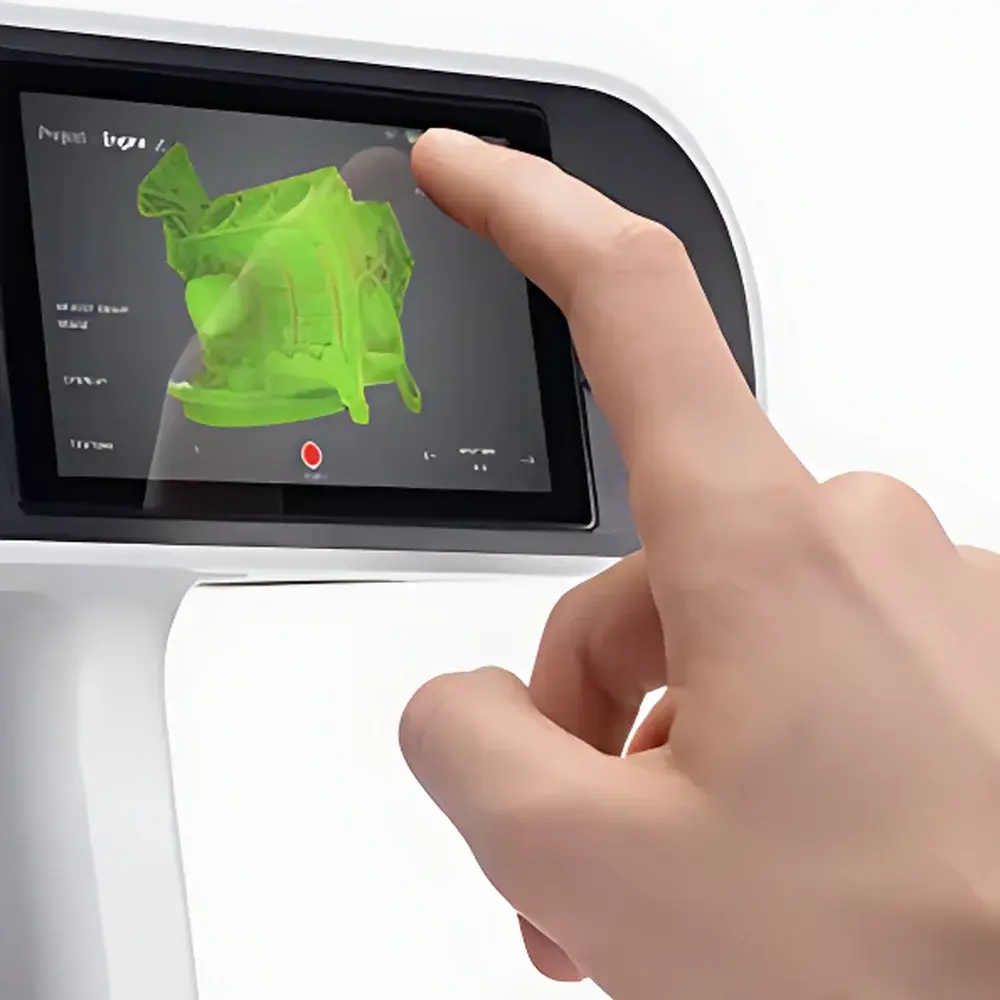
The Artec Leo is a professional-grade, fully autonomous handheld 3D scanner engineered for high-fidelity geometric and photorealistic texture acquisition in field and industrial environments. Unlike tethered scanning systems, the Leo integrates a complete embedded computing platform—including an NVIDIA Tegra processor, programmable FPGA, and dedicated GPU—enabling real-time surface reconstruction directly on its built-in 5.5-inch HD touchscreen. Its measurement principle relies on dual-mode structured light projection: white-light LED arrays deliver high-contrast texture mapping, while a VCSEL (Vertical-Cavity Surface-Emitting Laser) module projects high-frequency fringe patterns for sub-millimeter depth triangulation. This hybrid optical architecture ensures consistent accuracy across varying surface reflectivity, curvature, and ambient lighting conditions—critical for applications demanding traceable dimensional fidelity under ISO/IEC 17025-aligned workflows.
Key Features
- Fully self-contained operation: No external PC, cables, or power supply required—powered by hot-swappable lithium-ion battery with >60 minutes continuous runtime; optional extended-life batteries support remote or mobile deployments.
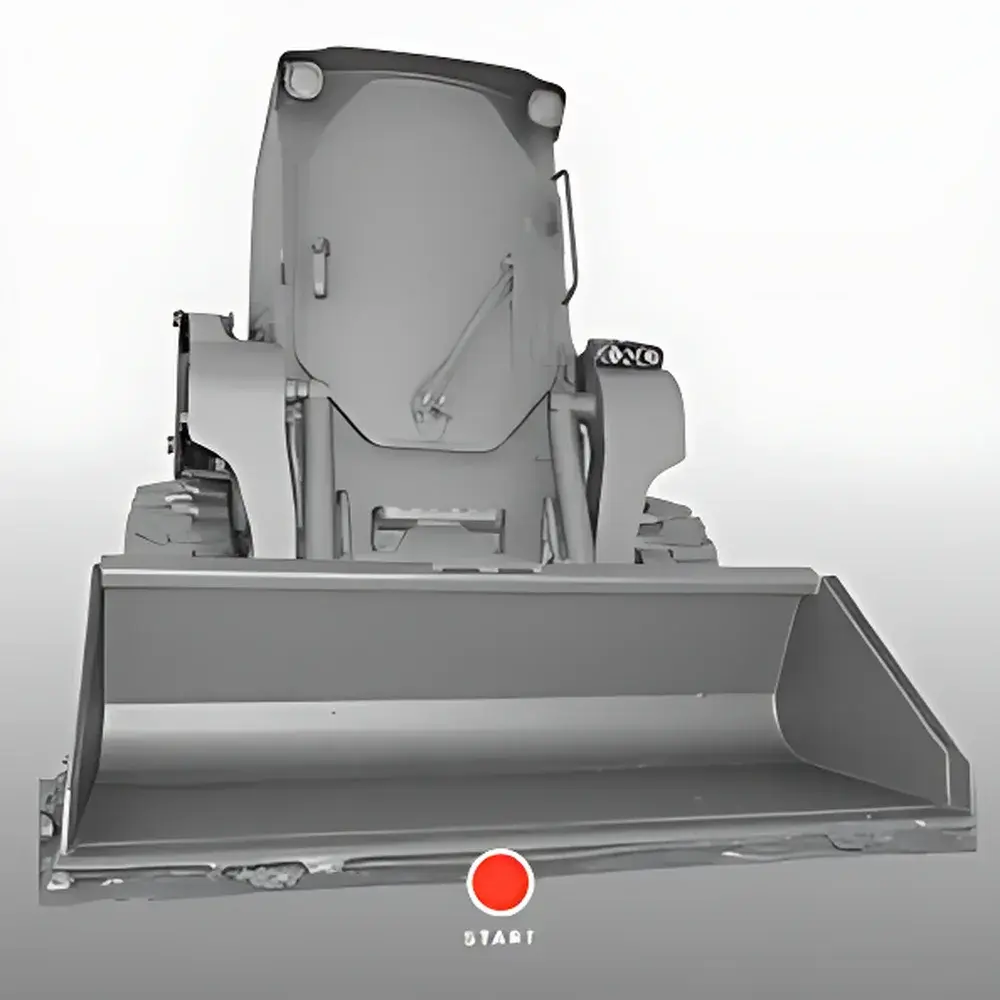
- Real-time visual feedback: Live 3D mesh generation displayed on integrated touchscreen during acquisition; users rotate objects, verify coverage completeness, and dynamically re-scan occluded regions without post-processing latency.
- Advanced inertial tracking: Integrated 9-degree-of-freedom IMU (triaxial accelerometer, gyroscope, magnetometer) enables robust motion compensation and spatial orientation estimation—essential for large-volume scans and non-static subjects such as human anatomy or vehicle exteriors.
- Adaptive working envelope: Switches seamlessly between near-field (246 × 153 mm at 0.35 m) and far-field (843 × 527 mm at 1.2 m) modes; maintains ≤0.1 mm point accuracy within nominal range and exhibits linear accuracy decay of ≤0.03% per meter—fully documented per ASTM E2924-21 guidelines for optical 3D metrology validation.
- Industrial-grade ruggedization: IP54-rated enclosure withstands dust ingress and incidental water exposure; ergonomic single-hand grip design minimizes operator fatigue during prolonged QC inspections or forensic documentation sessions.
Sample Compatibility & Compliance
The Artec Leo captures geometry and true-color texture from diverse material classes—including matte plastics, painted metal, human skin, composite laminates, and weathered organic surfaces—without requiring spray-based contrast enhancement. Its dual-light-source system mitigates specular reflection artifacts common in conventional laser scanners. The device complies with CE, FCC, and RoHS directives. While not certified as medical device hardware under FDA 21 CFR Part 820, its output data meets ISO 12836-1:2021 requirements for 3D scanning systems used in dimensional verification, and supports audit-ready metadata logging compatible with GLP/GMP documentation frameworks when paired with Artec Studio’s optional 21 CFR Part 11-compliant software module.
Software & Data Management
All processing—including alignment, global registration, noise filtering, hole filling, and polygonal mesh optimization—is executed onboard using Artec’s proprietary real-time engine. Scanned data exports natively to industry-standard formats: OBJ, STL, PLY, AOP, and PTX. For enterprise integration, the Leo supports automated over-the-air firmware updates via Wi-Fi and batch data synchronization to network-attached storage or cloud repositories through Gigabit Ethernet. SD card logging enables offline operation in secure or low-connectivity zones (e.g., crime scenes, offshore platforms), with timestamped, cryptographically signed acquisition logs available for chain-of-custody reporting.
Applications
- Quality Control & Reverse Engineering: Rapid digitization of machined parts, tooling, and assemblies for GD&T analysis against CAD models; supports first-article inspection per ASME Y14.5-2018 standards.
- Forensic Documentation: Non-contact capture of evidence—footwear impressions, tire marks, bullet trajectories, and trauma morphology—with georeferenced texture overlays suitable for courtroom visualization.
- Healthcare & Orthotics: Patient-specific anatomical modeling for prosthetic socket design, craniofacial surgery planning, and biomechanical gait analysis—validated in peer-reviewed clinical studies (e.g., J. Med. Eng. Technol., Vol. 46, 2022).
- Cultural Heritage Preservation: High-resolution archival scanning of sculptures, artifacts, and architectural elements with sub-millimeter repeatability across multi-session acquisitions.
- Automotive & Aerospace: In-situ inspection of composite panels, turbine blades, and body-in-white components—compatible with OEM digital twin pipelines leveraging Siemens Teamcenter or Dassault ENOVIA.
FAQ
Does the Artec Leo require a connected computer to operate?
No—the scanner functions autonomously with full onboard processing, storage, and display. A PC is only needed for advanced post-processing or long-term archive management.
Can the Leo scan shiny or black surfaces without surface treatment?
Yes—its adaptive VCSEL+LED illumination system dynamically adjusts exposure and fringe frequency to maintain stable point cloud density on challenging surfaces, though extreme specular reflectivity may still benefit from localized matte spray per ISO 10360-8 recommendations.
Is calibration traceable to national standards?
The Leo performs automatic internal calibration prior to each scan session; full volumetric verification reports—including length, angle, and form error metrics—can be generated using Artec’s certified calibration artifact suite, compliant with ISO/IEC 17025-accredited lab procedures.
What is the maximum recommended scan volume for a single uninterrupted acquisition?
While technically capable of capturing volumes exceeding 5 m³, optimal accuracy retention is achieved within 2–3 m³ per session; larger objects are best acquired via multi-station alignment using fiducial markers or natural feature matching.
How is data security handled during wireless transfer?
Wi-Fi communication uses WPA3-Enterprise encryption; all exported datasets include SHA-256 checksums and optional AES-256 encryption keys managed via Artec Studio’s enterprise policy engine.




