
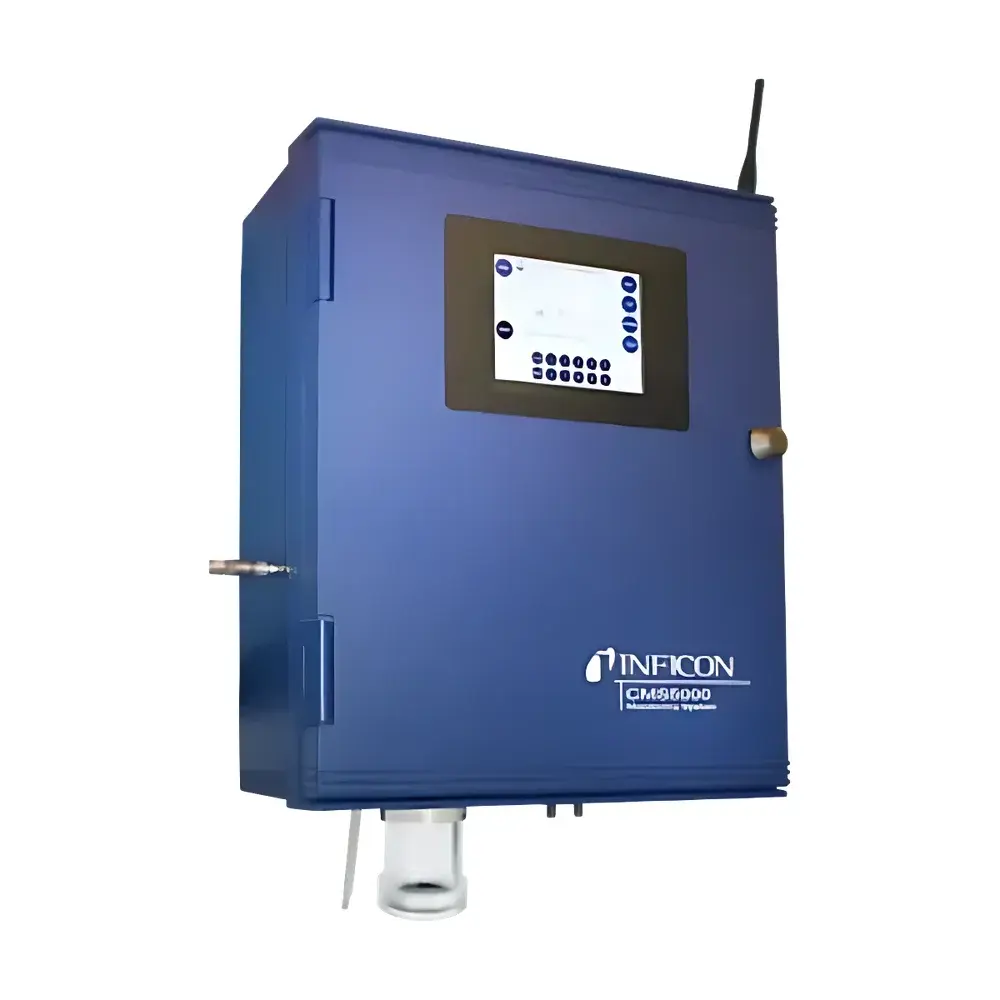
INFICON CMS5000 VOC Online Automatic Monitoring System
| Brand | INFICON |
|---|---|
| Origin | USA |
| Model | CMS5000 |
| Detection Principle | Purge-and-Trap GC with Micro-Ar Ionization Detector (MAID) |
| Regulatory Compliance | Designed per US EPA Method 502.2 |
| Sample Matrix | Raw water, finished drinking water, and treated water streams |
| Detection Limit | Sub-ppt (parts-per-quadrillion) for halogenated VOCs |
| Calibration Standard | Integrated long-life permeation tube (≥8 years) |
| Communication | Ethernet/Wi-Fi, FTP auto-reporting, remote method selection & data access |
| Enclosure Rating | NEMA 4X wall-mountable housing |
| Software | CMS IQ (programmable sequence control, default EPA methods, audit-trail enabled) |
| Maintenance Interval | <1 service/year (excluding purge water flush) |
| Carrier Gas | Ultra-high-purity argon (1.6 m³ cylinder lasts >12 months) |
Overview
The INFICON CMS5000 VOC Online Automatic Monitoring System is a fully automated, field-deployable gas chromatography (GC)-based analytical platform engineered for unattended, real-time monitoring of volatile organic compounds (VOCs) and toxic industrial chemicals (TICs) in drinking water and raw water sources. Built upon the proven architecture of the CMS100 and CMS200 series, the CMS5000 implements a modified US EPA Method 502.2-compliant purge-and-trap preconcentration workflow, coupled with high-resolution capillary GC separation and micro-argon ionization detection (MAID). Its core measurement principle relies on quantitative extraction of VOCs from aqueous matrices via inert-gas sparging, cryo-focusing onto a sorbent trap, thermal desorption into the GC column, and selective ionization of compounds with ionization potentials ≤11.7 eV—enabling reliable detection of chloromethanes, chloroethanes, and other low-volatility, high-toxicity analytes that elude conventional photoionization or flame ionization detectors. The system operates continuously with no operator intervention required after commissioning, delivering quantitative concentration data—traceable to NIST-traceable standards—with retention time stability of ±1 second over extended runs and peak area RSDs <3% across multi-week deployments.
Key Features
- True unattended operation: Fully autonomous sampling, purging, trapping, GC analysis, and reporting—no manual intervention needed beyond periodic purge-water container cleaning.
- SituProbe™ integrated purge-and-trap module: Enables direct in-line analysis of turbid, particulate-laden, or untreated water without filtration or pretreatment; compatible with continuous flow applications.
- Micro-Argon Ionization Detector (MAID): Offers sub-ppt (parts-per-quadrillion) detection limits for halogenated VOCs and other low-IP compounds, with inherent resistance to humidity and matrix interferences.
- Long-life calibration infrastructure: Internal permeation tube standard with ≥8-year certified stability; eliminates frequent external standard injections and reduces calibration drift due to seasonal temperature fluctuations.
- NEMA 4X wall-mount enclosure: Hermetically sealed for outdoor or utility-room deployment; IP66-rated against dust and water ingress; integrated status display for real-time diagnostics.
- Low operational overhead: Argon consumption optimized to <1.6 m³/year; no consumable traps or columns requiring routine replacement under normal operation.
Sample Compatibility & Compliance
The CMS5000 is validated for direct analysis of potable water, groundwater, surface water, and process water at any stage of treatment—including raw intake, post-filtration, and finished distribution points. It complies with the analytical performance criteria outlined in US EPA Method 502.2 for VOC quantification and supports regulatory reporting under the Safe Drinking Water Act (SDWA). The capillary column configuration is optimized for selectivity toward EPA-listed priority VOCs (e.g., benzene, trichloroethylene, vinyl chloride), while maintaining resolution of co-eluting isomers in Restek MegaMix-60 reference mixtures. All data acquisition, processing, and storage adhere to GLP/GMP-aligned practices, with optional 21 CFR Part 11 compliance achievable through CMS IQ software configuration (electronic signatures, audit trails, user role management).
Software & Data Management
CMS IQ software provides full lifecycle control—from method definition and sequence scheduling to report generation and remote diagnostics. Preloaded default methods conform to EPA 502.2 and include automated internal standard correction, retention time locking, and peak integration validation rules. All analyses generate timestamped, metadata-rich result files (.csv/.xml) with embedded QC flags. Results are automatically transmitted via secure FTP to centralized servers or cloud-based LIMS platforms. Remote access enables method switching, diagnostic review, and firmware updates over Ethernet or Wi-Fi. Internal memory retains ≥30 days of raw chromatograms and processed results; data export supports ISO/IEC 17025 traceability requirements including instrument ID, calibration history, and environmental logs.
Applications
- Continuous compliance monitoring for regulated VOCs in municipal drinking water systems (per SDWA and state-level TTHM/HAA5 programs).
- Early-warning detection of accidental or intentional contamination events in source water intakes or distribution networks.
- Performance verification of granular activated carbon (GAC) or air-stripping treatment units.
- Industrial effluent screening at wastewater discharge points where halogenated solvents or petrochemical residues are present.
- Research-grade longitudinal studies of VOC fate and transport in aquifer recharge systems or riverine environments.
FAQ
Does the CMS5000 require sample filtration prior to analysis?
No. The SituProbe™ purge module is designed to handle turbid, high-suspended-solid water without clogging or performance degradation—eliminating the need for inline filters or pretreatment steps.
How often must the system be calibrated?
The integrated permeation tube delivers automatic daily internal standard injections; no manual calibration is required for up to 8 years under normal operating conditions.
Can the CMS5000 detect chlorinated methanes such as chloroform and carbon tetrachloride?
Yes. MAID’s low ionization potential (11.7 eV) ensures robust, selective response to all EPA Method 502.2 target halomethanes and haloethanes, down to sub-ppt levels.
Is remote troubleshooting supported?
Yes. Full bidirectional communication via Ethernet or Wi-Fi enables real-time remote diagnostics, method modification, and firmware updates without site visits.
What regulatory standards does the CMS5000 support out-of-the-box?
US EPA Method 502.2 for VOC analysis in drinking water; configurable for ISO 10301, ASTM D5059, and EU Directive 98/83/EC Annex II parameters with appropriate method validation.







