
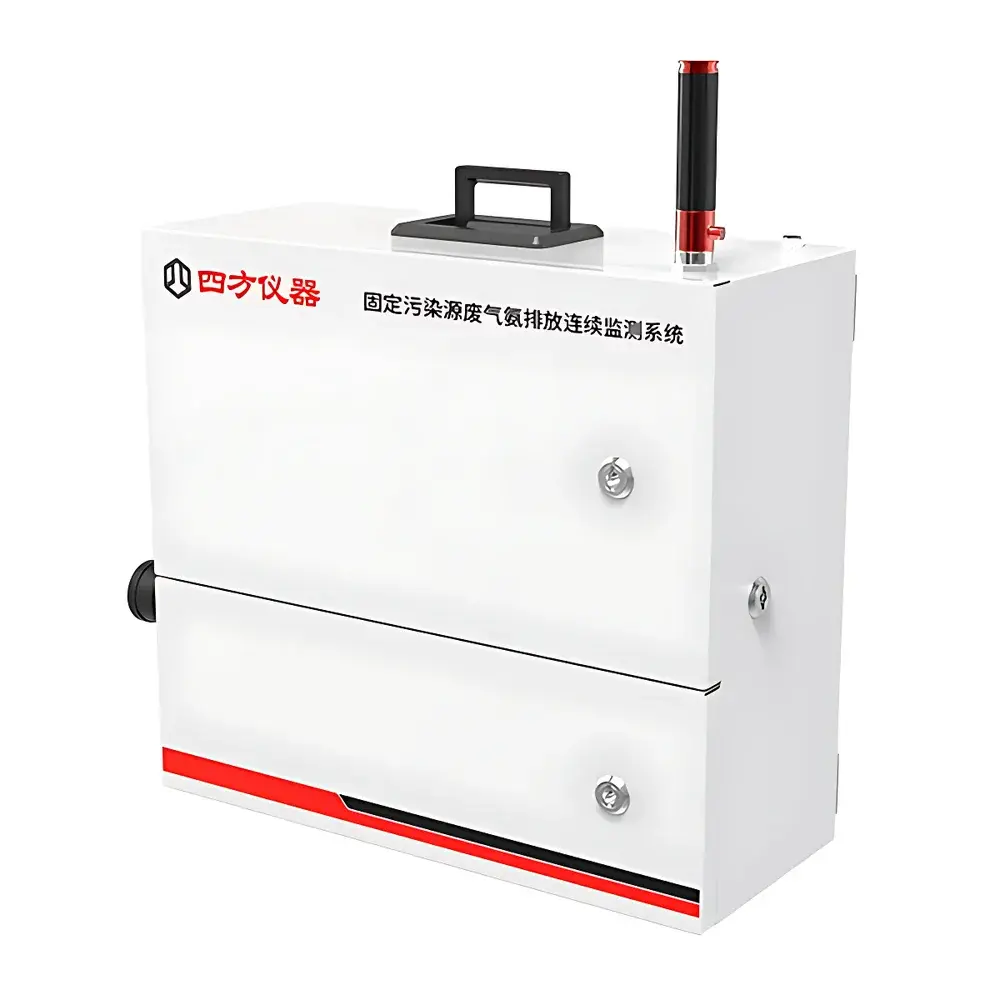
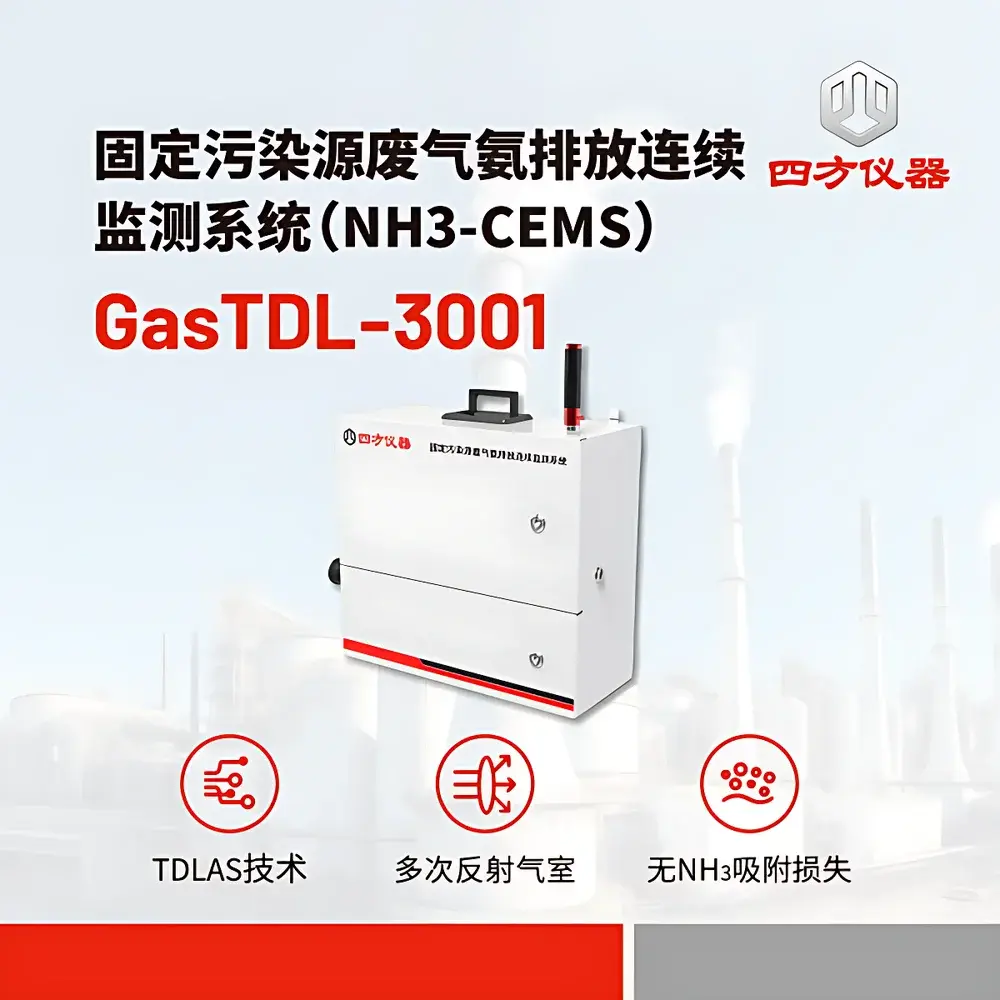
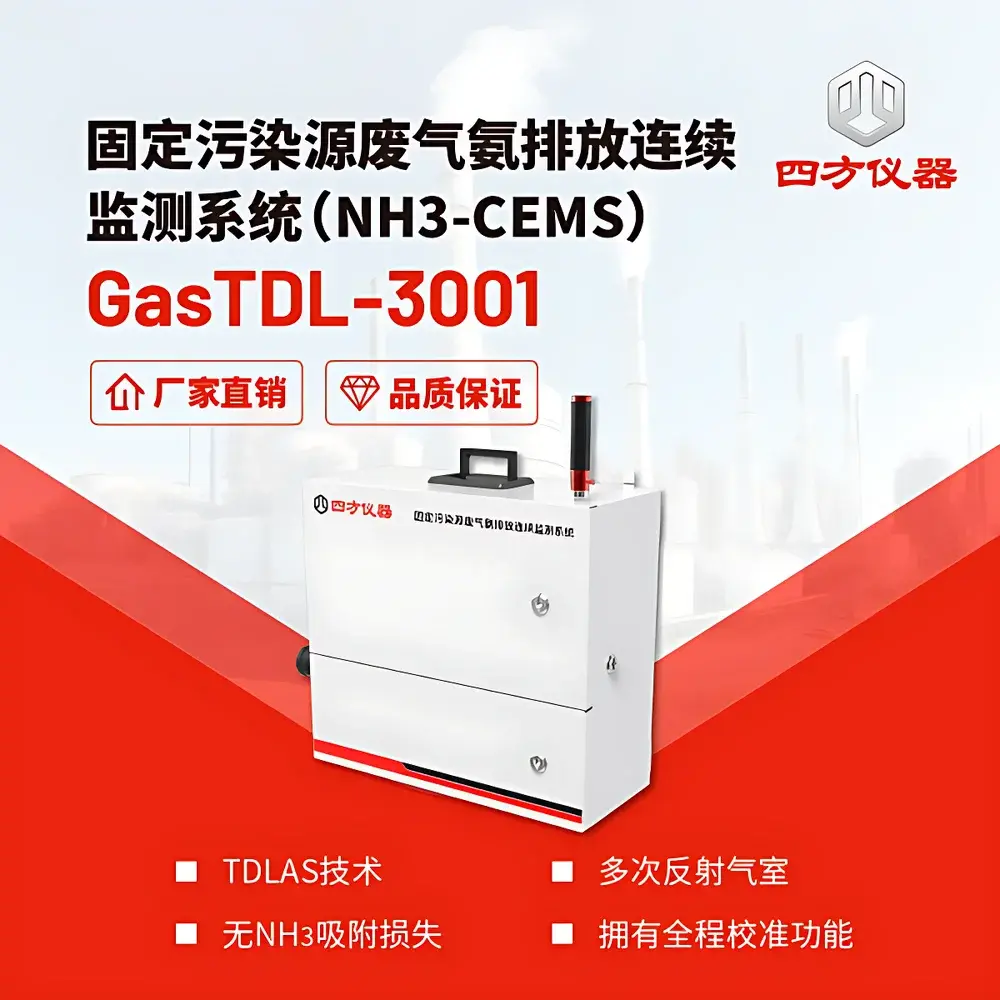
CUBIC INSTRUMENTS GasTDL-3001 Tunable Diode Laser Absorption Spectroscopy (TDLAS) Ammonia Slip Analyzer
| Brand | CUBIC INSTRUMENTS |
|---|---|
| Origin | Hubei, China |
| Model | GasTDL-3001 |
| Detection Principle | Tunable Diode Laser Absorption Spectroscopy (TDLAS) |
| Sampling Method | In-situ extraction |
| Measurement Range | 0–10–100 ppm (field-selectable) |
| Accuracy | ±1% F.S. |
| Response Time (T90) | ≤30 s |
| Repeatability | ±1% |
| Operating Ambient Temperature | −30 to +60 °C |
| Resolution | 0.01 ppm |
| Detection Limit | ±1% F.S. |
| IP Rating | IP65 |
| Power Supply | 220 VAC, 50 Hz, 800 W |
| Purge Air | 0.4–0.8 MPa compressed air |
| Communication | 1× RS-232, 1× RS-485 |
| Analog Outputs | 4× 4–20 mA |
| Digital Outputs | 8× relay |
Overview
The CUBIC INSTRUMENTS GasTDL-3001 is a high-stability, in-situ ammonia slip analyzer engineered for continuous emission monitoring systems (CEMS) in selective catalytic reduction (SCR) and selective non-catalytic reduction (SNCR) flue gas treatment applications. It employs Tunable Diode Laser Absorption Spectroscopy (TDLAS), a spectroscopic technique that exploits the narrow-line absorption features of NH₃ molecules in the near-infrared region (typically ~1530 nm or ~2000 nm depending on laser configuration). By modulating the laser wavelength across a target absorption line and detecting the resulting attenuation via photodetection, the instrument delivers quantitative, interference-free concentration measurements—immune to spectral overlap from common flue gas constituents such as H₂O, CO₂, NOₓ, and SO₂. Designed for installation directly on industrial ducts or stacks, the GasTDL-3001 utilizes an extraction-based optical path with high-temperature heated sample conditioning—ensuring no condensation, adsorption, or chemical loss of NH₃ during transport. Its robust mechanical architecture and thermal management system enable reliable operation across ambient temperatures from −30 °C to +60 °C, making it suitable for both indoor control rooms and outdoor stack-mounted deployments.
Key Features
- TDLAS-based detection ensures inherent selectivity for NH₃ without cross-sensitivity to background gases—eliminating the need for complex gas filtration or compensation algorithms
- Field-configurable measurement ranges (0–10 ppm and 0–100 ppm) accommodate varying SCR/SNCR operational conditions, including low-ammonia slip (<2 ppm) and transient high-concentration events
- Multi-pass absorption cell design enhances effective optical path length, achieving a resolution of 0.01 ppm and a practical detection limit aligned with ±1% F.S. specifications
- Entire gas pathway—including probe, transfer line, and optical cell—is maintained above 180 °C via integrated heating and insulation, preventing NH₃ wall adsorption and aqueous-phase loss
- Instrument-integrated zero/span calibration capability supports automated or manual full-system verification using certified NH₃ standard gases
- IP65-rated enclosure provides dust-tight and water-resistant protection for harsh industrial environments; all wetted materials are selected for low NH₃ affinity (e.g., electropolished stainless steel, PFA-lined tubing)
Sample Compatibility & Compliance
The GasTDL-3001 is validated for use with flue gas streams containing up to 20% vol. H₂O, ≤1000 ppm SO₂, ≤500 ppm NOₓ, and particulate loading ≤10 g/Nm³ (with optional inline filter). It meets functional requirements specified in EPA Method 320 and ISO 14956 for trace gas quantification in stack emissions. While not certified to EN 15267 or MCERTS as a standalone unit, its architecture supports integration into EN 14181-compliant QA/QC protocols—including daily zero/span checks, 7-day drift verification, and annual performance audits. Data integrity complies with basic audit-trail principles required under GLP and GMP-aligned environmental reporting frameworks; analog outputs (4–20 mA) and digital interfaces (RS-485 Modbus RTU) facilitate seamless integration with DCS/SCADA platforms and central CEMS data acquisition systems.
Software & Data Management
The embedded firmware provides real-time concentration display, diagnostic status monitoring (laser power, detector signal-to-noise ratio, temperature stability), and configurable alarm thresholds per I/O channel. All calibration events, system faults, and parameter changes are timestamped and stored locally (≥30 days of event logs). Optional Ethernet module enables remote access via HTTP-based interface for configuration, diagnostics, and historical trend export (CSV format). Data output conforms to standard CEMS reporting formats (e.g., hourly averages, 15-minute maxima/minima) and supports direct ingestion into EPA’s CDX or EU’s ETS reporting gateways when deployed within a fully compliant CEMS rack.
Applications
- Real-time NH₃ slip monitoring at SCR reactor outlet in coal-, gas-, and biomass-fired power plants
- Ammonia injection optimization and catalyst health assessment in waste-to-energy incinerators
- Compliance verification for regulatory limits (e.g., EU IED BREFs, China GB 13223–2011, US NSPS subpart UUUU)
- Process safety interlocks for NH₃ storage and dosing systems in chemical manufacturing facilities
- Research-grade validation of denitrification efficiency in pilot-scale emission control test benches
FAQ
What is the minimum detectable NH₃ concentration under field conditions?
The instrument achieves a practical lower detection limit of 0.01 ppm (as resolution) with measurement uncertainty bounded by ±1% of full scale—verified per ASTM D6348 Annex A3 procedures using certified calibration gases.
Can the GasTDL-3001 operate without external cooling or air conditioning?
Yes—the internal thermal management system maintains stable laser diode temperature and detector bias across −30 °C to +60 °C ambient, eliminating dependency on HVAC support.
Is the system compatible with existing CEMS infrastructure?
It supports industry-standard 4–20 mA analog signals, Modbus RTU over RS-485, and passive relay outputs—enabling plug-and-play integration with most DCS and CEMS data loggers.
How often does the analyzer require maintenance or recalibration?
Under typical power plant conditions, quarterly zero/span verification is recommended; optical alignment and laser output verification are advised annually or after mechanical shock events.
Does the analyzer meet cybersecurity requirements for industrial networks?
The base model operates as an isolated field device with no open network ports; optional Ethernet modules include configurable firewall rules and TLS 1.2 support for secure remote access (IEC 62443-3-3 Level 1 compliant architecture).
Related Products







