
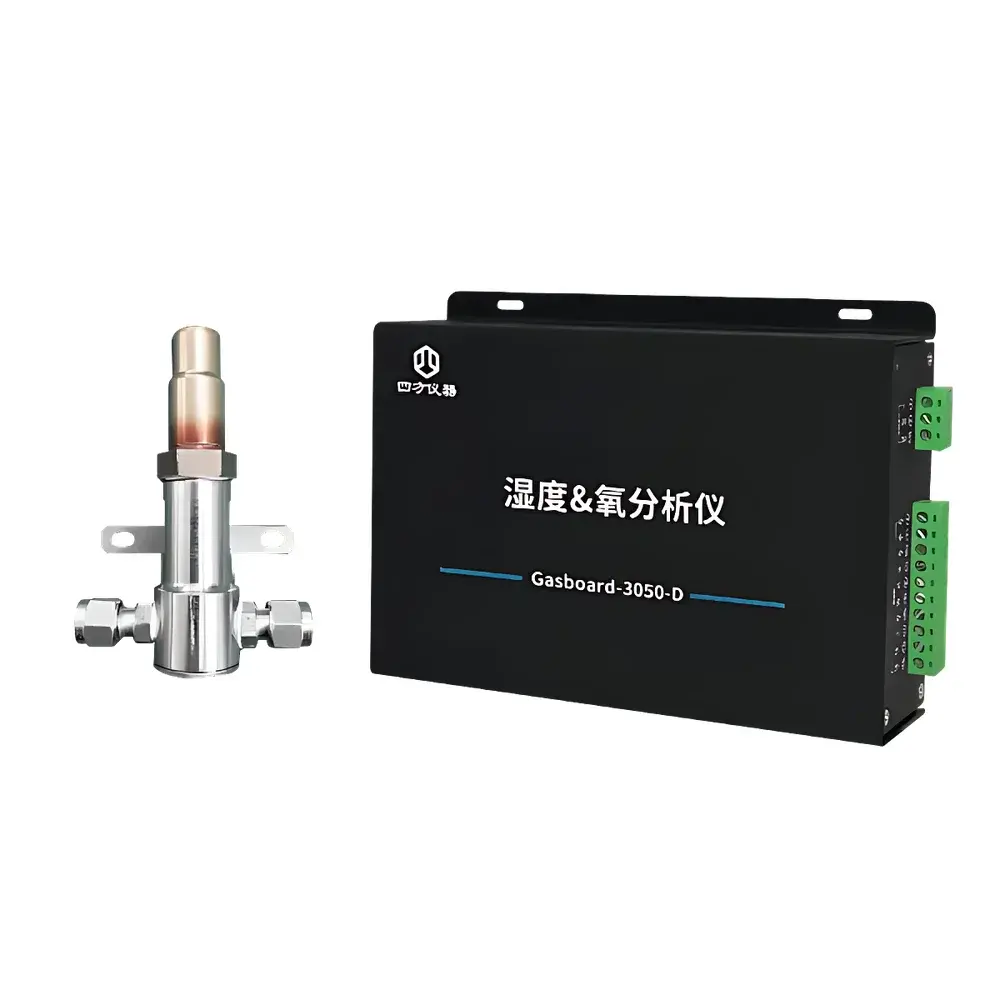
CUBIC INSTRUMENTS Gasboard-3050-D Dual-Parameter In-Situ Flue Gas Analyzer for H₂O and O₂
| Brand | CUBIC INSTRUMENTS |
|---|---|
| Origin | Hubei, China |
| Model | Gasboard-3050-D |
| Measurement Principle | Ceramic Zirconia Electrolyte (O₂), Derived H₂O Calculation via O₂/H₂O Correlation |
| H₂O Range | 0–40 %v/v |
| O₂ Range | 0.1–25 %v/v |
| Accuracy | ±2 %F.S. (H₂O & O₂) |
| Repeatability | ±2 % |
| Sample Temp. Limit | ≤ 180 °C |
| Output | Dual 4–20 mA, RS485 (standard), RS232 (optional), 3 x Relay Outputs |
| Power | 24 V DC, 50 W |
| Installation | Wall-mounted probe + DIN-rail instrument housing |
| Enclosure | Non-explosion-proof |
| Operating Ambient | −10 to +50 °C, <90 %RH |
Overview
The CUBIC INSTRUMENTS Gasboard-3050-D is an in-situ dual-parameter flue gas analyzer engineered for continuous, real-time measurement of oxygen concentration (O₂) and water vapor content (H₂O) in hot, humid, and chemically aggressive industrial exhaust streams. Unlike conventional single-gas analyzers, the Gasboard-3050-D integrates a high-stability ceramic zirconia electrochemical sensor for direct O₂ quantification—operating on the principle of oxygen ion conduction across a heated zirconium dioxide electrolyte—and employs a thermodynamically consistent algorithm to derive H₂O concentration from the measured O₂ signal and known stoichiometric or process-based gas composition assumptions. This approach eliminates reliance on standalone capacitive or chilled-mirror hygrometers, reducing system complexity while maintaining metrological traceability under dynamic sampling conditions. Designed for integration into regulatory-compliant Continuous Emissions Monitoring Systems (CEMS), the analyzer meets functional requirements for post-desulfurization (FGD) and selective catalytic reduction (SCR) duct monitoring, where accurate moisture correction is critical for normalizing pollutant concentrations (e.g., NOₓ, SO₂) to dry, standard conditions per ISO 12039 and EPA Method 3A.
Key Features
- Ceramic zirconia O₂ sensor with integrated heating element (probe temperature maintained >150 °C), preventing condensation-induced signal drift and enabling stable operation at sample temperatures up to 180 °C.
- Corrosion-resistant probe construction using 316L stainless steel and inert ceramic sealing materials, certified for exposure to acidic flue gases containing SO₂, NOₓ, and particulate-laden streams typical in coal-fired and biomass combustion.
- Multi-stage particulate filtration system upstream of the sensing element, including sintered metal pre-filter and hydrophobic membrane, minimizing fouling and extending calibration interval beyond 12 months under routine CEMS duty cycles.
- Dual analog outputs (4–20 mA) fully isolated and configurable per parameter—O₂ and H₂O—supporting direct connection to DCS, PLC, or SCADA systems without external signal conditioning.
- Standard RS485 Modbus RTU communication interface (RS232 optional) enables remote configuration, real-time data polling, and firmware updates; all digital transactions logged with timestamp for GLP/GMP audit readiness.
- Integrated status signaling: LED indicators for power, measurement active, and fault condition; three programmable relay outputs for alarm (e.g., out-of-range, sensor timeout) and maintenance alerts aligned with IEC 61508 functional safety principles.
Sample Compatibility & Compliance
The Gasboard-3050-D accepts extractive, positive-pressure gas samples at flow rates of 1–5 L/min and near-atmospheric pressure (±10 % of ambient). It is validated for use with flue gases containing up to 10 % CO₂, <500 ppm SO₂, and <200 mg/Nm³ total suspended particulates. While not intrinsically safe or ATEX-certified, its non-explosion-proof enclosure complies with IP65 ingress protection when installed per manufacturer-specified orientation. The analyzer supports compliance workflows for ISO 5800 (flue gas analysis), EN 14181 (QAL2/QAL3 verification), and US EPA Performance Specification 2 (PS-2) for O₂ analyzers. All calibration records—including zero/span checks, linearity verification, and response time validation—can be exported in CSV format for inclusion in 21 CFR Part 11–compliant electronic lab notebooks.
Software & Data Management
Local configuration is performed via embedded web interface accessible through Ethernet or serial terminal, requiring no proprietary software. Data logging occurs internally at user-defined intervals (1 s to 1 h resolution) with storage capacity for ≥30 days of dual-parameter time-series data. Exported logs include metadata: instrument ID, sensor serial number, calibration dates, ambient temperature/humidity, and operator ID (if authenticated). Firmware versioning follows semantic versioning (e.g., v2.4.1), with release notes publicly available on CUBIC’s technical support portal. Remote diagnostics—including sensor impedance monitoring, heater current profiling, and signal noise spectral analysis—are accessible to authorized service engineers for predictive maintenance planning.
Applications
- Power generation: Real-time O₂ and H₂O monitoring in boiler air preheater outlets, SCR inlet ducts, and stack emissions prior to wet FGD scrubbers—enabling dynamic excess air control and moisture-corrected mass emission rate calculation.
- Industrial process control: Closed-loop humidity regulation in kilns (ceramics, lime), dryers (paper, textiles), and sterilization chambers (pharma), where dew point stability directly impacts product quality and energy efficiency.
- Environmental compliance: Integration into municipal waste incinerator CEMS per EU Directive 2010/75/EU (IED), providing mandatory O₂ dilution correction and H₂O saturation assessment for dioxin/furan sampling protocols.
- Research & development: Quantitative study of combustion stoichiometry shifts during fuel blending (e.g., coal/biomass co-firing), where simultaneous O₂ depletion and H₂O generation kinetics inform kinetic modeling.
- Material processing: In-line moisture supervision during thermal treatment of wood composites, gypsum board, and lithium-ion battery electrode drying ovens—preventing microcracking and delamination.
FAQ
What is the recommended calibration frequency for the Gasboard-3050-D in continuous CEMS operation?
Annual calibration is advised per ISO 14001 and EN 14181 QAL2 requirements; however, quarterly verification using certified span gases (N₂/O₂ and N₂/H₂O mixtures) is strongly recommended for applications subject to regulatory audit.
Can the analyzer operate in vacuum or pressurized ducts?
No—it is rated for ambient-pressure sampling only (±10 % atmospheric). For pressurized stacks, a pressure-regulated extractive probe module must be installed upstream.
Is the H₂O measurement traceable to national standards?
Yes—the derived H₂O value is traceable to NIST SRM 2810 (moist air) via the certified zirconia O₂ sensor and documented algorithmic uncertainty propagation per GUM (JCGM 100:2008).
Does the device support automatic temperature compensation for varying flue gas profiles?
Yes—integrated Pt100 RTD in the probe tip continuously feeds temperature data to the onboard processor, applying real-time correction to both O₂ electromotive force and H₂O calculation coefficients.
What maintenance actions are required between calibrations?
Monthly visual inspection of probe filter integrity, quarterly cleaning of the ceramic sensor surface with isopropyl alcohol, and biannual verification of relay output thresholds using multimeter and load resistor.







