
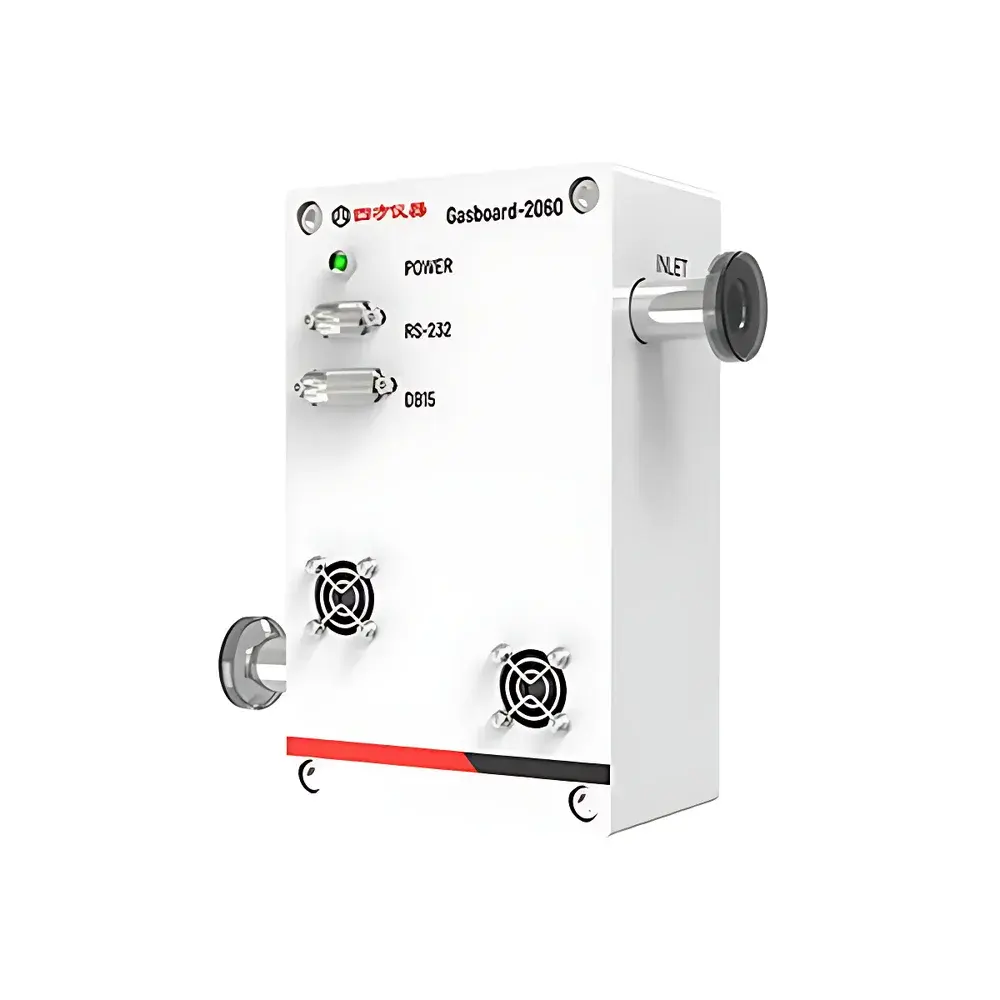
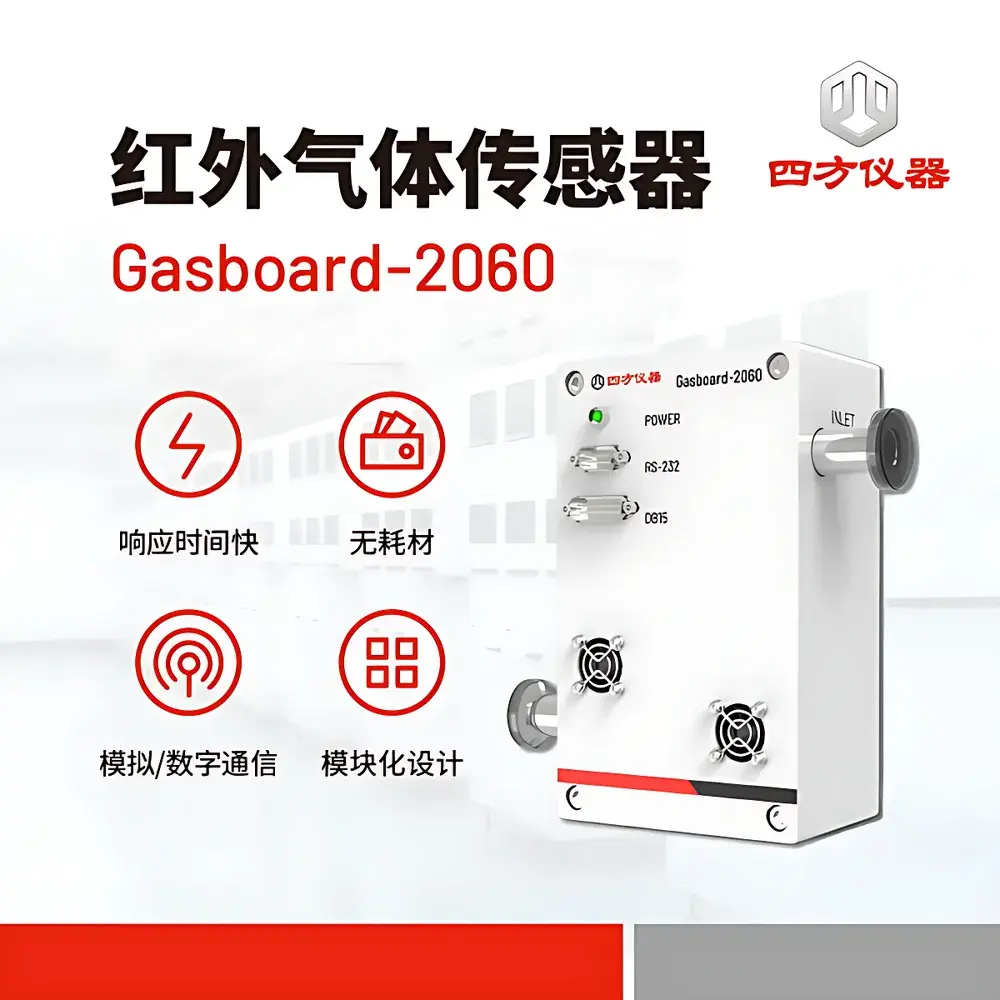
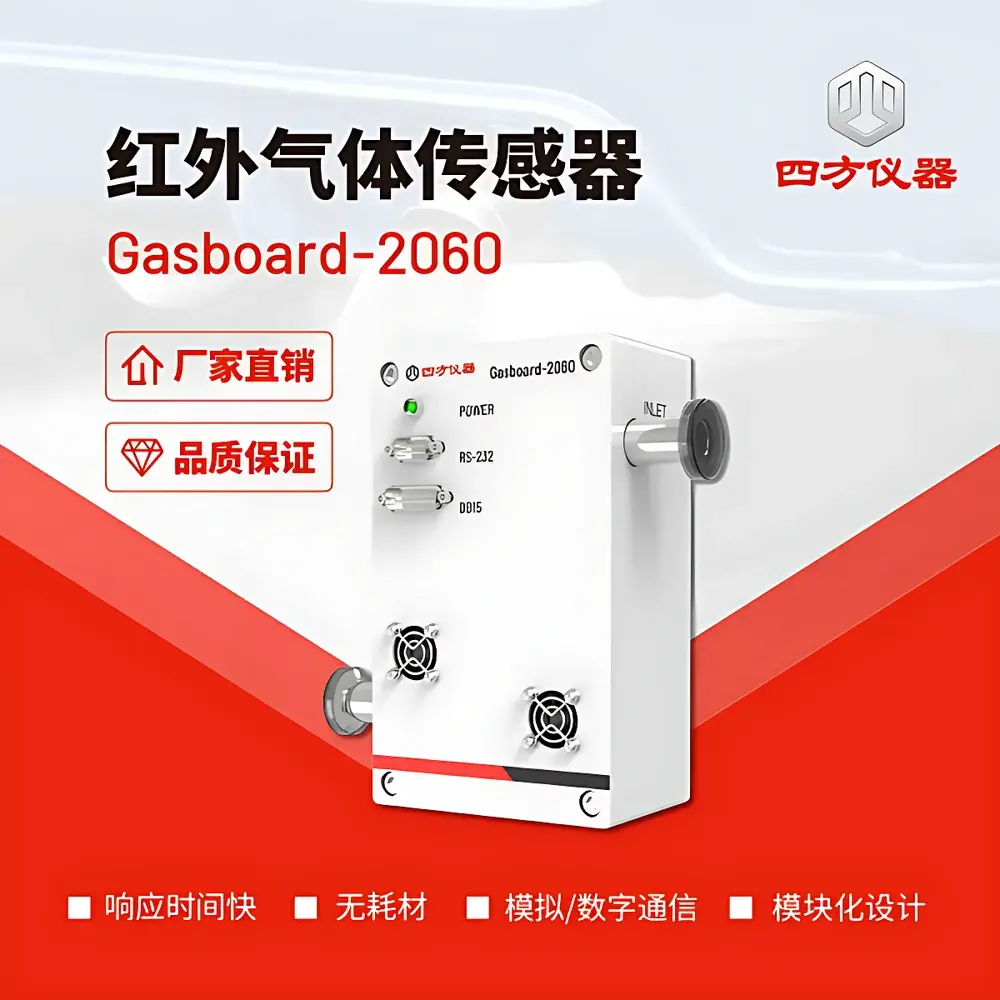
CUBIC INSTRUMENTS Gasboard-2060 NDIR-Based Endpoint Detection Gas Sensor for Semiconductor CVD and Etch Process Monitoring
| Brand | CUBIC INSTRUMENTS |
|---|---|
| Origin | Hubei, China |
| Model | Gasboard-2060 |
| Detection Principle | Non-Dispersive Infrared (NDIR) |
| Target Gases | SiF₄, CF₄, SF₆, NF₃, CO₂ |
| Range | 1–264 ppm (0–200 mTorr) |
| Repeatability | ±0.5% |
| Linearity | ±1% F.S. |
| Detection Limit | 1 ppm |
| Output | Analog (4–20 mA) & Digital (RS485/Modbus RTU) |
| Design | Modular, Flange-Mountable (CF/KF compatible), Protocol-Ready for OEM Integration |
Overview
The CUBIC INSTRUMENTS Gasboard-2060 is a purpose-engineered non-dispersive infrared (NDIR) gas sensor designed for real-time endpoint detection (EPD) and process gas monitoring in semiconductor thin-film manufacturing environments—specifically within chemical vapor deposition (CVD), plasma-enhanced CVD (PECVD), and reactive ion etching (RIE) tools. Unlike electrochemical or catalytic bead sensors, the Gasboard-2060 leverages dual-beam NDIR spectroscopy with thermopile detection and temperature-compensated optical path design to deliver stable, interference-resistant quantification of key fluorinated and carbon-based process gases—including silicon tetrafluoride (SiF₄), carbon tetrafluoride (CF₄), sulfur hexafluoride (SF₆), nitrogen trifluoride (NF₃), and carbon dioxide (CO₂). Its measurement principle relies on selective absorption of mid-infrared radiation (typically 7–12 µm) at characteristic vibrational-rotational bands of each target molecule, enabling high specificity without cross-sensitivity to common background gases such as N₂, Ar, He, or O₂. The sensor operates directly inside vacuum-compatible process chambers or inline gas lines via standardized flange interfaces (CF-35/KF-25 configurable), supporting dynamic pressure ranges up to 200 mTorr—making it suitable for both low-pressure CVD and atmospheric-pressure purge monitoring.
Key Features
- Multi-gas NDIR platform calibrated for SiF₄, CF₄, SF₆, NF₃, and CO₂—each with independent spectral filtering and algorithmic baseline correction
- Fast response time (T₉₀ ≤ 2 seconds) optimized for sub-second endpoint transitions during chamber cleaning or film termination
- No consumables or reagents: solid-state optical architecture ensures >5-year operational lifetime under continuous duty cycles
- High metrological stability: repeatability ±0.5% and linearity ±1% full scale, validated per ISO 12039 and ASTM D6259 protocols for IR gas analyzers
- Integrated analog (4–20 mA) and digital (RS485 Modbus RTU) outputs—enabling seamless integration into SECS/GEM-compliant tool controllers and MES systems
- Modular mechanical design with vacuum-rated stainless-steel housing and customizable flange adapters (CF, KF, ISO-K) for drop-in replacement in existing CVD tool architectures
Sample Compatibility & Compliance
The Gasboard-2060 is qualified for use in Class 100 cleanroom environments and rated for operation in aggressive plasma-processed gas streams containing fluorine radicals, silanes, and halogenated byproducts. It complies with SEMI S2-0217 (Safety Guidelines for Semiconductor Manufacturing Equipment) and meets electromagnetic compatibility requirements per EN 61326-1:2013. While not intrinsically safe for Zone 0/1 hazardous areas, its design conforms to SEMI E10-0217 (Specification for Equipment Safety) for integration into Class 1 semiconductor fabrication equipment. All firmware and calibration data are traceable to NIST-traceable reference standards, supporting GLP/GMP-aligned audit trails when deployed in FDA-regulated advanced packaging or compound semiconductor production lines.
Software & Data Management
The sensor supports host-side configuration via ASCII command protocol over RS485, allowing remote zero/span adjustment, alarm threshold setting, and diagnostic status polling. When integrated into factory automation frameworks (e.g., FabLink XT, CIM300), raw concentration values are timestamped and logged with millisecond precision—enabling correlation with RF power, pressure ramp, and mass flow controller events. Optional firmware upgrades include built-in data buffering (up to 72 hours at 1 Hz sampling) and support for OPC UA PubSub for secure, firewall-friendly edge-to-cloud telemetry. Audit logs record all parameter changes, calibrations, and fault events—meeting 21 CFR Part 11 requirements for electronic records and signatures when paired with validated host software.
Applications
- Endpoint detection during chamber cleaning cycles (e.g., NF₃ plasma etch residue removal)
- Real-time monitoring of SiF₄ evolution during silicon nitride or oxide PECVD film growth termination
- CF₄/SF₆ ratio tracking in dielectric etch processes to maintain critical dimension (CD) uniformity
- In-line verification of gas delivery purity and residual moisture/CO₂ contamination in ultra-high-purity (UHP) gas lines
- Process signature analysis for predictive maintenance of RF generators and turbo-molecular pumps based on gas composition drift
FAQ
What gases does the Gasboard-2060 detect—and how is selectivity achieved?
It detects SiF₄, CF₄, SF₆, NF₃, and CO₂ using discrete optical bandpass filters matched to their fundamental IR absorption peaks (e.g., SiF₄ at 10.5 µm, NF₃ at 9.7 µm), minimizing cross-interference.
Can it operate under vacuum or high-pressure conditions?
Yes—it is rated for continuous operation from 1 mTorr to 200 mTorr; optional pressure-compensated firmware enables accurate readings across variable vacuum profiles typical in load-lock and process chamber transitions.
Is calibration required—and how often?
Factory calibration is performed using NIST-traceable gas standards; field recalibration is recommended annually or after exposure to >1000 ppm fluorine-containing plasmas, using certified span gas and zero air.
Does it support integration with 300mm wafer fab automation systems?
Yes—RS485 Modbus RTU output is fully compatible with GEM300-compliant equipment interfaces; analog output supports legacy PLC-based control loops without protocol translation.
How is long-term drift mitigated in harsh plasma environments?
The optical path incorporates dual-beam referencing, active temperature stabilization (±0.1°C), and auto-zero compensation triggered during idle periods—reducing baseline drift to <0.2% F.S./year under continuous operation.
Related Products







