
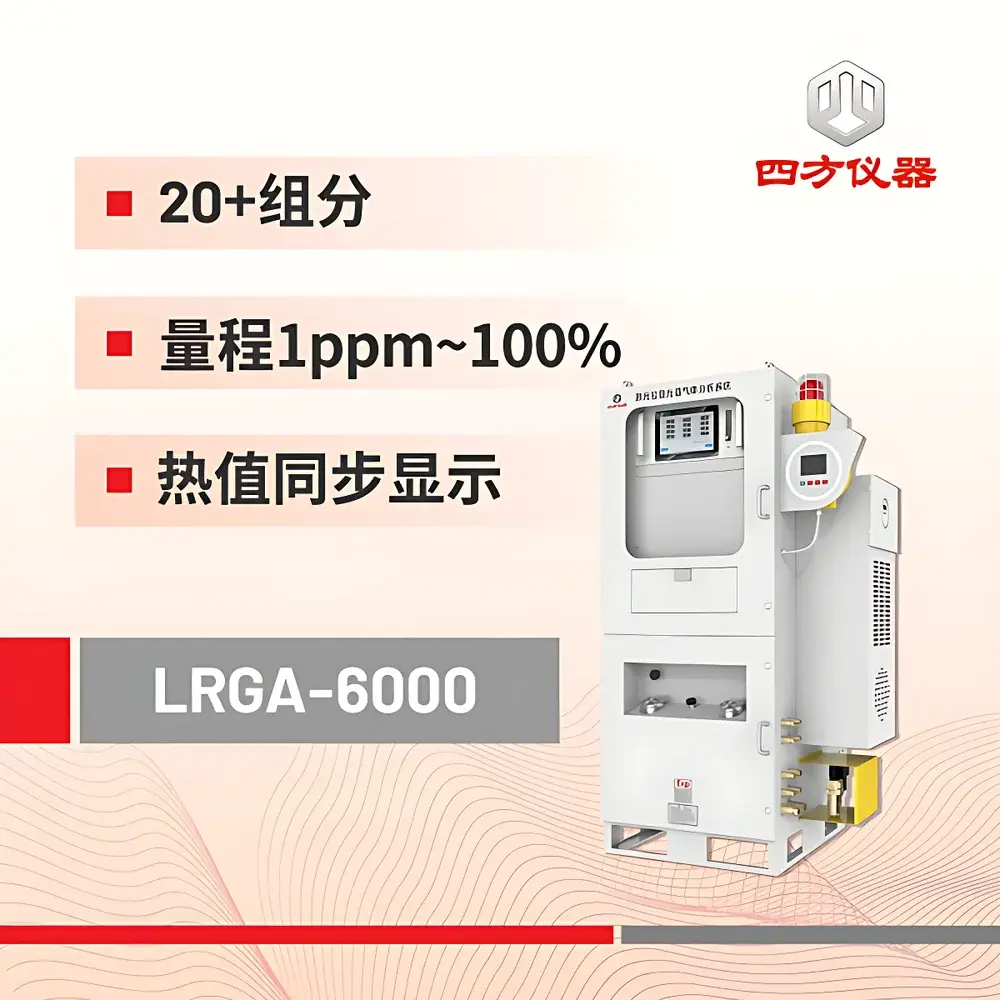
CUBIC INSTRUMENTS LRGA-6000 Laser Raman Gas Analyzer
| Brand | CUBIC INSTRUMENTS |
|---|---|
| Origin | Hubei, China |
| Manufacturer Type | Authorized Distributor |
| Country of Origin | China |
| Model | LRGA-6000 |
| Instrument Type | Grating-Based Raman Spectrometer |
| Spectral Range | 400–700 nm |
| Spectral Resolution | 0.01% |
| Spatial Resolution | 1 µm (lateral), 2 µm (axial) |
| Minimum Wavenumber | 10 cm⁻¹ |
| Spectral Reproducibility | ≤1% (dependent on configured measurement range) |
Overview
The CUBIC INSTRUMENTS LRGA-6000 Laser Raman Gas Analyzer is a high-performance, industrial-grade spectroscopic system engineered for real-time, in-situ multicomponent gas analysis based on spontaneous Raman scattering. Unlike absorption-based techniques, Raman spectroscopy relies on inelastic photon scattering to generate molecule-specific vibrational fingerprints—enabling direct, non-destructive identification and quantification of homonuclear diatomic gases (e.g., N₂, O₂, H₂) that are optically inactive in infrared methods. The LRGA-6000 integrates a stabilized narrow-linewidth laser excitation source, high-throughput volume-phase holographic (VPH) grating spectrometer, thermoelectrically cooled back-illuminated CCD detector, and fiber-coupled probe optics to deliver robust spectral acquisition under demanding process conditions. Its design supports continuous online operation without consumables, carrier gas, or chromatographic separation—making it suitable for unattended deployment in hazardous area environments compliant with IECEx and ATEX principles.
Key Features
- Simultaneous detection and quantification of up to 20 gas species—including H₂, N₂, O₂, CO, CO₂, CH₄, C₂H₂, C₂H₄, C₂H₆, C₃H₈, H₂S, and hydrocarbons—within a single spectral acquisition
- Sub-30-second response time from sample introduction to validated concentration output, enabling dynamic process control and rapid fault detection
- Full-scale concentration measurement range from 0–10% to 0–100% vol/vol, configurable per application; linear error ≤ ±1% FS across all calibrated ranges
- Gas concentration normalization algorithm with automated zero-point correction via internal purge cycle, minimizing long-term drift without manual recalibration
- Modular optical architecture with field-replaceable fiber-optic probe assemblies rated to IP65 and Ex d II C T4 Gb for Class I, Division 1 hazardous locations
- Integrated thermal management and vibration-damped optical bench ensuring spectral stability over ambient temperature fluctuations (10–35 °C operating range)
Sample Compatibility & Compliance
The LRGA-6000 is validated for direct analysis of raw, humid, particulate-laden, and corrosive process streams—including syngas, coke oven gas, blast furnace top gas, refinery off-gas, biogas, and battery thermal runaway effluents. It requires no sample conditioning beyond standard particulate filtration (≤5 µm) and pressure regulation (up to 4 MPa). The analyzer complies with ISO/IEC 17025 calibration traceability requirements and supports audit-ready data integrity protocols aligned with FDA 21 CFR Part 11 when operated with optional secure software configuration. All hardware components meet RoHS Directive 2011/65/EU and CE marking standards for electromagnetic compatibility (EN 61326-1) and safety (EN 61010-1).
Software & Data Management
The embedded Linux-based firmware features a 10.1-inch capacitive touchscreen HMI with intuitive workflow navigation, real-time spectral overlay, and multi-gas trend visualization. Data logging occurs at user-defined intervals (1 s to 1 h) with timestamped metadata (pressure, temperature, laser power, integration time). Raw spectra and processed results are exportable in CSV, HDF5, and ASTM E1382-compliant formats. Optional PC-hosted RamanAnalyzer Suite provides advanced chemometric modeling (PLS, PCA, MCR-ALS), method validation reporting, and integration with DCS/SCADA systems via Modbus TCP, OPC UA, or 4–20 mA analog outputs. Audit trails record all parameter changes, calibration events, and user logins with role-based access control.
Applications
The LRGA-6000 serves as a primary analytical platform in industries where rapid, interference-free multicomponent gas composition is critical to safety, efficiency, and regulatory compliance. Key use cases include: real-time heating value calculation for natural gas custody transfer; stoichiometric ratio monitoring in ammonia synthesis loops; H₂/N₂/CH₄ tracking during coal gasification; O₂ excess control in steel reheating furnaces; H₂S breakthrough detection in amine scrubbers; and early-stage thermal runaway gas profiling in lithium-ion battery module testing. It replaces legacy GC and MS systems in applications requiring <60-second turnaround, eliminating dependency on carrier gases, column aging, and vacuum maintenance.
FAQ
Does the LRGA-6000 require calibration gases or reference standards for routine operation?
No—zero-point correction is performed automatically using internal nitrogen-purge cycles; span calibration is recommended annually or after major optical component replacement.
Can the instrument operate in explosive atmospheres?
Yes—the analyzer enclosure meets Ex d II C T4 Gb requirements; optional explosion-proof probe housings enable direct installation in Zone 1 areas.
Is spectral interference from water vapor or CO₂ a concern in humid samples?
No—Raman cross-sections are inherently selective; proprietary multivariate baseline correction algorithms suppress broad-band fluorescence and continuum background without compromising quantitative accuracy.
What is the maximum allowable particulate loading in the sample stream?
Inlet gas must be filtered to ≤5 µm particle size; optional heated probe variants prevent condensation-induced fouling in high-humidity applications.
How is data integrity ensured for regulated environments (e.g., pharmaceutical or energy sectors)?
With optional 21 CFR Part 11-compliant software mode, the system enforces electronic signatures, immutable audit logs, and encrypted data storage meeting ALCOA+ principles.






