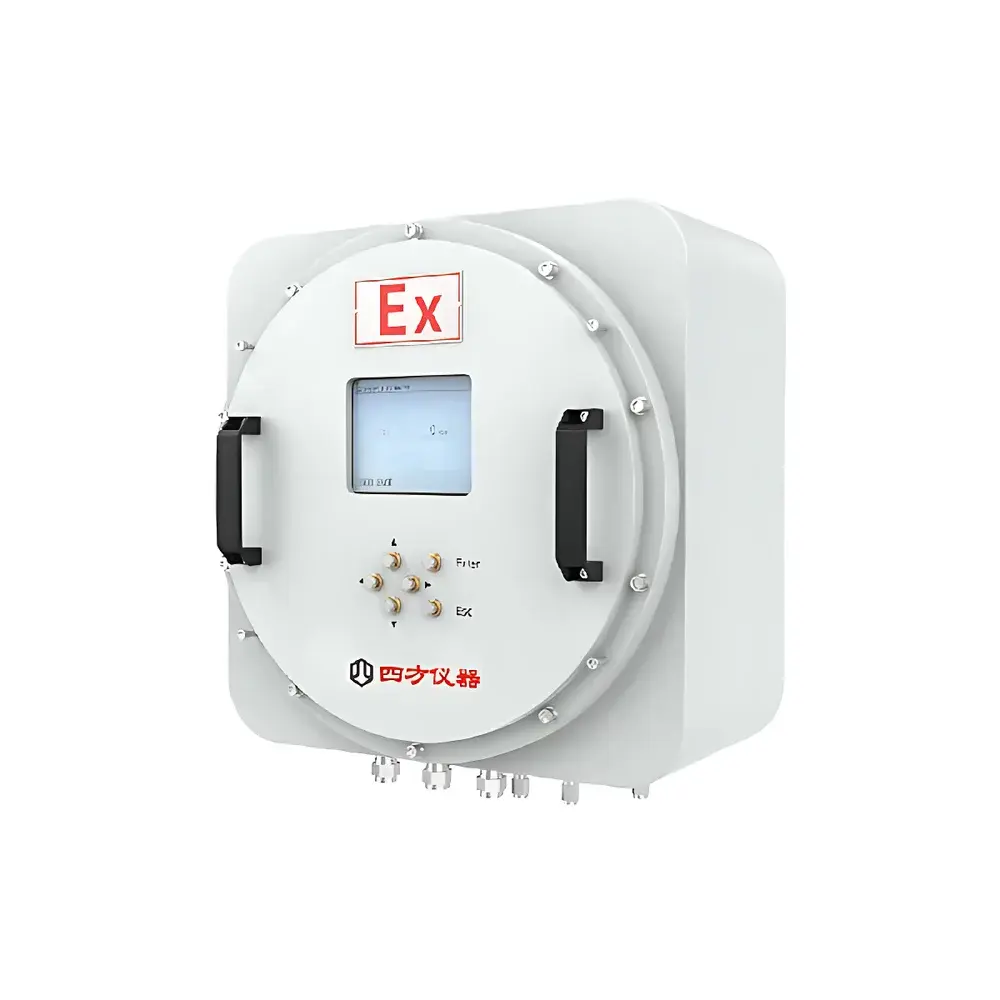
CUBIC INSTRUMENTS LMS-1000 Tunable Diode Laser Absorption Spectroscopy (TDLAS) Trace Moisture Analyzer
| Brand | CUBIC INSTRUMENTS |
|---|---|
| Origin | Hubei, China |
| Manufacturer Type | Authorized Distributor |
| Country of Origin | China |
| Model | LMS-1000 |
| Pricing | Upon Request |
| Measurement Principle | TDLAS |
| Measurand | H₂O vapor |
| Range | 0–50 ppm to 0–6000 ppm (customizable) |
| Accuracy | ±2% FS |
| Resolution | 0.1 ppm |
| Repeatability | ≤1.5% FS |
| Explosion Protection | Ex db IIC T6 Gb / Ex tb IIIC T80°C Db |
| Ingress Protection | IP66 |
| Ambient Temperature | −10°C to +50°C |
| Relative Humidity | 0–98% RH (non-condensing) |
| Sample Pressure | Inlet: 140–310 kPa |
| Measurement Cell | 800–1200 mbar(a) |
| Power Supply | 24 VDC ±20% or 100–240 VAC ±10%, 50/60 Hz, 10 W |
| Output Interfaces | 4–20 mA, RS-485, Modbus RTU/TCP, Ethernet |
| Display Options | Volume ratio (ppm(v)) and dew point temperature (°C/°F) |
| Dimensions (L×W×H) | 400 × 400 × 250 mm |
| Weight | 36 kg |
Overview
The CUBIC INSTRUMENTS LMS-1000 is a high-performance, in-situ trace moisture analyzer engineered for continuous, real-time monitoring of water vapor concentration in industrial process gases. It employs Tunable Diode Laser Absorption Spectroscopy (TDLAS), a direct-absorption optical technique that targets the fundamental rotational-vibrational absorption line of H₂O near 1.39 µm. Unlike chilled-mirror or aluminum oxide sensors, the LMS-1000 requires no sample conditioning, refrigeration, or consumables—eliminating drift, calibration drift, and cross-sensitivity to background gas composition (e.g., CO₂, H₂S, CH₄, N₂, or hydrocarbons). Its robust optical architecture delivers sub-part-per-trillion (ppt-level) detection sensitivity with microsecond-scale response time, making it suitable for demanding applications where rapid moisture excursions must be captured without lag—particularly in cryogenic natural gas processing and LNG liquefaction trains.
Key Features
- True in-situ measurement via dual-beam TDLAS optics, enabling direct insertion into process lines or bypass streams without extractive sampling systems
- Field-configurable measurement range (0–50 ppm to 0–6000 ppm H₂O) optimized for low-dew-point verification (e.g., < −60°C) in LNG feed gas and NGL stabilization units
- High-stability laser source with >5-year operational lifetime and integrated wavelength referencing for long-term zero stability
- Intrinsically safe and explosion-proof design certified to Ex db IIC T6 Gb (gas) and Ex tb IIIC T80°C Db (dust), compliant with IEC 60079-0/-1/-31 standards
- IP66-rated enclosure with stainless steel housing and sapphire optical windows, rated for outdoor installation in harsh petrochemical environments
- Simultaneous real-time output of volumetric moisture concentration (ppm(v)) and corresponding dew point temperature (°C/°F), traceable to NIST-calibrated reference standards
Sample Compatibility & Compliance
The LMS-1000 is validated for use with natural gas, ethane-propane mixtures, nitrogen, hydrogen, syngas, and other non-corrosive process streams typical in midstream and downstream hydrocarbon facilities. It operates reliably across inlet pressures from 140–310 kPa and maintains measurement integrity within a sealed optical cell pressurized to 800–1200 mbar(a)—a configuration that minimizes pressure-induced spectral broadening while ensuring consistent path-length absorption. The analyzer meets functional safety requirements per IEC 61508 SIL2 for critical moisture monitoring loops and supports audit-ready data logging aligned with ISO/IEC 17025 and API RP 14C guidelines. All firmware and calibration records are timestamped and support GLP-compliant electronic signatures when integrated with validated DCS or SCADA platforms.
Software & Data Management
The embedded firmware provides local configuration via intuitive web interface (HTTPS-enabled) accessible over Ethernet. Remote operation supports Modbus TCP and RTU protocols for seamless integration into DeltaV, Emerson DCS, Siemens PCS7, and Honeywell Experion PKS systems. Analog 4–20 mA outputs are fully isolated and configurable for linear or square-root scaling. Data archiving includes second-resolution time-series logs stored on internal flash memory (≥30 days at 1 Hz), exportable via USB or FTP. Audit trails record all parameter changes, calibration events, and alarm acknowledgments—fully compliant with FDA 21 CFR Part 11 requirements when deployed under validated SOPs. Optional cloud telemetry enables predictive maintenance alerts based on laser intensity decay trends and signal-to-noise ratio (SNR) degradation thresholds.
Applications
- Moisture verification upstream of molecular sieve dryers in LNG liquefaction plants (target: ≤0.1 ppm(v) post-drying)
- Real-time monitoring of water breakthrough in amine contactor overheads and glycol reboiler vents
- Quality assurance during NGL fractionation—ensuring dew point compliance per GPA 2145 and ISO 8573-1 Class 1 for pipeline injection
- Leak detection and purge validation in hydrogen refueling stations and PEM electrolyzer feed lines
- Process optimization in semiconductor bulk gas delivery systems requiring <1 ppm(v) H₂O control
FAQ
Does the LMS-1000 require periodic recalibration with NIST-traceable standards?
Yes—initial factory calibration is performed using gravimetrically prepared moisture standards traceable to NIST SRM 2810. Field verification is recommended annually or after exposure to condensation events; no user-accessible optical alignment is required.
Can the analyzer operate continuously at ambient temperatures exceeding 45°C?
The unit is rated for −10°C to +50°C ambient operation. For installations above 45°C, optional thermostatically controlled sunshades or forced-air cooling enclosures are available to maintain internal thermal stability.
Is the 4–20 mA output intrinsically safe for Zone 1 installation?
The analog output is galvanically isolated and compatible with common IS barriers (e.g., Pepperl+Fuchs KFD2-ST2-Ex2). Full loop safety validation must be performed per IEC 60079-27 by the end-user’s functional safety engineer.
How does TDLAS mitigate interference from CO₂ or H₂S in sour gas applications?
The LMS-1000 uses narrow-linewidth (<0.001 nm) single-mode lasers tuned precisely to an isolated H₂O absorption line with negligible overlap with CO₂ (near 1.57 µm) or H₂S (near 1.58 µm); spectral interference is mathematically excluded via second-derivative absorption fitting algorithms.
What is the minimum detectable dew point under standard conditions?
At 1 atm and 25°C, the 0–50 ppm range corresponds to a theoretical dew point limit of −75°C (−103°F), verified experimentally per ISO 6245 using chilled-mirror reference correlation.