
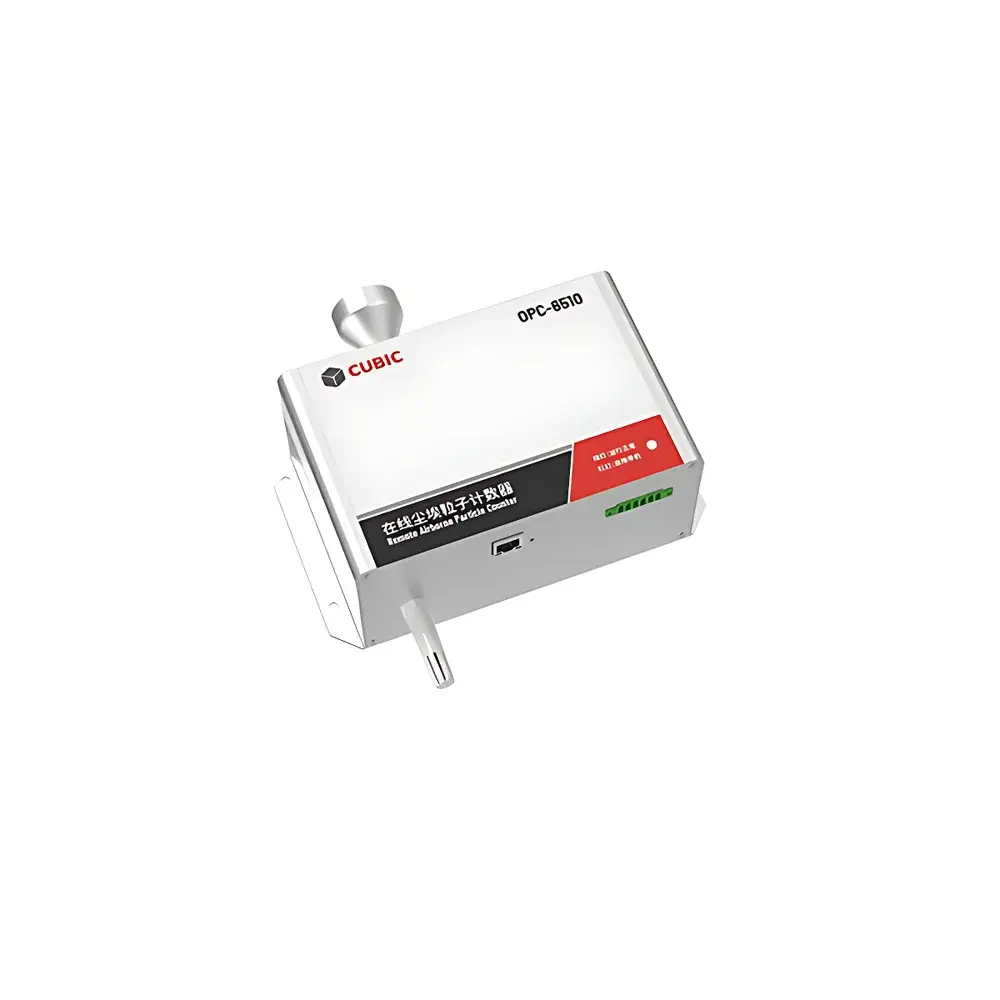
Cubic OPC-6510 Online Optical Particle Counter (28.3 L/min)
| Brand | Cubic |
|---|---|
| Origin | Hubei, China |
| Model | OPC-6510 |
| Flow Rate | 28.3 L/min |
| Flow Accuracy | Compliant with JJF-1190 |
| Timing Accuracy | Compliant with JJF-1190 |
| Size Distribution Accuracy | Compliant with JJF-1190 |
| Indication Error | Compliant with JJF-1190 |
| Detection Principle | Light Scattering |
| Channel Count | 6 (0.3, 0.5, 1.0, 2.5, 5.0, 10.0 µm) |
| Counting Efficiency | 50% at 0.3 µm |
| Measurement Range | 0–1,000,000 particles per 28.3 L |
| Warm-up Time | ≤8 s |
| Data Update Interval | 1 s |
| Operating Temp. | 0–45°C |
| Operating RH | 0–95% non-condensing |
| Storage Temp./RH | −20–60°C / 0–95% non-condensing |
| Power Supply | DC 24 V |
| Avg. Current Draw | ≤3 A |
| Communication | RS485 (standard), RJ45 (optional) |
| Service Life | ≥3 years |
Overview
The Cubic OPC-6510 Online Optical Particle Counter is an industrial-grade, real-time airborne particulate monitoring instrument engineered for continuous environmental surveillance in cleanrooms, pharmaceutical manufacturing suites, semiconductor fabrication facilities, and HVAC system validation environments. It operates on the principle of single-particle light scattering—where aerosolized particles pass through a focused laser beam, generating scattered light pulses proportional to particle size and refractive index. These pulses are detected by a high-sensitivity photodiode and converted into digital counts across six calibrated size channels. With a nominal volumetric flow rate of 28.3 L/min—equivalent to the standard cubic foot per minute (CFM) sampling rate used in ISO 14644-1 and EU GMP Annex 1 compliance testing—the OPC-6510 delivers statistically robust particle concentration data per unit volume (pcs/28.3 L), enabling direct comparison against international cleanliness classification thresholds.
Key Features
- High-fidelity optical detection architecture featuring a stable industrial-class laser diode (650 nm wavelength) and optimized optical path design for consistent signal-to-noise ratio across all six size channels.
- Dual-stage flow control system incorporating a mass flow sensor and precision feedback-controlled vacuum pump, maintaining ±2% flow stability under variable backpressure conditions—critical for long-term measurement reproducibility.
- Proprietary dust source intelligent recognition module that discriminates between transient contamination events (e.g., door openings, personnel movement) and sustained process-related particulate generation, reducing false alarms in automated monitoring networks.
- Real-time, synchronized six-channel output: simultaneous reporting of particle concentrations at 0.3 µm, 0.5 µm, 1.0 µm, 2.5 µm, 5.0 µm, and 10.0 µm—supporting multi-threshold alarm logic and cumulative distribution analysis.
- Robust environmental tolerance: operational capability from 0°C to 45°C and up to 95% relative humidity (non-condensing), validated for deployment in demanding production-floor or utility tunnel environments.
- Low thermal drift design ensures ≤8 seconds warm-up stabilization time, minimizing downtime during system startup or recovery from power interruption.
Sample Compatibility & Compliance
The OPC-6510 is designed for continuous sampling of ambient or ducted air streams without preconditioning. It meets metrological traceability requirements defined in JJF 1190–2008 (Calibration Specification for Airborne Particle Counters), including verification of flow accuracy, timing error, size bin boundary alignment, and indication error across its full dynamic range. While not certified to ISO 21501-4 as a standalone calibration standard, its performance characteristics align with the repeatability (≤±10%), counting efficiency (50% @ 0.3 µm, ≥99% @ ≥0.5 µm), and resolution criteria specified therein. The instrument supports integration into GLP- and GMP-regulated environments when deployed with documented installation qualification (IQ), operational qualification (OQ), and periodic performance verification protocols.
Software & Data Management
Data output is delivered via isolated RS485 Modbus RTU protocol (standard) for seamless integration into SCADA, BMS, or MES platforms. Optional Ethernet (RJ45) connectivity enables TCP/IP-based communication for centralized cloud or on-premise data historians. All timestamped particle count records include channel-specific values, flow status flags, internal temperature/humidity readings, and diagnostic codes. Audit-trail-capable firmware versions support configurable data logging intervals (1 s to 300 s), buffered storage (≥72 h local retention), and secure remote configuration via password-protected access levels—facilitating compliance with FDA 21 CFR Part 11 requirements when paired with validated software infrastructure.
Applications
- Continuous ISO Class monitoring in Grade A/B cleanrooms per EU GMP Annex 1 and PIC/S TR 13.
- Filter integrity verification and leak detection in HEPA/ULPA systems using upstream/downstream differential counting.
- Environmental monitoring (EM) programs for sterile product manufacturing, including routine sampling points and critical process zones.
- Compressed air quality assessment in pharmaceutical and biotech facilities per ISO 8573-1:2010 Class 1–3 particulate specifications.
- Real-time feedback control of laminar airflow units and isolator gloveports during aseptic processing.
- Validation and routine operation of HVAC systems in hospitals, laboratories, and microelectronics fabrication lines.
FAQ
What calibration standards does the OPC-6510 comply with?
The instrument conforms to JJF 1190–2008 for flow rate, timing, sizing accuracy, and indication error. Calibration traceability requires annual verification using NIST-traceable PSL (polystyrene latex) reference particles and certified flow meters.
Can the OPC-6510 be integrated into a facility-wide EM system?
Yes—its RS485 Modbus interface supports direct integration with industry-standard supervisory systems. Optional Ethernet enables MQTT or HTTP-based telemetry for cloud analytics platforms.
Is the 0.3 µm channel suitable for assessing HEPA filter penetration?
While the OPC-6510 achieves 50% counting efficiency at 0.3 µm (per JJF 1190), HEPA filter testing per ISO 14644-3 typically requires instruments with ≥50% efficiency at MPPS (~0.1–0.2 µm). This model is intended for environmental monitoring—not filter certification.
Does the device support alarm outputs for out-of-specification events?
Yes—programmable digital I/O (optional relay module) triggers configurable threshold alarms per channel or cumulative count, with latching/non-latching modes and event logging.
How often does the instrument require maintenance?
Optical chamber cleaning is recommended every 6 months under typical cleanroom use; laser and detector alignment verification is advised annually. No consumables are required beyond periodic inlet filter replacement.







