
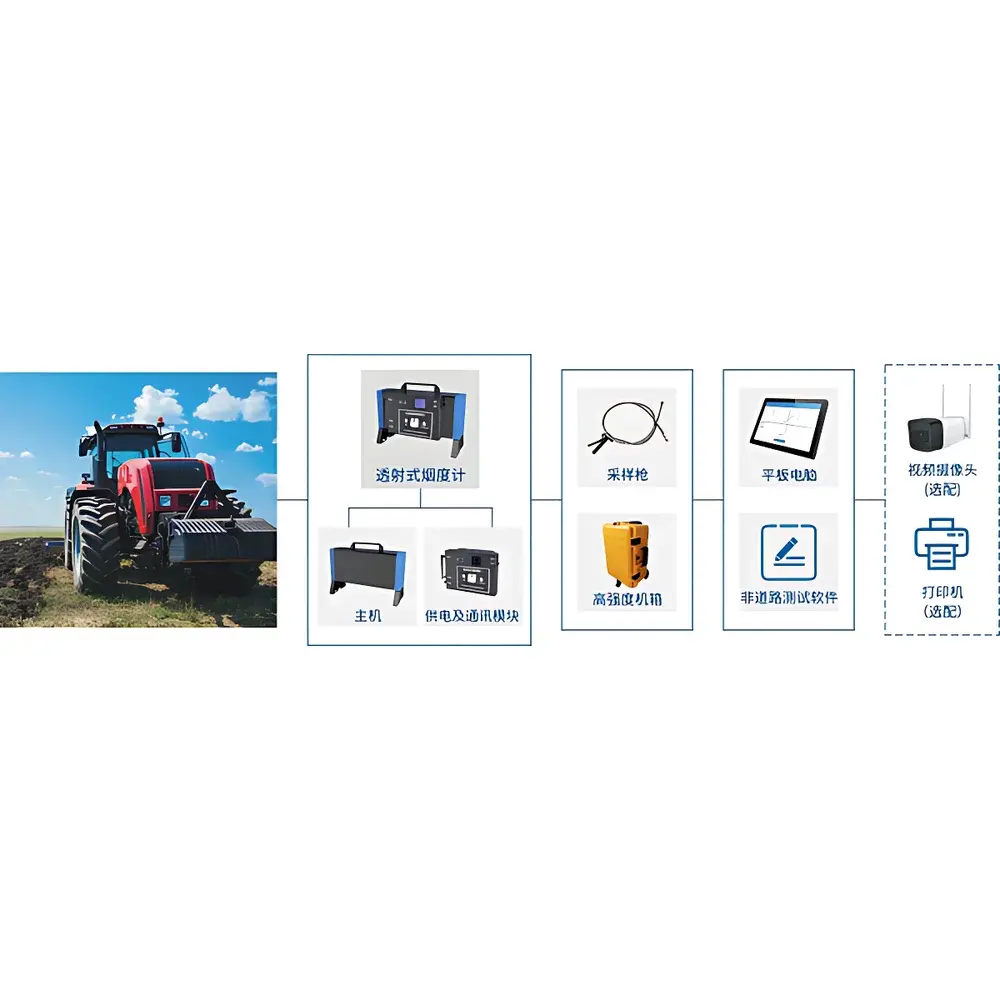
CUBIC INSTRUMENTS Basic-Grade Opacity Meter System for Non-Road Mobile Machinery and Diesel Vehicle Exhaust Smoke Testing
| Brand | CUBIC INSTRUMENTS |
|---|---|
| Origin | Hubei, China |
| Manufacturer Type | Authorized Distributor |
| Country of Origin | China |
| Model | Basic Edition |
| Instrument Type | Portable |
| Measurement Principle | Optical Transmission (Nephelometric Absorption) |
| Maximum Permissible Error | ±2.0% |
| Measuring Range | Opacity N: 0–99.99% |
| Absorption Coefficient K | 0–16 m⁻¹ |
| Resolution | N: 0.1% |
| K | 0.01 m⁻¹ |
| Power Supply | Integrated Li-ion Battery (11.1 V / 35 Ah), ≥8 h continuous operation |
| Communication | Wi-Fi & Bluetooth |
| Data Output | Digital via USB/Bluetooth/Wi-Fi |
| Optional Accessories | HD Video Recording Module, Engine RPM & Oil Temperature Sensor Inputs |
Overview
The CUBIC INSTRUMENTS Basic-Grade Opacity Meter System is a field-deployable, regulatory-compliant instrumentation platform engineered for quantitative measurement of exhaust smoke opacity and light absorption coefficient (K-value) from diesel-fueled non-road mobile machinery (NRMM) and on-road diesel vehicles. Based on the optical transmission principle—where infrared or visible light passes through a defined length of exhaust plume and attenuation is measured—the system determines opacity (N, %) and derives the spectral absorption coefficient (K, m⁻¹) in accordance with internationally recognized photometric standards. Designed to meet the metrological and procedural requirements of GB 3847–2018 (for road-going diesel vehicles) and GB 36886–2018 (for construction, agricultural, and industrial NRMM), this system delivers traceable, repeatable measurements under real-world operating conditions—including free-acceleration mode, steady-state idle, and transient load scenarios. Its portable architecture enables direct vehicle-side deployment without requiring fixed test benches or ambient climate control.
Key Features
- Simultaneous real-time display of opacity (N, %) and light absorption coefficient (K, m⁻¹), both calculated per ISO 8549 and GB-defined algorithms
- Integrated high-capacity lithium-ion battery (11.1 V / 35 Ah) enabling ≥8 hours of uninterrupted field operation; optional DC input supports continuous powered use during extended inspections
- Automated measurement sequence compliant with free-acceleration test protocols—no manual timing or operator intervention required
- Dual-interface connectivity: Wi-Fi and Bluetooth for wireless data streaming to Android/iOS tablets preloaded with certified CUBIC TestSuite software
- Expandable I/O architecture with dedicated analog inputs for engine oil temperature and rotational speed (RPM), enabling correlation of smoke output with operational parameters
- Ruggedized transport case with shock-absorbing chassis, IP54-rated enclosure, and anti-vibration mounting for probe and sampling tube
Sample Compatibility & Compliance
The system accommodates exhaust sampling from all common diesel-powered platforms, including but not limited to excavators, wheel loaders, forklifts, generators, tractors, and medium- to heavy-duty trucks. It supports both raw exhaust (pre-turbine, pre-DPF) and diluted tailpipe sampling configurations, provided sampling geometry adheres to GB 36886–2018 duct diameter and probe insertion depth specifications. All optical path components—including collimated LED source, dual-wavelength photodetector array, and calibrated reference channel—are factory-aligned and NIST-traceable. The system’s ±2.0% maximum permissible error conforms to the accuracy class stipulated in Clause 6.3 of GB 3847–2018 and Annex B of GB 36886–2018. Full audit trail functionality—including timestamped measurement logs, operator ID tagging, and GPS-stamped location metadata—is enabled when used with CUBIC TestSuite v3.2+ under GLP-aligned workflows.
Software & Data Management
CUBIC TestSuite is a Windows- and Android-compatible application certified for regulatory reporting under China’s Ministry of Ecology and Environment (MEE) framework. It provides automated pass/fail evaluation against jurisdiction-specific limit values (e.g., ≤0.5 m⁻¹ for Stage IV NRMM, ≤1.2 m⁻¹ for Class III diesel trucks), generates PDF inspection reports with embedded digital signatures, and exports CSV/Excel datasets compatible with national environmental monitoring platforms (e.g., CNEMC Emission Data Hub). All measurement records include immutable metadata: date/time, GPS coordinates, instrument serial number, calibration certificate expiry, and firmware revision. Optional video capture module synchronizes HD 1080p footage with opacity traces, producing forensically admissible evidence bundles compliant with MEE Enforcement Directive No. 2022-17 on electronic chain-of-custody.
Applications
- On-site enforcement testing at construction sites, ports, logistics hubs, and municipal depots
- Pre-delivery compliance verification for OEMs and Tier-1 suppliers
- Periodic in-service emission audits mandated under China’s “Blue Sky Defense Campaign” policy
- Real-world emissions factor development for atmospheric modeling and inventory refinement
- Technical support for retrofitting programs involving DPF installation or ECU recalibration
- Training and capacity building for provincial environmental supervision agencies
FAQ
Does the system require annual recalibration by an accredited lab?
Yes—per GB 3847–2018 Section 7.2.1, optical alignment and zero/span verification must be performed at least once every 12 months by a CNAS-accredited calibration laboratory; onboard self-diagnostic routines verify optical path integrity before each test session.
Can the device store measurement data offline if Wi-Fi is unavailable?
Yes—internal 32 GB eMMC storage retains ≥10,000 complete test records with full metadata, synchronized automatically upon network reconnection.
Is the video recording module compatible with third-party evidence management systems?
Yes—the module outputs MP4 files with timecode-locked SMPTE metadata and supports RTSP streaming for integration into existing law enforcement digital evidence platforms.
What is the minimum exhaust pipe diameter supported for probe insertion?
The standard sampling probe (Ø12 mm) requires a minimum internal duct diameter of 50 mm; optional extendable probes accommodate pipes down to Ø35 mm while maintaining laminar flow sampling per GB 36886–2018 Annex C.
How is traceability ensured for field measurements?
Each test record embeds cryptographic hash signatures, digitally signed calibration certificates, and hardware-level tamper detection logs—fully auditable under MEE’s “Emission Inspection Data Integrity Regulation” (MEP Order No. 22, 2023).
Related Products







