
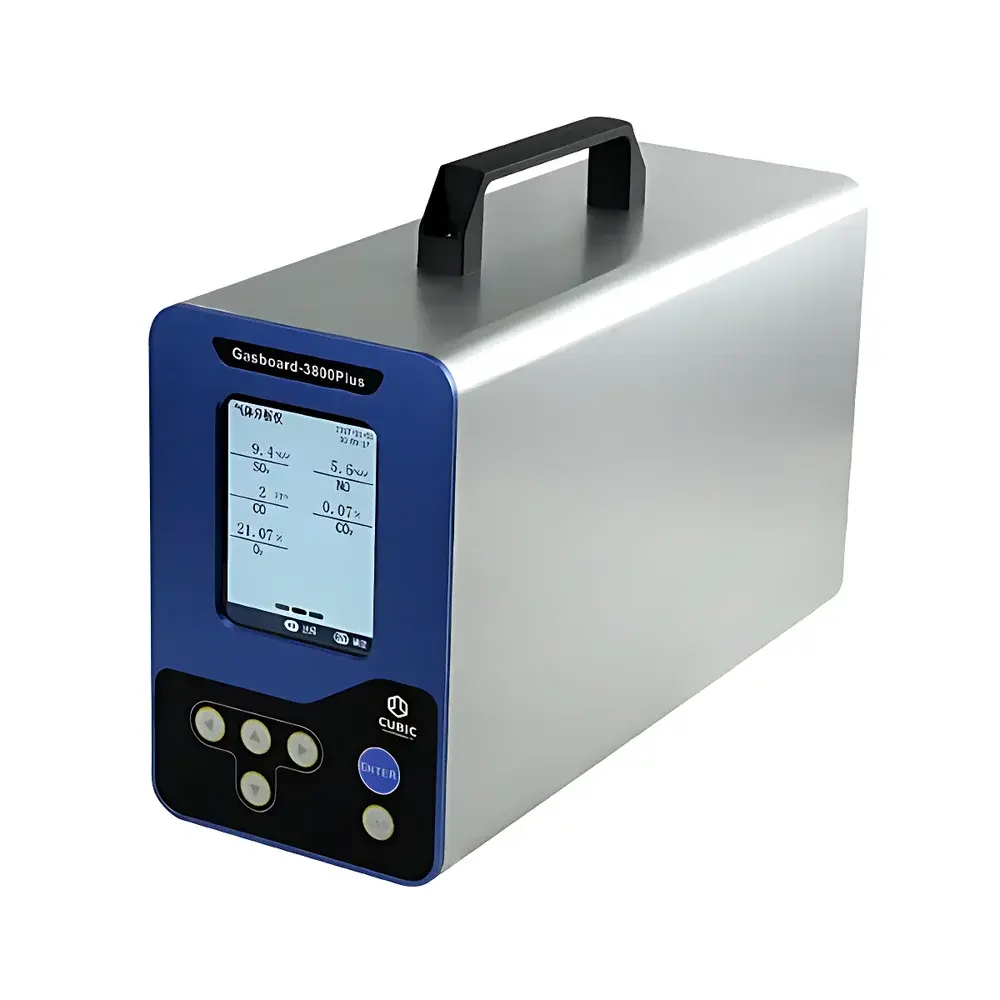
CUBIC INSTRUMENTS Gasboard-3800Plus Portable Infrared Flue Gas Analyzer
| Brand | CUBIC INSTRUMENTS |
|---|---|
| Origin | Hubei, China |
| Model | Gasboard-3800Plus |
| Instrument Type | Portable Flue Gas Analyzer |
| Measurement Accuracy | ≤2% F.S. |
| Repeatability | ≤2% |
| Response Time | ≤30 s |
| Stability | ≤2% F.S./24 h |
| Measured Gases | SO₂, NO, CO, CO₂, O₂ |
| Measurement Principles | Micro-flow NDIR (SO₂/NO/CO), Broadband NDIR (CO₂), Electrochemical Detection (O₂) |
| Sample Flow Rate | 0.7–1.2 L/min |
| Dimensions | 275 × 470 × 175 mm |
| Weight | 7.5 kg |
| Power Supply | AC 220 V ±10%, 50 Hz |
| Display | LCD |
Overview
The CUBIC INSTRUMENTS Gasboard-3800Plus is a field-deployable, multi-component flue gas analyzer engineered for precision environmental emissions monitoring and energy efficiency assessment. It integrates dual-sensing modalities: micro-flow non-dispersive infrared (NDIR) spectroscopy for SO₂, NO, and CO; broadband NDIR for CO₂; and electrochemical detection (ECD) for O₂. This hybrid architecture ensures high selectivity and minimal cross-sensitivity among target analytes—critical for regulatory-grade measurements in complex combustion exhaust streams. The instrument operates on the principle of Beer–Lambert absorption for infrared-active gases and Faradaic current generation for oxygen, delivering trace-level quantification without chemical reagents or consumables. Designed for compliance with international stack testing protocols, the Gasboard-3800Plus supports real-time, in-situ analysis of fixed emission sources—including coal-fired boilers, natural gas turbines, industrial kilns, and waste incinerators—without requiring laboratory sample transport or dilution.
Key Features
- Integrated heated sampling probe and thermostatically controlled gas conditioning unit (including particulate filtration, condensate removal, and flow regulation) to preserve native gas composition and prevent water vapor interference;
- Patented split-gas chamber optical design that enhances thermal and electrical stability, reducing zero drift and sensitivity to ambient temperature fluctuations (±0.5 °C) and line voltage variation (±10%);
- Simultaneous five-parameter measurement (SO₂, NO, CO, CO₂, O₂) with full digital signal processing and auto-zero calibration routines;
- Robust mechanical architecture optimized for field use: IP54-rated enclosure, shock-absorbing chassis, and battery-backed internal memory for offline data logging (up to 10,000 records);
- Pre-calibrated sensor modules with factory traceability to NIST-certified reference standards; field verification supported via certified span gas kits (ISO 12039, EN 15267-compliant);
- Real-time calculation of derived parameters including excess air ratio (λ), combustion efficiency, and NOₓ (as NO₂-equivalent), supporting ISO 5167 and ASTM D6216 workflows.
Sample Compatibility & Compliance
The Gasboard-3800Plus is validated for direct sampling of hot, humid, and particulate-laden flue gases up to 180 °C (with optional high-temp probe). Its heated sampling train maintains dew point above condensation threshold throughout the entire gas path, eliminating sorption losses of soluble species (e.g., SO₂) and preserving stoichiometric integrity. All measurement algorithms adhere to fundamental metrological principles outlined in ISO 14064-3 (greenhouse gas verification) and EN 14181 (QAL3 performance validation). The device meets functional requirements for periodic monitoring under EU Industrial Emissions Directive (IED) Annex VI and U.S. EPA Method 3A (for O₂) and Method 7E (for SO₂/NO). While not intrinsically rated for Zone 1 hazardous areas, it complies with IEC 61000-4 electromagnetic immunity standards for industrial environments.
Software & Data Management
Data acquisition and reporting are managed via the proprietary Gasboard PC Suite v4.2, compatible with Windows 10/11 and supporting USB, Bluetooth, and RS232 connectivity. The software enables configurable logging intervals (1–600 s), automated report generation in PDF/CSV formats per EN 15267-3 Annex B templates, and audit-trail-enabled user access control. Raw spectral data and diagnostic logs (e.g., detector voltage, cell temperature, pump status) are stored with time stamps and operator ID. For regulated laboratories, the system supports 21 CFR Part 11-compliant electronic signatures when deployed with validated IT infrastructure and documented change control procedures. Firmware updates are digitally signed and version-locked to ensure measurement continuity and traceability.
Applications
- Continuous compliance monitoring of desulfurization (FGD) and denitrification (SCR/SNCR) systems in power plants;
- Third-party emissions verification for ISO 14064-1 GHG inventories and CDM/VER projects;
- Boiler tuning and combustion optimization studies per ASME PTC 4 and EN 12952-15;
- Mobile source testing support (e.g., marine auxiliary engines, stationary diesel generators);
- Academic and governmental research on pollutant formation mechanisms, catalyst deactivation, and low-carbon fuel substitution effects;
- Pre-commissioning QA/QC of flue gas treatment installations and post-maintenance performance validation.
FAQ
What calibration gases are required for routine operation?
Standard span gases certified to ISO 6141:2015 are recommended—typically 500 ppmv SO₂/N₂, 500 ppmv NO/N₂, 1000 ppmv CO/N₂, 15% CO₂/N₂, and 10% O₂/N₂. Zero gas must be ultra-pure synthetic air (O₂ < 0.1 ppmv).
Can the instrument measure NO₂ directly?
No. The Gasboard-3800Plus measures NO only. For total NOx, users must apply the conversion factor specified in EN 14792 (NO → NO₂ at 95% efficiency in catalytic converter mode) or integrate with an external thermal converter.
Is the device suitable for unattended long-term deployment?
It is designed for intermittent field use (≤8 h/day). For continuous monitoring, integration with a certified CEMS platform (e.g., via 4–20 mA analog outputs or Modbus RTU) is required per EN 15267-3 QAL1 certification.
How often should the electrochemical O₂ sensor be replaced?
Under typical operating conditions (20–25% O₂, 25 °C), the ECD sensor has a service life of ≥24 months. Performance degradation is tracked via built-in diagnostics and verified during semi-annual QAL2 audits.







