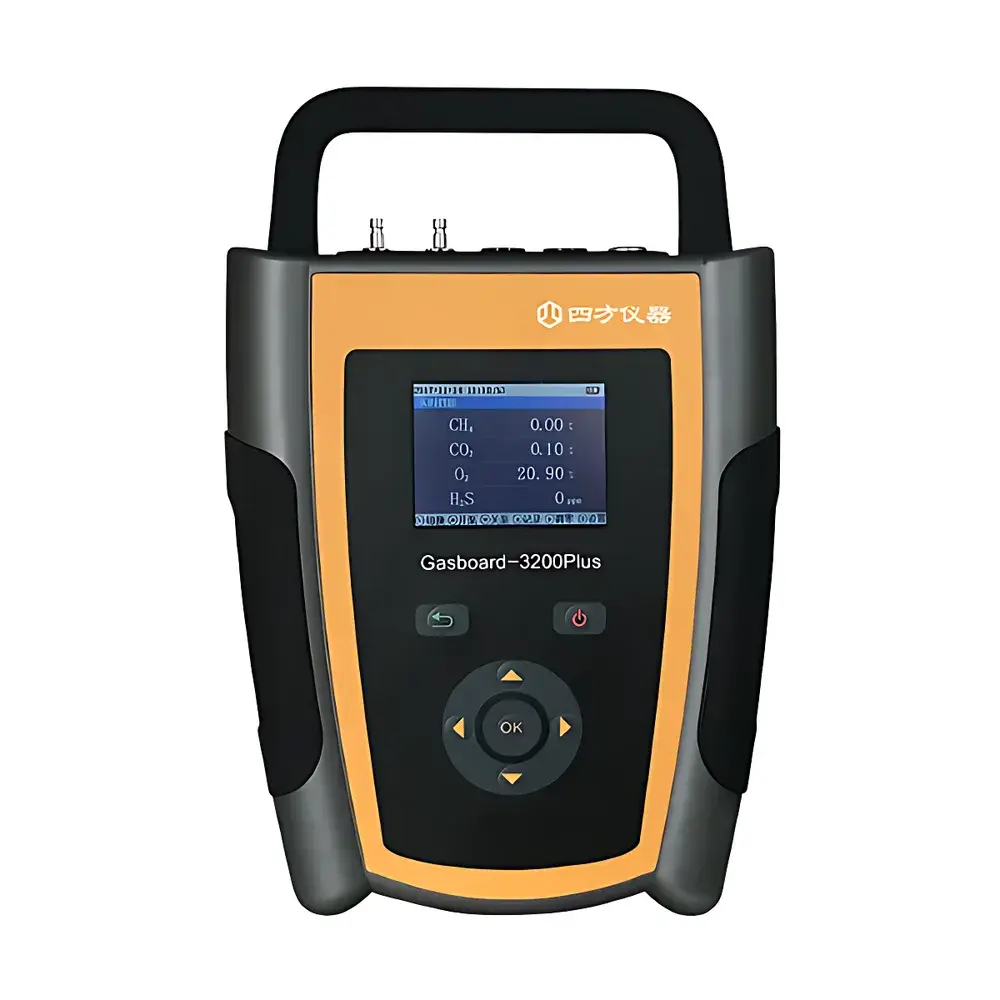
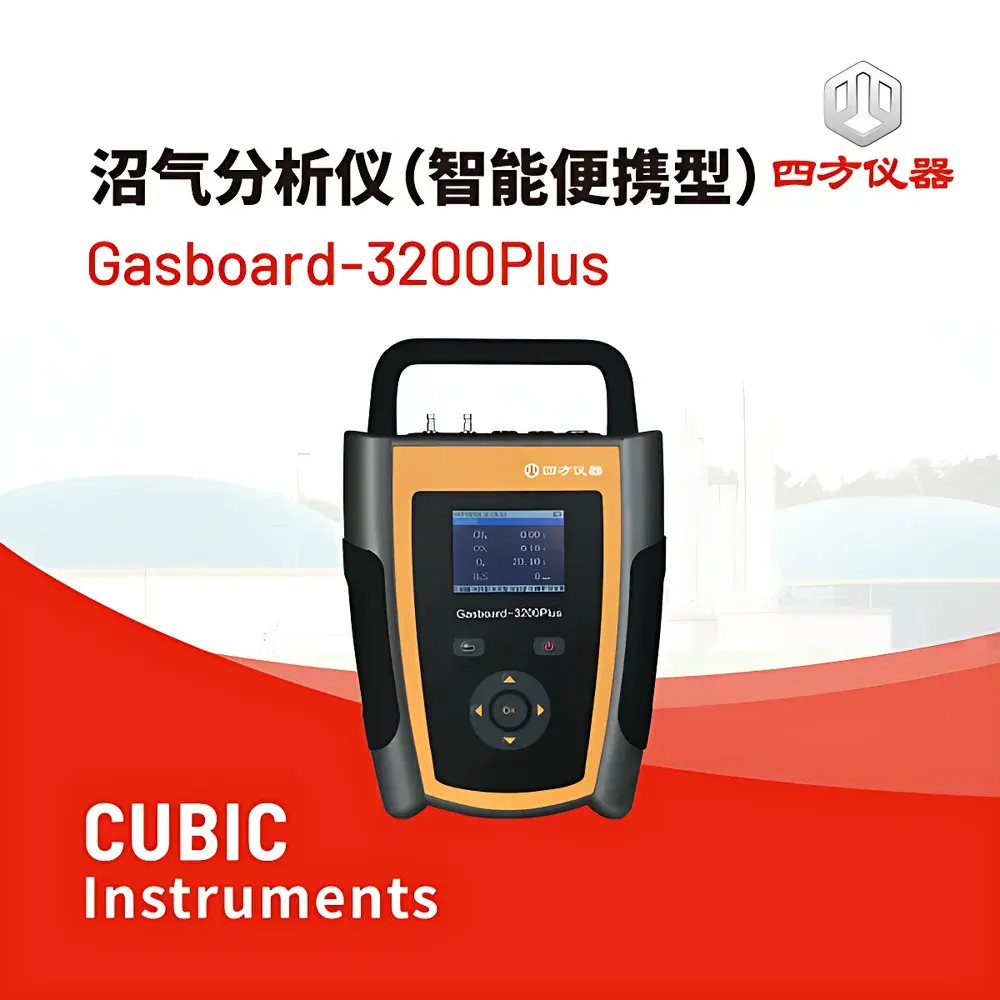
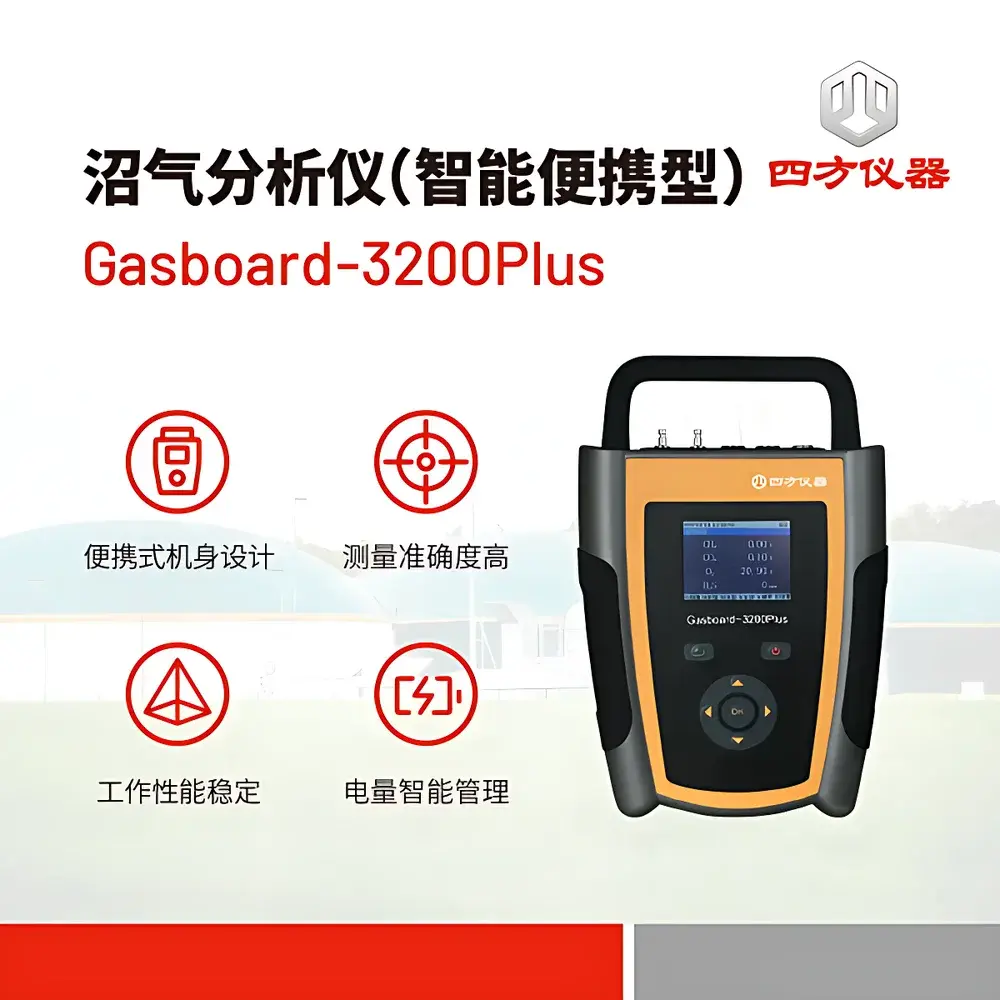
CUBIC INSTRUMENTS Gasboard-3200Plus Portable Biogas Analyzer
| Brand | CUBIC INSTRUMENTS |
|---|---|
| Origin | Hubei, China |
| Model | Gasboard-3200Plus |
| Measurement Range | CH₄: (0–100) % vol |
| CO₂ | (0–50) % vol |
| H₂S | (0–9999) ppm |
| O₂ | (0–25) % vol (all ranges configurable) |
| Accuracy | CH₄/CO₂: ±2% FS |
| O₂/H₂S | ±3% FS |
| Detection Principle | CH₄ & CO₂ via NDIR |
| Display | Color LCD |
| Power | Rechargeable 18650 Li-ion battery (replaceable), external 5 V / 2 A charger |
| Connectivity | USB interface, Bluetooth 4.0 |
| Data Storage | Internal logging with query/delete functions |
Overview
The CUBIC INSTRUMENTS Gasboard-3200Plus is a compact, field-deployable biogas analyzer engineered for real-time, multi-component gas concentration measurement in anaerobic digestion environments. It employs dual-sensing architecture: non-dispersive infrared (NDIR) spectroscopy for high-selectivity, drift-resistant quantification of methane (CH₄) and carbon dioxide (CO₂), and electrochemical detection (ECD) for precise, low-range monitoring of hydrogen sulfide (H₂S) and oxygen (O₂). Unlike wet-chemical or chromatographic methods, this instrument requires no carrier gases, chemical reagents, or consumable optical filters—enabling maintenance-free operation over extended deployment cycles. Its lightweight, ergonomic housing (75% smaller volume and 60% reduced mass vs. prior-generation units) supports both handheld field surveys and fixed-position sampling from gas bags or process vents. Designed for compliance with routine operational monitoring requirements in waste-to-energy infrastructure, the Gasboard-3200Plus delivers traceable, repeatable measurements under variable ambient conditions—including fluctuating humidity and temperature gradients typical of landfill leachate zones or digester headspace.
Key Features
- Modular sensor architecture ensures cross-interference-free simultaneous detection of CH₄, CO₂, H₂S, and O₂—with optional expansion to H₂ and CO via plug-in ECD modules.
- Dual-channel signal processing enhances long-term stability: reference and active channels compensate for thermal drift and aging effects in NDIR cells and electrochemical electrodes.
- Integrated self-diagnostic firmware continuously monitors sensor health, battery status, and calibration validity—flagging anomalies before measurement deviation exceeds specification limits.
- Smart power management includes soft-start circuitry, low-voltage cutoff protection, and battery-level estimation algorithms to prevent data corruption during shutdown.
- On-device data logging stores timestamped concentration records with automatic overwrite policy; export supported via USB mass storage mode or Bluetooth 4.0 BLE profile to iOS/Android companion applications.
- Optional integration with external handheld anemometers enables volumetric flow-corrected biogas emission rate calculation (e.g., m³/h × %CH₄ → CH₄ kg/h), supporting GHG reporting per IPCC Tier 2 methodologies.
Sample Compatibility & Compliance
The Gasboard-3200Plus accepts direct sampling from flexible gas collection bags (Tedlar®, FEP), stainless-steel sample lines, or inline process taps via standard 6 mm OD push-fit connectors. Sample conditioning is minimal: built-in particulate filter (5 µm rating) and hydrophobic membrane prevent moisture ingress without requiring external chillers or permeation dryers. The analyzer meets CE marking requirements for electromagnetic compatibility (EN 61326-1) and environmental robustness (IP54 ingress protection). While not certified for hazardous area use (ATEX/IECEx), it complies with functional safety expectations for Class I, Division 2 environments when operated outside explosive atmospheres. Data integrity aligns with GLP principles: each measurement record includes firmware version, sensor serial numbers, calibration date, and ambient temperature/humidity metadata—supporting audit readiness for municipal wastewater utility QA/QC programs.
Software & Data Management
Firmware v3.2+ implements secure local data handling with encrypted internal flash storage (≥10,000 records). The CUBIC Biogas Connect mobile application (iOS/Android) provides live telemetry visualization, historical trend overlays, and CSV export with ISO 8601 timestamps. Bluetooth pairing uses AES-128 encryption; no cloud upload occurs unless explicitly initiated by user. For enterprise integration, USB CDC ACM mode exposes raw ASCII-formatted output compatible with SCADA systems (e.g., Ignition, WinCC) and LabVIEW-based DAQ platforms. Calibration logs are digitally signed and exportable as PDF reports compliant with ISO/IEC 17025 documentation standards.
Applications
- Landfill gas monitoring: periodic profiling of CH₄/CO₂ ratios to assess decomposition stage and optimize extraction well sequencing.
- Wastewater treatment plants: real-time verification of anaerobic digester biogas composition prior to CHP engine feeding or flaring.
- Agro-industrial biogas facilities: feedstock optimization studies via diurnal CH₄ yield tracking across manure, crop residue, and co-digestion batches.
- Research laboratories: validation of microbial activity assays using gas bag sampling followed by offline analysis.
- Regulatory compliance: support for EPA Method 2C (landfill surface emissions) and EN 15439 (biogas quality for grid injection) pre-screening.
FAQ
What calibration gases are required for field verification?
Certified zero air and span gases matching your target ranges (e.g., 50% CH₄ in N₂, 20% CO₂ in N₂, 500 ppm H₂S in air) are recommended annually or after 200 hours of operation.
Can the instrument operate continuously while charging?
Yes—the device supports pass-through power: external 5 V / 2 A input enables uninterrupted measurement and battery top-up simultaneously.
Is H₂S measurement affected by high humidity?
The integrated hydrophobic membrane reduces condensate formation, but prolonged exposure to >90% RH may accelerate ECD electrode saturation; use of optional heated sample line is advised for saturated biogas streams.
Does the analyzer meet FDA 21 CFR Part 11 requirements?
While not validated for pharmaceutical GMP environments, its audit-trail-capable firmware and electronic signature-ready calibration logs provide foundational elements for Part 11 alignment in environmental monitoring contexts.
How often must the NDIR optical path be cleaned?
Under typical biogas conditions, optical windows require cleaning only every 6–12 months; no user-serviceable optics—cleaning is performed by authorized service centers using ISO Class 5 cleanroom protocols.