
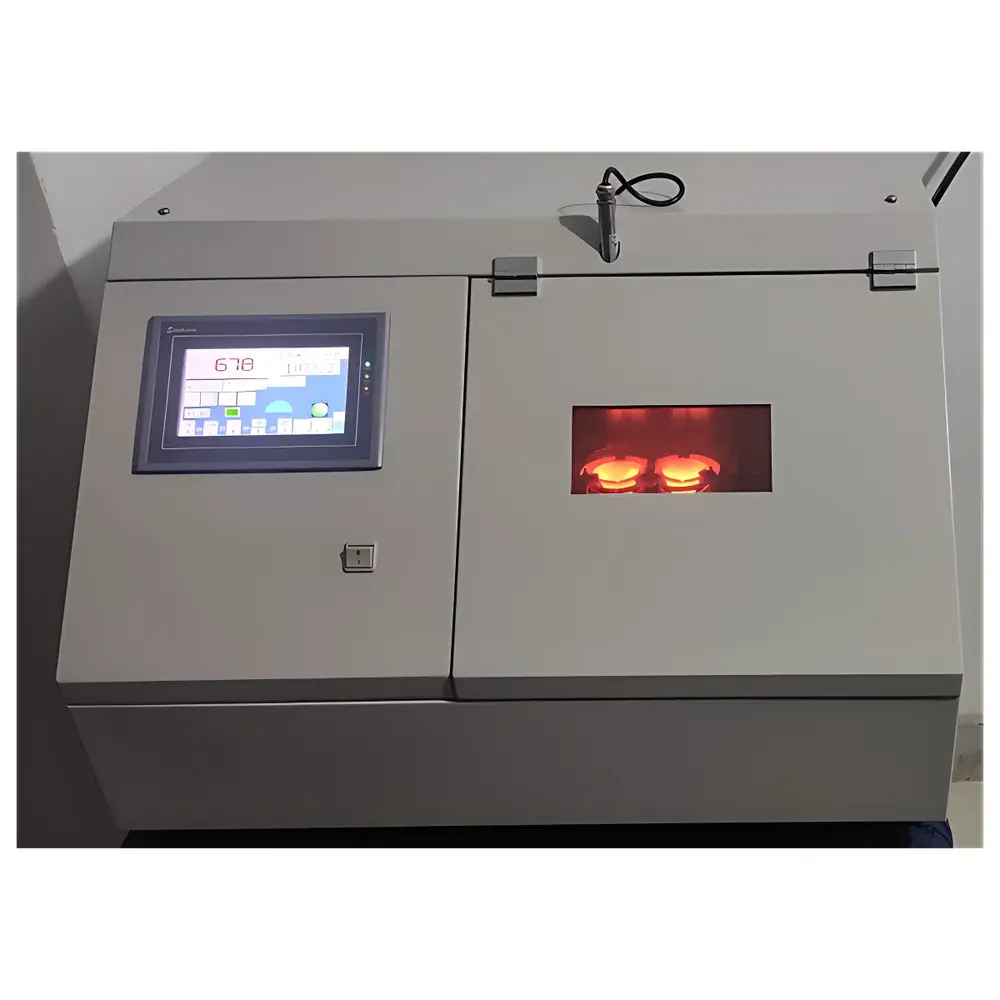
XQ Toptech-OX4.1 Automatic Inverting High-Frequency Fusion Machine for XRF Sample Preparation
| Brand | XQ |
|---|---|
| Origin | Liaoning, China |
| Manufacturer Type | Authorized Distributor |
| Country of Origin | China |
| Model | XQ Toptech-OX4.1 |
| Throughput | 16 samples/hour |
| Operating Temperature Range | 1100–1300 °C |
| Dimensions (L×W×D) | 800×720×560 mm |
Overview
The XQ Toptech-OX4.1 is an automatic inverting high-frequency fusion machine engineered specifically for the preparation of homogeneous, bubble-free glass beads used in wavelength-dispersive (WDXRF) and energy-dispersive (EDXRF) X-ray fluorescence spectrometry. It employs high-frequency induction heating (typically 200–400 kHz) to rapidly and uniformly heat platinum–gold (Pt–Au) or Pt–Au–Rh crucibles containing sample–flux mixtures—such as lithium tetraborate (Li₂B₄O₇), lithium metaborate (LiBO₂), or mixed fluxes—to full melt under controlled inert or oxidizing atmospheres. Unlike resistive furnace-based systems, this design eliminates thermal lag, ensures precise temperature ramping, and delivers superior thermal stability across the 1100–1300 °C operational range. The unit integrates a programmable pre-oxidation stage (600–800 °C), enabling controlled decomposition of sulfides, carbonates, and organic matrices prior to fusion—critical for accurate major- and trace-element quantification in geological, metallurgical, and environmental samples.
Key Features
- Automated inverting casting mechanism with synchronized crucible rotation and tilt control, ensuring complete, laminar pour-out and uniform bead geometry (diameter tolerance ±0.3 mm, thickness variation <±2%);
- Dual-stage thermal programming: independent pre-oxidation (600–800 °C) and high-temperature fusion (1000–1300 °C) with real-time thermocouple feedback from crucible base;
- Low-voltage high-frequency power supply (≤48 V AC output) compliant with IEC 61000-4-3 EMC standards, minimizing arc risk and enhancing operator safety;
- Microprocessor-controlled operation with 16 preloaded method templates; each method stores target temperatures, ramp rates, hold times, rotation speed (0–60 rpm), and inversion angle (90°–120°);
- Integrated crucible shaker subsystem generating controlled vortex motion during melt homogenization—reducing segregation and improving mixing efficiency for heterogeneous ores and slag matrices;
- Full-cycle automation: crucible loading → pre-oxidation → fusion → stirring → casting → cooling → bead ejection—requiring zero manual intervention after start;
- Robust stainless-steel chassis with forced-air cooling ducts and ceramic-insulated heating chamber, supporting continuous operation at rated throughput (16 samples/hour).
Sample Compatibility & Compliance
The XQ Toptech-OX4.1 accommodates standard 32 mm or 37 mm Pt–Au alloy crucibles and supports common XRF fusion protocols per ASTM D5630, ISO 29581-2, and GB/T 14506.28. It is validated for use with silicate rocks, coal ash, cement clinker, ferrous/non-ferrous slags, soil digests, and mineral concentrates. All thermal profiles comply with GLP documentation requirements, including time-stamped audit logs of setpoints, actual temperatures, and process events. Optional RS-232/RS-485 serial interface enables integration into LIMS environments supporting 21 CFR Part 11-compliant electronic signatures and data integrity controls.
Software & Data Management
The embedded control firmware provides intuitive touch-screen navigation with multilingual UI (English, Spanish, German, Chinese). Process data—including real-time temperature curves, crucible rotation speed, inversion timing, and fault codes—are logged internally and exportable via USB to CSV or XML formats. Firmware supports secure user-level access control (administrator/operator modes) and automatic backup of calibration coefficients and method libraries. Remote diagnostics are available via optional Ethernet module, facilitating predictive maintenance scheduling and traceable calibration history management aligned with ISO/IEC 17025 laboratory accreditation requirements.
Applications
- Preparation of fused beads for quantitative XRF analysis of SiO₂, Al₂O₃, Fe₂O₃, CaO, MgO, Na₂O, K₂O, TiO₂, P₂O₅, MnO, and trace elements (e.g., Cr, Ni, Zn, Pb) in geological survey labs;
- Routine quality control of raw materials and final products in cement, steel, and non-ferrous smelting industries;
- Environmental monitoring labs processing fly ash, bottom ash, and contaminated soils under EPA Method 6010D or ISO 12846;
- Research laboratories developing novel flux chemistries or validating multi-acid digestion–fusion hybrid workflows;
- Reference material producers requiring batch-to-batch reproducibility (RSD <0.8% for major oxides across 10 consecutive beads).
FAQ
What crucible types and sizes are supported?
Standard 32 mm and 37 mm Pt–Au (95/5) or Pt–Au–Rh (95/3/2) crucibles are compatible. Custom crucible holders can be supplied upon request.
Is pre-oxidation programmable per sample batch?
Yes—each method template includes independent pre-oxidation temperature, duration, and atmosphere control (air or O₂ purge).
How is temperature accuracy verified and maintained?
A calibrated Type S thermocouple embedded in the crucible support plate provides direct measurement; annual verification against NIST-traceable reference standards is recommended.
Does the system meet international safety standards?
It complies with IEC 61010-1 (Safety Requirements for Electrical Equipment for Measurement, Control, and Laboratory Use) and carries CE marking for EMC and Low Voltage Directive conformity.
Can the machine integrate with existing LIMS or ERP platforms?
Yes—via ASCII-based serial protocol or Modbus TCP (optional Ethernet module), enabling bidirectional sample ID transfer and result metadata synchronization.



