
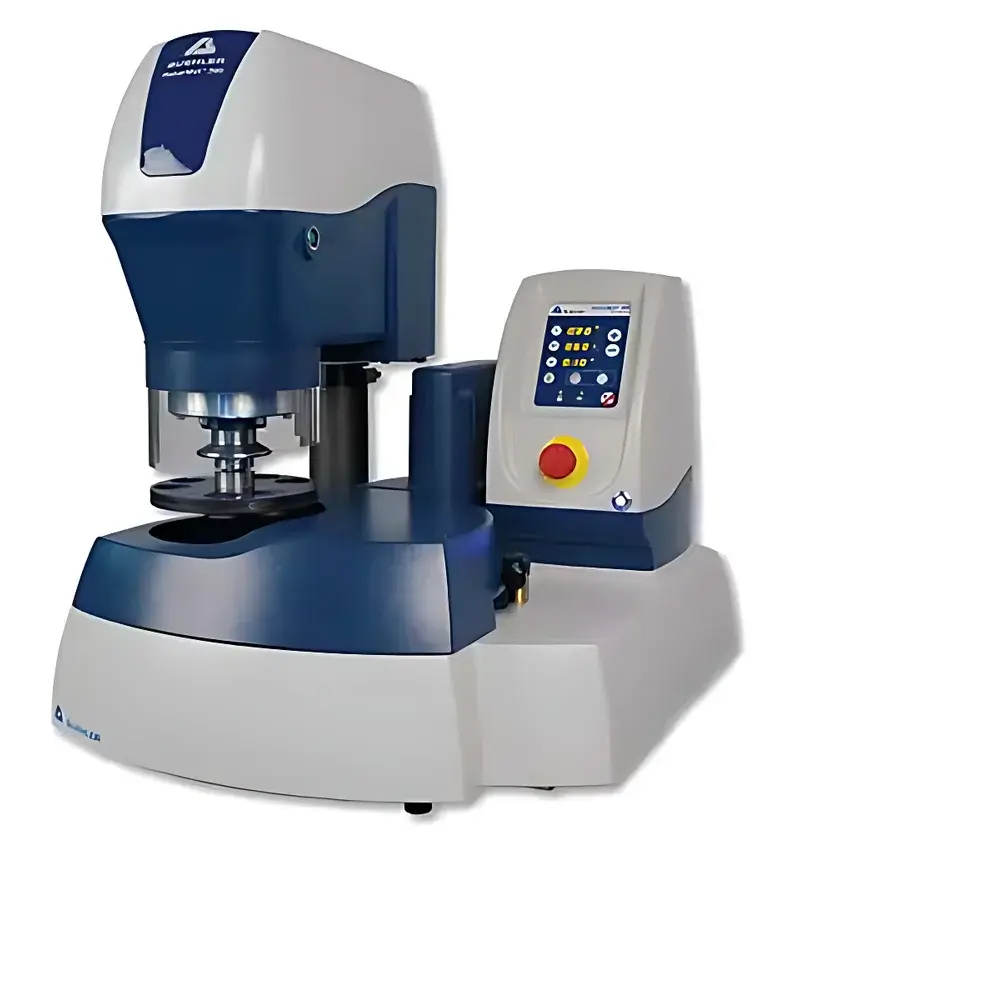
Buehler PlanarMet™ 300 Desktop Precision Planar Grinding System
| Brand | Buehler |
|---|---|
| Origin | USA |
| Model | PlanarMet™ 300 |
| Dimensions (L×W×D) | 539 mm × 787 mm × 755 mm |
| Grinding Wheel Count | 1 |
| Wheel Diameter | 305 mm (12 in) |
| Wheel Speed | 1600 rpm |
| Z-axis Depth Control Resolution | 0.01 mm |
| Programmable Grinding Depth Range | 0.1–3.0 mm (0.1 mm increments) |
| Downforce Range | 40–445 N (10–100 lbf, 20 N / 5 lbf steps) |
| Head Rotation Speed | 60–150 rpm (10 rpm increments) |
| Head Rotation Direction | CW/CCW |
| Wheel Rotation Direction | CCW |
| Automatic Wheel Dressing System | Yes |
| Dressing Depth Range | 10–50 µm (5 µm increments) |
| Dressing Interval | 10 s – 10 min |
| Motor Power | 5.7 HP (base) + 0.7 HP (head), Total 5.6 kW |
| Electrical Supply | Integrated 10-pin interface |
| Operating Temperature | 5–40 °C (non-condensing), Humidity: 30–90 % RH |
| Noise Level | 71 dB(A) |
| Coolant Reservoir Options | 45 L or 83 L |
| Water Manifold | Integrated continuous flow system |
| Fixturing Max Diameter | 184 mm (7.2 in) |
| Mounting Thread | M8 |
| Tooling Wrench | 5 mm hex |
Overview
The Buehler PlanarMet™ 300 is a desktop-integrated, high-precision planar grinding system engineered for reproducible, controlled material removal in metallographic and materials science laboratories. Unlike conventional rotary grinders relying on orbital motion or random abrasive action, the PlanarMet™ 300 employs a true planar (flat-surface) grinding principle—where the specimen remains stationary while the grinding wheel rotates and traverses vertically (Z-axis) under programmable force and depth control. This architecture eliminates edge rounding, minimizes subsurface deformation, and delivers exceptional flatness and parallelism across heterogeneous or multi-phase samples—including ceramics, composites, electronic substrates, and hardened alloys. Designed to meet ISO 14971 risk management requirements for laboratory equipment and aligned with ASTM E3, E407, and ISO 643 standards for microstructural preparation, the system supports GLP-compliant workflows through audit-trail-capable software and deterministic process parameters.
Key Features
- True planar grinding geometry ensuring uniform material removal and minimal topographic distortion
- Programmable Z-axis depth control with 0.01 mm resolution and 0.1–3.0 mm adjustable stroke range
- Automated diamond wheel dressing system with user-defined dressing depth (10–50 µm) and interval (10 s–10 min)
- Dual-motor architecture: 5.7 HP base motor for wheel rotation (1600 rpm, CCW) and 0.7 HP head motor for precise rotational positioning (60–150 rpm, CW/CCW selectable)
- Integrated coolant manifold delivering consistent, laminar water flow across the grinding interface to suppress thermal damage and extend wheel life
- Film-based HMI with intuitive parameter navigation, real-time force monitoring, and cycle status feedback
- Modular fixturing support up to 184 mm diameter specimens, compatible with standard Buehler mounting systems and custom jigs
- Low-noise operation (71 dB(A)) and compact footprint (539 × 787 × 755 mm) enabling seamless integration into benchtop workflows without floor space compromise
Sample Compatibility & Compliance
The PlanarMet™ 300 accommodates a broad spectrum of specimen types—from brittle silicon wafers and PCB cross-sections to ductile titanium alloys and refractory ceramics—without requiring specialized adapters beyond standard Buehler mounting fixtures. Its force-controlled grinding mechanism (40–445 N, 20 N increments) enables optimization for soft polymers and hard carbides alike. All consumables—including Planar™ grinding wheels, CarbiMet™ SiC papers, MetaDi™ diamond suspensions, and TexMet™ polishing cloths—are manufactured to ASTM D7232 and ISO 12127 specifications. The system’s electrical design conforms to UL 61010-1 and IEC 61010-1 safety standards; its software architecture supports FDA 21 CFR Part 11 compliance when paired with Buehler’s OmniMet™ Suite via optional electronic signature and audit trail modules.
Software & Data Management
While the PlanarMet™ 300 operates independently via its onboard controller, it is fully interoperable with Buehler’s OmniMet™ Software Platform (v5.2+). This integration enables method synchronization, remote parameter validation, electronic batch record generation, and export of grinding logs (timestamp, depth, force, RPM, coolant flow rate) in CSV or PDF formats. All process data are stored locally with timestamped metadata and support version-controlled method libraries. For regulated environments, optional firmware upgrades provide electronic signature enforcement, user role-based access control (admin/operator/technician), and immutable audit trails compliant with GLP and GMP documentation requirements.
Applications
- Precision cross-sectioning of electronic packages, solder joints, and multilayer PCBs for failure analysis (FA)
- Controlled thinning of ceramic matrix composites (CMCs) prior to TEM lamella preparation
- Flat-face grinding of additively manufactured metal parts to eliminate surface roughness prior to hardness testing
- Routine metallographic preparation of cast iron, stainless steels, and aluminum alloys per ASTM E3 guidelines
- Preparation of geological thin sections where optical clarity and planarity are critical for petrographic analysis
- Grinding of brittle semiconductor materials (e.g., GaN, SiC) with minimized chipping and subsurface cracking
FAQ
What distinguishes planar grinding from conventional rotary grinding?
Planar grinding maintains constant specimen orientation and applies uniform vertical force across the entire surface, eliminating edge beveling and producing superior flatness—critical for quantitative image analysis and EBSD indexing.
Can the PlanarMet™ 300 be used for final polishing?
No—it is optimized for precision grinding and coarse-to-intermediate material removal. Final polishing requires dedicated polishing units (e.g., Buehler EcoMet™ or AutoMet™ systems) using cloth-backed abrasives and colloidal suspensions.
Is the system compatible with third-party grinding wheels?
Only Buehler-certified Planar™ wheels are validated for use with the automatic dressing algorithm and force calibration; non-OEM wheels may compromise repeatability and void warranty coverage.
How is coolant flow managed during extended cycles?
The integrated recirculating pump (45 L or 83 L reservoir options) maintains stable temperature and particulate suspension; optional inline filters and conductivity sensors enable closed-loop monitoring for high-throughput labs.
Does the system support automated multi-step protocols?
Yes—via OmniMet™ Software, users can chain sequential grinding stages (e.g., rough → intermediate → fine) with independent force, depth, time, and RPM settings, all triggered by a single execution command.



