
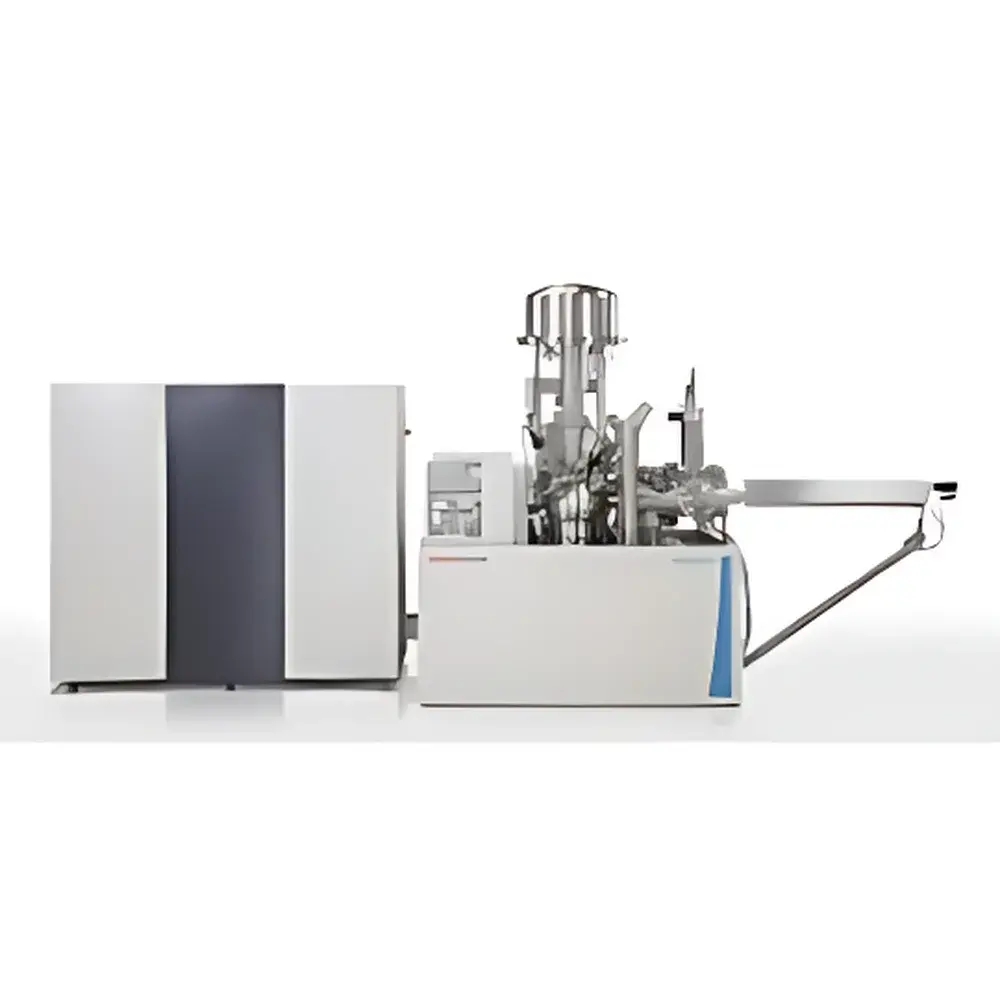
Thermo Scientific ESCALAB QXi X-Ray Photoelectron Spectrometer
| Brand | Thermo Fisher |
|---|---|
| Origin | United Kingdom |
| Manufacturer | Thermo Fisher Scientific |
| Origin Category | Imported |
| Model | ESCALAB QXi |
| Pricing | Upon Request |
Overview
The Thermo Scientific ESCALAB QXi X-Ray Photoelectron Spectrometer (XPS) represents the latest generation of high-performance surface analysis instrumentation in the ESCALAB platform family. Engineered for precision, reproducibility, and multi-technique versatility, the QXi is designed as a modular, ultra-high-vacuum (UHV) compatible surface science system capable of quantitative elemental composition, chemical state identification, depth profiling, and nanoscale spatial mapping. Its core measurement principle relies on the photoelectric effect: monochromatic Al Kα X-rays irradiate the sample surface, ejecting photoelectrons whose kinetic energy is measured by a high-transmission hemispherical electron energy analyzer. From this, binding energy spectra are derived—enabling unambiguous identification of elemental species and their oxidation states with sub-eV energy resolution. The system operates under base pressures better than 1 × 10⁻¹⁰ mbar, ensuring minimal surface contamination during acquisition and supporting rigorous surface-sensitive analysis down to the top 1–10 nm.
Key Features
- Monochromated Microfocus X-ray Source: Dual-crystal monochromator delivers tunable spot sizes from 20 µm to 900 µm with continuous adjustment; optimized for both high-sensitivity survey scans and high-resolution microanalysis.
- High-Performance Energy Analyzer: Large acceptance angle hemispherical analyzer with multi-channel detection enables rapid acquisition of high signal-to-noise spectra and parallel imaging without spectral distortion.
- Dual-Detector Architecture: Integrated electron multiplier (for high-sensitivity spectroscopy) and resistive-anode detector (RAD) for true background-free, spatially continuous XPS imaging at ≤1 µm lateral resolution—eliminating detector artifacts and enabling direct quantification of elemental distributions.
- Automated Depth Profiling: Hybrid ion source combining Ar⁺ cluster beams (e.g., Ar₂₀₀₀⁺) and conventional monoatomic Ar⁺ enables controlled sputtering of organic, polymeric, and inorganic layered structures while minimizing interface mixing.
- Angle-Resolved XPS (ARXPS): Motorized sample stage with precise angular positioning (±0.1° repeatability) and software-controlled data acquisition workflows support quantitative thickness modeling of ultrathin films (1–5 nm) and interfacial layer analysis per ISO 18118 and ASTM E1523 guidelines.
- Integrated Charge Neutralization: Dual-beam low-energy electron/ion flood gun system with independent parameter control ensures stable charge compensation across insulating samples—including rough, heterogeneous, or low-conductivity substrates—without manual intervention.
Sample Compatibility & Compliance
The ESCALAB QXi accommodates a broad range of solid-state samples—including metals, semiconductors, oxides, polymers, catalysts, thin-film devices, and biological coatings—within standard 50 mm diameter sample holders. Optional accessories extend capability to in situ heating/cooling (−150 °C to +600 °C), reactive gas dosing, and high-pressure reaction environments (up to 1 bar). All hardware and software modules comply with international surface analysis standards including ISO 18118 (XPS terminology), ISO 14637 (depth profiling methodology), and ASTM E1523 (ARXPS data analysis). Data acquisition and processing workflows support audit-ready documentation aligned with GLP and GMP requirements; Avantage software includes full electronic signature support and 21 CFR Part 11-compliant audit trails.
Software & Data Management
Thermo Scientific Avantage™ v6.x is the fully integrated, Windows-based control and analysis platform. It provides real-time instrument status monitoring, synchronized multi-technique acquisition (XPS, UPS, ISS, REELS, AES), and automated calibration routines—including work function verification, energy scale alignment, and ion gun focus optimization. The software features an extensive reference database of over 25,000 high-fidelity XPS spectra, compound identification tools based on peak-shape fitting and chemical shift libraries, and customizable report templates compliant with ISO/IEC 17025 reporting conventions. All raw and processed data are stored in vendor-neutral formats (VAMAS, JCAMP-DX), facilitating long-term archival and third-party reanalysis.
Applications
The ESCALAB QXi supports mission-critical surface characterization in academic research, semiconductor R&D, catalysis development, corrosion science, battery materials engineering, and medical device coating validation. Typical use cases include: chemical state mapping of gate dielectrics in FinFET structures; quantification of oxide layer stoichiometry in Li-ion cathode materials; identification of degradation products at polymer–metal interfaces; depth-resolved analysis of passivation layers on photovoltaic absorbers; and surface functional group distribution in bioactive coatings. Its modularity allows seamless integration with UHV transfer systems, in situ electrochemical cells, and synchrotron beamline coupling for correlative studies.
FAQ
What vacuum level does the ESCALAB QXi achieve in the analysis chamber?
The base pressure is typically <1 × 10⁻¹⁰ mbar, maintained via a combination of turbomolecular pumping and non-evaporable getter (NEG) panels.
Is ARXPS data acquisition fully automated?
Yes—sample tilt angle, analysis position, and data collection parameters are programmable within Avantage; full ARXPS datasets (including take-off angle series) can be acquired unattended.
Can the system perform simultaneous XPS and AES measurements?
AES is available as an optional add-on module; it shares the same electron analyzer but requires separate electron gun installation and is not acquired simultaneously with XPS.
How is energy calibration performed?
Calibration uses certified reference samples (e.g., Au 4f₇/₂ at 84.0 eV, Cu 2p₃/₂ at 932.7 eV, Ag 3d₅/₂ at 368.3 eV); Avantage includes one-click auto-calibration routines with drift correction.
Are consumables required for the X-ray source?
No—anode replacement is unnecessary; the monochromated Al Kα source offers ≥20 distinct operational focal points, ensuring >10 years of typical service life without target degradation.





