
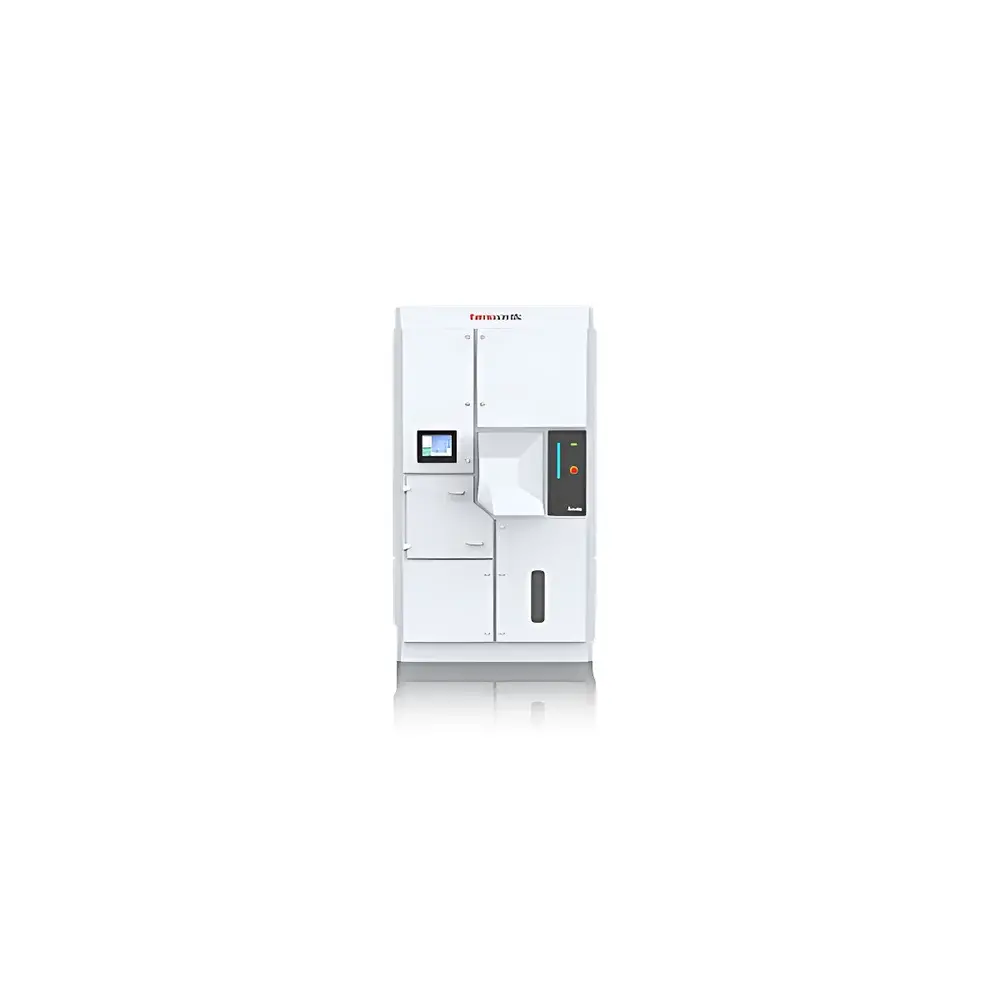
Thermo Scientific Arctis Cryo-Plasma Focused Ion Beam Scanning Electron Microscope
| Brand | Thermo Scientific |
|---|---|
| Origin | Netherlands |
| Model | Arctis |
| Ion Sources | Xe⁺, O⁺, Ar⁺ |
| Sample Capacity | Up to 12 cryo-grids (TomoGrids/AutoGrids) |
| Integrated iFLM | Yes |
| Vacuum System | Ultra-high vacuum cryo-chamber |
| Cooling Architecture | Dual-stage cryo-shielding with braided cryo-sleeve |
| Compliance | Designed for GLP/GMP-aligned cryo-EM workflows, compatible with FDA 21 CFR Part 11–ready software environments |
| Biocontainment Option | High-temperature decontamination mode for BSL-3 labs |
| Stage Tilt Range | ±90° (180° total) CompuStage™ |
Overview
The Thermo Scientific Arctis Cryo-Plasma Focused Ion Beam Scanning Electron Microscope (Cryo-PFIB-SEM) is an integrated, ultra-low-contamination platform engineered specifically for high-fidelity, automated cryo-electron tomography (cryo-ET) sample preparation. Unlike conventional gallium-based liquid metal ion source (LMIS) FIB-SEM systems, the Arctis employs a plasma ion source capable of generating focused beams of xenon (Xe⁺), oxygen (O⁺), and argon (Ar⁺) ions—enabling non-destructive, Ga-free milling of vitrified biological specimens. Its core function is the in situ fabrication of electron-transparent lamellae (~200 nm or thinner) directly from flash-frozen, high-pressure frozen (HPF) cellular volumes, preserving native ultrastructure without ion implantation artifacts. The system operates within a dedicated ultra-high vacuum (UHV) cryo-chamber maintained below 10⁻⁷ mbar, coupled with multi-stage cryogenic shielding—including a braided cryo-sleeve and insulated cryo-storage cassettes—to suppress ice contamination over multi-day operation. This architecture ensures consistent lamella thickness, minimal curtaining, and reproducible surface quality across sequential samples.
Key Features
- Plasma ion source with selectable Xe⁺, O⁺, and Ar⁺ beams for optimized milling kinetics, reduced sputter damage, and elimination of Ga⁺ ion implantation in sensitive biological matrices.
- Integrated on-axis widefield fluorescence microscope (iFLM) co-registered with electron and ion beam optical axes—enabling correlative light and electron microscopy (CLEM) without stage translation or grid repositioning.
- CompuStage™ with ±90° tilt capability (180° total range) for dual-sided imaging and precise lamella alignment relative to the tomographic tilt axis.
- TomoGrid™-optimized sample holders featuring dual-planar surfaces that maintain fixed angular registration between the lamella plane and the TEM tilt axis—eliminating manual realignment during transfer to Krios™ or Glacios™ cryo-TEM systems.
- Automated cryo-handling system supporting up to 12 TomoGrids or AutoGrids per run, with robotic loading/unloading into a sealed, temperature-stable capsule compatible with Thermo Scientific cryo-TEM auto-loaders.
- BSL-3-ready configuration with optional high-temperature decontamination cycle (up to 120°C) for use in high-containment biosafety laboratories.
Sample Compatibility & Compliance
The Arctis Cryo-PFIB-SEM accommodates standard 3 mm TEM grids (including lacey carbon, gold, and silicon nitride variants), with full compatibility for Thermo Scientific TomoGrids and AutoGrids. All cryo-manipulation occurs under continuous cryogenic conditions (< −170°C at sample position), maintaining vitrification integrity throughout milling, imaging, and storage. The system meets stringent requirements for structural biology workflows aligned with ISO/IEC 17025, ASTM E2641 (for cryo-EM sample preparation), and USP (for biopharmaceutical characterization). Its software architecture supports audit-trail logging, electronic signatures, and role-based access control—facilitating compliance with FDA 21 CFR Part 11 and GLP/GMP documentation standards in regulated environments.
Software & Data Management
Operation is managed via a browser-based graphical user interface (GUI) supporting remote monitoring and protocol-driven workflow execution. Pre-milling grid mapping, region-of-interest (ROI) selection, lamella geometry definition, and ion dose calibration are all programmable and repeatable. Image metadata—including stage coordinates, ion beam parameters, temperature logs, and vacuum history—is embedded in standardized TIFF and EMDB-compliant formats. Integration with Thermo Scientific Connect™ software enables seamless data handoff to SerialEM, IMOD, or Dynamo for downstream tomographic reconstruction. All session logs and parameter sets are exportable in CSV/JSON for traceability and quality assurance reporting.
Applications
- High-throughput lamella preparation for cryo-ET of intact eukaryotic cells, bacterial microcompartments, and virus-infected tissues.
- CLEM-guided targeting of fluorescently labeled subcellular structures (e.g., organelles, protein complexes) for site-specific lamella milling.
- Multimodal structural analysis combining cryo-FIB milling, STEM-EELS, and energy-filtered TEM on the same lamella.
- Preparation of ultra-thin sections from thick resin-embedded samples where Ga⁺ contamination must be avoided (e.g., metal-sensitive catalytic materials).
- Method development for correlative volume electron microscopy (vEM) in neurobiology, infectious disease research, and structural vaccinology.
FAQ
How does the Arctis eliminate Ga⁺ ion implantation artifacts?
By replacing the traditional Ga⁺ LMIS with a plasma ion source delivering Xe⁺, O⁺, or Ar⁺—ions that sputter material without residual metallic implantation or lattice disruption.
Can the Arctis be integrated directly with a Krios™ cryo-TEM?
Yes—the Arctis uses the same cryo-auto-loader interface standard as Thermo Scientific Krios™ and Glacios™ systems, enabling fully automated, glove-box-free transfer of prepared TomoGrids.
What is the maximum tilt range supported for lamella orientation?
The CompuStage™ provides ±90° mechanical tilt (180° total), allowing both top- and bottom-surface imaging and precise orthogonal alignment to the tomographic axis.
Is the iFLM module compatible with common fluorescent dyes and tags?
Yes—the integrated widefield system supports excitation/emission bands covering DAPI, GFP, mCherry, Alexa Fluor 488/647, and other standard fluorophores used in cryo-CLEM.
Does the system support regulatory-compliant data archiving?
Yes—software logs include timestamped operator actions, instrument parameters, environmental conditions, and digital signatures, fulfilling audit requirements for FDA 21 CFR Part 11 and ISO 13485 environments.




