
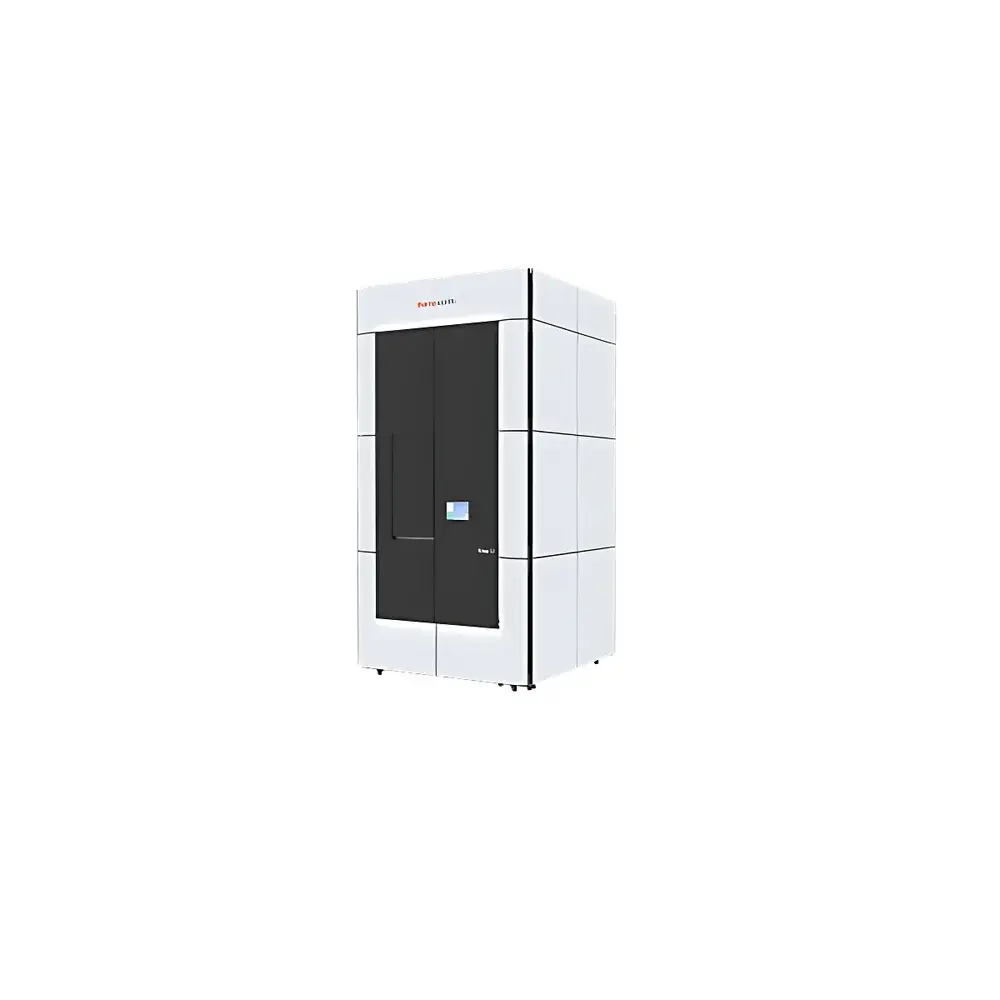
Thermo Scientific Krios G4 Cryo-Transmission Electron Microscope
| Brand | Thermo Fisher Scientific |
|---|---|
| Origin | Czech Republic |
| Manufacturer Type | Original Equipment Manufacturer (OEM) |
| Origin Category | Imported Instrument |
| Model | Krios G4 Cryo-TEM |
| Price Range | USD 5.2–5.8 million (estimated FOB) |
Overview
The Thermo Scientific™ Krios™ G4 Cryo-Transmission Electron Microscope (Cryo-TEM) represents the fourth-generation platform in Thermo Fisher’s high-end cryo-EM instrumentation line, engineered specifically for structural biology laboratories requiring atomic-resolution imaging of biomacromolecules in near-native, vitrified states. Operating on the principle of high-voltage electron transmission through ultra-thin, flash-frozen specimens under cryogenic conditions (typically <−180 °C), the Krios G4 delivers sub-ångström resolution capabilities essential for single-particle analysis (SPA), cryo-electron tomography (cryo-ET), and microcrystal electron diffraction (MicroED). Its compact mechanical architecture—achieved via re-engineered base frame rigidity and optimized column envelope design—reduces total instrument height to under 3.0 meters (9.8 ft), enabling installation in standard-height laboratories with ceiling clearances ≥3.04 m (10 ft) without structural modification. This dimensional optimization does not compromise optical performance; rather, it integrates enhanced mechanical stability, reduced thermal drift, and improved electromagnetic shielding to support consistent data acquisition at information limits of 0.12 nm with linear distortion <0.5%.
Key Features
- Compact footprint & height-optimized design: Net height <3.0 m enables deployment in conventional lab spaces, eliminating costly facility retrofitting.
- Enhanced mechanical stability: Redesigned monolithic base frame minimizes acoustic and vibrational coupling, improving long-exposure coherence and reducing image drift by up to 3× compared to prior generations.
- Advanced electron optics: Optimized condenser and objective lens configurations deliver improved spherical aberration correction, extended depth of field, and fringe-free imaging (FFI) across a larger field of view.
- Aberration-Free Image Shift (AFIS): Enables precise, distortion-corrected stage navigation without re-centering or refocusing—critical for multi-position tilt-series acquisition and automated grid mapping.
- Falcon 4 Direct Electron Detector: Integrated with high DQE (>0.7 at 300 keV), 4k × 4k sensor, and hardware-based real-time motion correction for optimal signal-to-noise ratio in low-dose imaging.
- Advanced Performance Monitoring (APM) software: Continuously monitors lens alignments, beam stability, vacuum integrity, and detector calibration—triggering automated diagnostics and recalibration protocols to maintain system readiness prior to each particle acquisition.
Sample Compatibility & Compliance
The Krios G4 supports standard 3.05 mm TEM grids mounted in Gatan AutoGrid holders or compatible cryo-transfer cassettes. It is fully interoperable with Thermo Fisher’s Autoloader ecosystem—including Glacios™, Arctica™, and Talos™ platforms—enabling seamless sample exchange and workflow continuity from screening to high-resolution data collection. All cryo-handling components comply with ISO 14644-1 Class 5 cleanroom specifications during operation. The system meets requirements for GLP-compliant structural biology workflows, including full audit trail logging (per FDA 21 CFR Part 11), electronic signature support, and traceable calibration records. Software modules are validated per ICH GCP and ASTM E3185-20 standards for quantitative electron microscopy data acquisition.
Software & Data Management
Control and acquisition are managed via Thermo Fisher’s EPU 3.x software suite, which provides end-to-end automation for SPA workflows—from auto-focus and beam-induced motion compensation to grid-level quality scoring and EPU-driven grid clustering. Real-time preprocessing includes on-the-fly motion correction, CTF estimation, and particle picking preview, allowing immediate experimental feedback and adaptive dose allocation. Raw data is stored in standardized TIFF/DM4 formats with embedded metadata (accelerating voltage, magnification, defocus, exposure time, stage coordinates). Integration with Thermo Fisher Connect™ enables secure, role-based cloud synchronization, centralized instrument usage analytics, and remote monitoring of APM health metrics. All software modules support DICOM-EM extensions for cross-platform structural data exchange.
Applications
- Atomic-resolution structure determination of membrane proteins, viral capsids, and large ribonucleoprotein complexes via single-particle analysis.
- Cryo-electron tomography of cellular sections, organelles, and intact bacterial cells at sub-3 nm resolution.
- Time-resolved cryo-EM studies using rapid plunge-freezing and automated time-point triggering.
- MicroED data collection from nanocrystalline pharmaceutical compounds and inorganic materials.
- Correlative light and electron microscopy (CLEM) workflows leveraging integrated fluorescence stage modules and fiducial-based registration.
FAQ
What is the maximum specimen temperature achievable during data collection?
The Krios G4 maintains specimen temperatures ≤−185 °C under standard cryo-transfer and imaging conditions, with stable thermal drift <0.5 nm/min at −180 °C.
Is the system compatible with third-party detectors or software pipelines?
While Falcon 4 is the natively optimized detector, the system supports standard DM4/TIFF export and EMPIAR-compliant metadata schemas, enabling integration with RELION, cryoSPARC, cisTEM, and Scipion via open-format ingestion.
How does APM ensure reproducibility across multiple users and sessions?
APM logs all calibration events, lens current deviations, and environmental parameters (vacuum pressure, cooling water temperature, room vibration RMS) into a tamper-evident database, generating PDF reports compliant with ISO/IEC 17025 internal audit requirements.
Can the Krios G4 be upgraded from earlier Krios generations?
Field-upgrade paths exist for Krios G3 systems—including new base frames, APMS modules, and EPU 3.x licensing—but full G4 performance requires replacement of the column, detector interface, and control electronics.
What service and support options are available post-installation?
Thermo Fisher offers Platinum Care™ contracts covering 24/7 remote diagnostics, annual performance validation (per ASTM E2936-22), on-site engineer response within 4 business hours, and access to the Cryo-EM User Community Portal for protocol sharing and expert-led webinars.




