
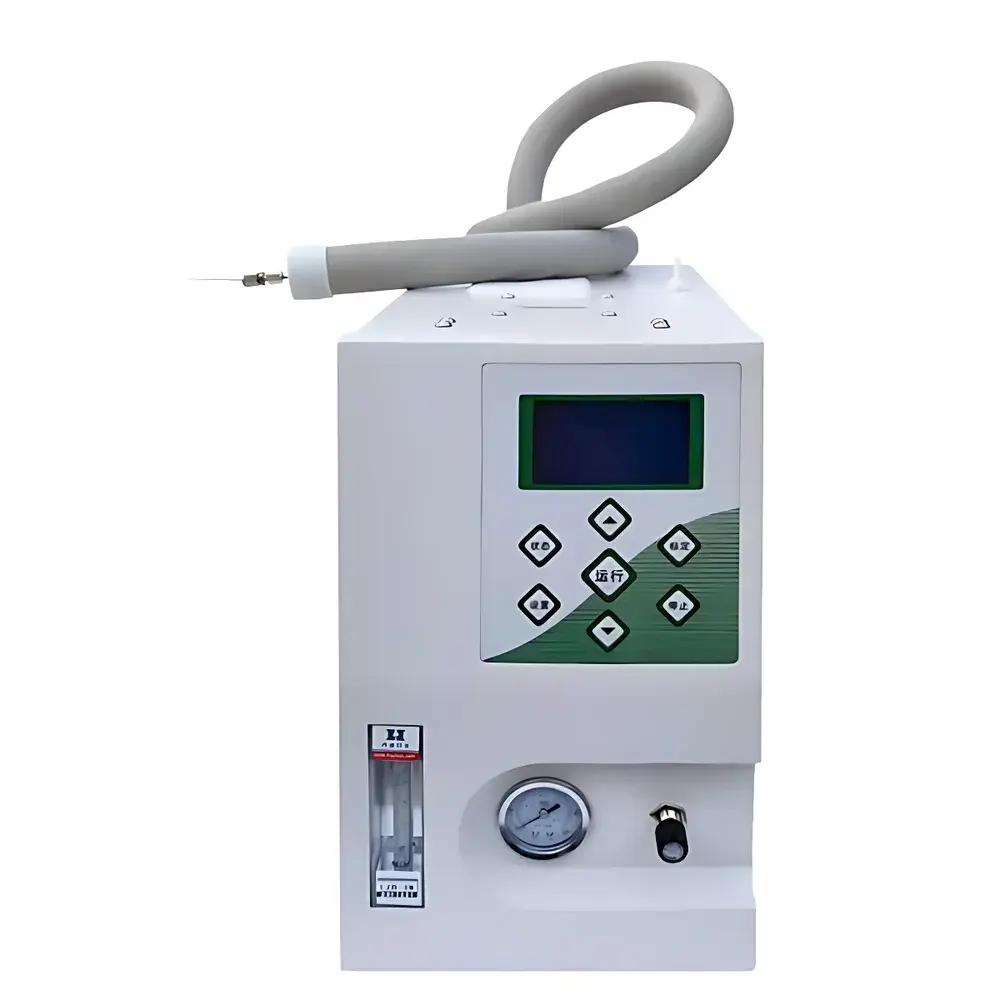
Zhuhui HP JX-5N Automated Cryo-Focusing Thermal Desorber
| Brand | Zhuhui HP |
|---|---|
| Origin | Beijing, China |
| Manufacturer Type | Direct Manufacturer |
| Region of Origin | Domestic (China) |
| Model | JX-5N |
| Automation Level | Semi-Automatic |
| Desorption Temperature Range | -35 °C to 450 °C |
| Valve Injection Zone Temperature Range | 50 °C to 240 °C, ±1 °C accuracy |
| Transfer Line Temperature Range | 50 °C to 240 °C, ±1 °C accuracy |
| Flash Heating Rate | >70 °C/s |
| Cryofocusing Trap Temperature | Down to -40 °C (ambient-dependent) |
| Enrichment Time | 0–60 min |
| Desorption Time | 0–10 min |
| Simulated Sampling Flow Rate | 16–160 mL/min |
| Power Consumption | 500 W |
| Cold Trap Cooling Method | Thermoelectric (Peltier) |
| Valve Type | Motor-Driven, Sulfinert-Passivated High-Temperature 6-Port Switching Valve |
| Tubing Material | Electropolished 316 Stainless Steel with Sulfinert Surface Treatment |
| Seals | PTFE |
| Dead Volume Optimization | Engineered Variable-Diameter Sulfinert-Treated Fittings |
Overview
The Zhuhui HP JX-5N Automated Cryo-Focusing Thermal Desorber is a semi-automated sample introduction system engineered for trace-level volatile organic compound (VOC) and semi-volatile organic compound (SVOC) analysis in environmental, occupational health, and industrial hygiene applications. It operates on the principle of thermal desorption coupled with cryogenic focusing—first collecting analytes onto a sorbent tube under controlled flow conditions, then thermally desorbing them in two stages: primary desorption from the tube followed by rapid flash heating (>70 °C/s) into a cryogenically cooled trap (down to –40 °C via Peltier cooling), and finally sharp, narrow-band injection (<3 s peak width at 450 °C) into a gas chromatograph (GC). This dual-stage thermal management architecture ensures high analyte recovery, minimal breakthrough, and exceptional chromatographic resolution—particularly critical for low-concentration sulfur-containing compounds such as hydrogen sulfide, methanethiol, dimethyl sulfide, and dimethyl disulfide, as specified in GB/T 14678–1993.
Key Features
- Thermoelectric (Peltier) cold trap capable of reaching –40 °C without liquid nitrogen or external cryogens—reducing operational cost and logistical complexity.
- Motor-driven, Sulfinert-passivated 6-port switching valve housed in a thermostatically controlled valve oven (50–240 °C, ±1 °C), eliminating need for pneumatic actuation gases and minimizing dead volume.
- Integrated heating design: co-located valve oven and transfer line heating zones (both 50–240 °C, ±1 °C) reduce thermal gradients and condensation risk across the analytical pathway.
- Electropolished 316 stainless steel gas pathways with Sulfinert surface treatment ensure inertness toward reactive sulfur species and acidic/basic VOCs; all seals are PTFE-rated for high-temperature stability and zero extractables.
- Variable-diameter, Sulfinert-treated fittings optimized via computational fluid dynamics to minimize interfacial dead volume between the cold trap and transfer line—critical for preserving peak shape and quantitative reproducibility.
- Triple-function operation: automated sampling (with programmable flow control), thermal desorption, and in-situ sorbent tube conditioning—enabling full workflow integration without manual intervention.
Sample Compatibility & Compliance
The JX-5N supports standard 1/4″ OD stainless steel or quartz sorbent tubes (e.g., Tenax TA, Carbopack B/C, Carboxen 1000) and is compatible with both domestic and international GC systems—including Agilent, Thermo Fisher, Shimadzu, and PerkinElmer platforms—via universal heated transfer interfaces. Its design aligns with method requirements for ISO 16017-1 (indoor air), EPA TO-17 (ambient air), and Chinese national standards including GB/T 14678–1993 and HJ 644–2013. The instrument’s temperature-controlled zones meet GLP traceability requirements, and its parameter logging supports audit-ready documentation per ISO/IEC 17025 and FDA 21 CFR Part 11 when integrated with compliant LIMS or chromatography data systems (CDS).
Software & Data Management
Control is executed via embedded firmware with a dedicated Windows-based configuration utility supporting method creation, sequence programming, real-time temperature monitoring, and event logging. All temperature setpoints, timing parameters (enrichment: 0–60 min; desorption: 0–10 min; flash ramp rate >70 °C/s), and flow profiles (16–160 mL/min simulated sampling) are digitally stored with timestamps. Audit trails include operator ID, method version, and calibration history—enabling full traceability for regulated laboratories operating under GMP or environmental accreditation frameworks. Export formats include CSV and XML for seamless integration into enterprise data management systems.
Applications
- Environmental air monitoring: quantification of odorants, reduced sulfur compounds, BTEX, and halogenated VOCs in ambient, indoor, and stack emissions.
- Occupational exposure assessment: personal and area sampling for OSHA-permissible exposure limits (PELs) and ACGIH TLVs®.
- Product emissions testing: off-gassing analysis of building materials, automotive interiors, and consumer goods per ASTM D5116 and ISO 16000 series.
- Forensic and failure analysis: identification of trace volatiles in fire debris, polymer degradation products, or contaminated pharmaceutical excipients.
- Method development labs: validation of thermal desorption parameters for novel sorbents or complex matrices requiring cryo-focusing enhancement.
FAQ
Does the JX-5N require liquid nitrogen or other cryogens?
No—the cold trap uses solid-state Peltier cooling, achieving ≤–40 °C without consumables.
Is the instrument compatible with EPA TO-17 compliant workflows?
Yes; it meets all thermal desorption timing, temperature, and inertness criteria outlined in TO-17 for sorbent tube analysis.
Can the JX-5N perform tube reconditioning in situ?
Yes—integrated tube activation mode applies precise high-temperature purging (up to 450 °C) under controlled carrier gas flow to regenerate sorbent beds.
What level of temperature uniformity is maintained across the valve and transfer line zones?
Both zones are independently PID-controlled with ±1 °C accuracy and <±0.5 °C spatial uniformity over the heated length.
How is system inertness validated for sulfur analysis?
All wetted surfaces undergo Sulfinert passivation—a proprietary silanization process verified by low-level H2S recovery testing (>95% at sub-ppbv levels) and blank integrity assessment per ISO 16017-2 Annex C.





