
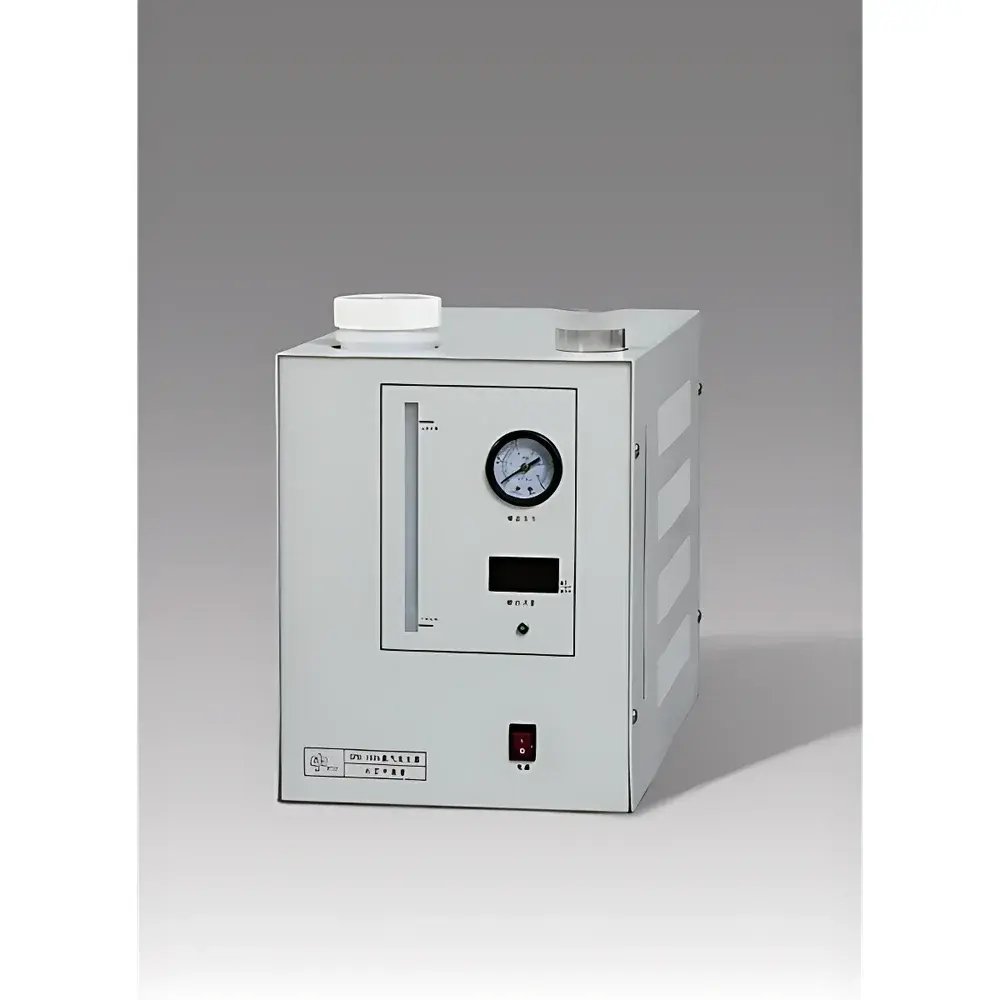
Zhonghui Pu SPH-300AT Automatic Makeup Water Hydrogen Generator
| Brand | Zhonghui Pu |
|---|---|
| Origin | Beijing, China |
| Manufacturer Type | Direct Manufacturer |
| Country of Origin | China |
| Model | SPH-300AT |
| Pricing | Upon Request |
| Hydrogen Generation Principle | Aqueous Alkaline Electrolysis |
| Output Flow Rate | 0–300 mL/min |
| Output Pressure | 0–0.4 MPa |
| Hydrogen Purity | 99.999% |
| Power Consumption | 150 W |
Overview
The Zhonghui Pu SPH-300AT Automatic Makeup Water Hydrogen Generator is a compact, laboratory-grade on-site hydrogen supply system engineered for precision gas delivery in analytical instrumentation—particularly gas chromatography (GC), GC-MS, and other hydrogen-dependent detection systems. It employs aqueous alkaline electrolysis of deionized water using a nickel-based electrode stack, producing high-purity hydrogen without reliance on compressed gas cylinders. The core electrochemical process ensures stable molecular H₂ generation with minimal oxygen co-evolution, supported by integrated membrane separation and multi-stage catalytic purification. Designed for continuous unattended operation, the SPH-300AT maintains consistent output pressure and flow across variable demand conditions, making it suitable for both single-instrument and small-scale multi-port configurations.
Key Features
- Automatic makeup water replenishment via level-sensing reservoir with audible/visual low-water alert—eliminates manual intervention and prevents dry-electrolysis damage.
- Digital pressure and flow monitoring with real-time LED display; closed-loop PID control enables automatic pressure stabilization (< ±0.001 MPa) and dynamic flow modulation (0–300 mL/min) proportional to downstream demand.
- Stainless-steel particulate filter and ultra-low-sulfur silicone O-rings throughout the gas path minimize trace contaminants (e.g., sulfur compounds, hydrocarbons), ensuring baseline stability and extended column life in GC applications.
- Integrated anti-backflow alkaline protection system with dual-level liquid trap and pH-sensitive shutoff—prevents caustic solution migration into connected instruments under pressure fluctuation or shutdown conditions.
- Robust mechanical architecture: 360 × 200 × 260 mm footprint, 9 kg net weight, front-access service panel, and IP20-rated enclosure compliant with IEC 61010-1 for laboratory electrical safety.
Sample Compatibility & Compliance
The SPH-300AT delivers hydrogen meeting ASTM D7537-21 specifications for carrier and fuel gas purity in chromatographic analysis. Its 99.999% H₂ output (with <1 ppm O₂, <1 ppm H₂O, <0.1 ppm total hydrocarbons, and <0.1 ppm NH₃) satisfies USP , ISO 8573-1 Class 1 compressed air equivalency for gaseous impurities, and GC manufacturer requirements (e.g., Agilent, Thermo Fisher, Shimadzu). The unit operates within standard laboratory power infrastructure (220 V ±10%, 50 Hz) and complies with CE marking directives for electromagnetic compatibility (2014/30/EU) and low-voltage safety (2014/35/EU). While not certified to FDA 21 CFR Part 11 out-of-the-box, its operational logs (pressure, flow, runtime, fault codes) are timestamped and exportable—enabling integration into GLP/GMP-compliant data governance workflows when paired with validated LIMS or instrument control software.
Software & Data Management
The SPH-300AT operates as a standalone hardware-controlled system with no embedded firmware-based user interface beyond the front-panel display and tactile controls. All operational parameters—including cumulative runtime, total H₂ volume generated, number of auto-refill cycles, and thermal event history—are stored in non-volatile memory and accessible via USB-C data dump (CSV format). Optional RS-485 Modbus RTU interface allows integration with building management systems (BMS) or centralized lab gas monitoring platforms for remote status polling and alarm relay. Audit trails support traceability for ISO/IEC 17025 accreditation, and raw log files meet minimum ALCOA+ criteria (Attributable, Legible, Contemporaneous, Original, Accurate) when exported and archived per institutional SOPs.
Applications
- Carrier gas source for capillary GC and GC-MS systems requiring ultra-high-purity hydrogen at constant pressure (e.g., flame ionization detection, thermal conductivity detection).
- Fuel gas supply for nitrogen-phosphorus detectors (NPD) and helium ionization detectors (HID), where stoichiometric H₂:N₂ ratios must remain invariant.
- Hydrogenation reaction support in benchtop catalytic reactors, provided auxiliary pressure regulation and leak-tight fittings are implemented upstream.
- Calibration gas blending systems where H₂ serves as a primary component in certified reference mixtures (CRMs) for environmental or petrochemical analysis.
- Replacement for cylinder-based supply in regulated environments where gas storage restrictions apply (e.g., university teaching labs, cleanrooms, mobile analytical units).
FAQ
What type of water is required for optimal operation?
Deionized water with resistivity ≥5 MΩ·cm and silica content <10 ppb is mandatory. Tap water or distilled water alone will cause rapid electrode fouling and void the warranty.
Can the SPH-300AT be used with multiple GC inlets simultaneously?
Yes—provided total combined flow demand remains ≤300 mL/min and a calibrated manifold with individual needle valves and pressure regulators is installed downstream to maintain instrument-specific pressure setpoints.
Does the unit require periodic electrolyte replacement?
No. The SPH-300AT uses a sealed, maintenance-free alkaline electrolyte cell; only deionized water replenishment is required. Electrolyte degradation is negligible over the rated 10,000-hour service life.
How is safety ensured during extended无人值守 operation?
Three independent hardware safeguards are implemented: (1) pressure relief valve (set at 0.45 MPa), (2) temperature cutoff switch (>85°C), and (3) conductive-level sensor interlock that halts electrolysis if reservoir level falls below operational threshold.
Is hydrogen purity verified by third-party certification?
Each production batch undergoes factory verification using online gas chromatography with TCD detection against NIST-traceable standards; full test reports are available upon request for quality assurance documentation.



