
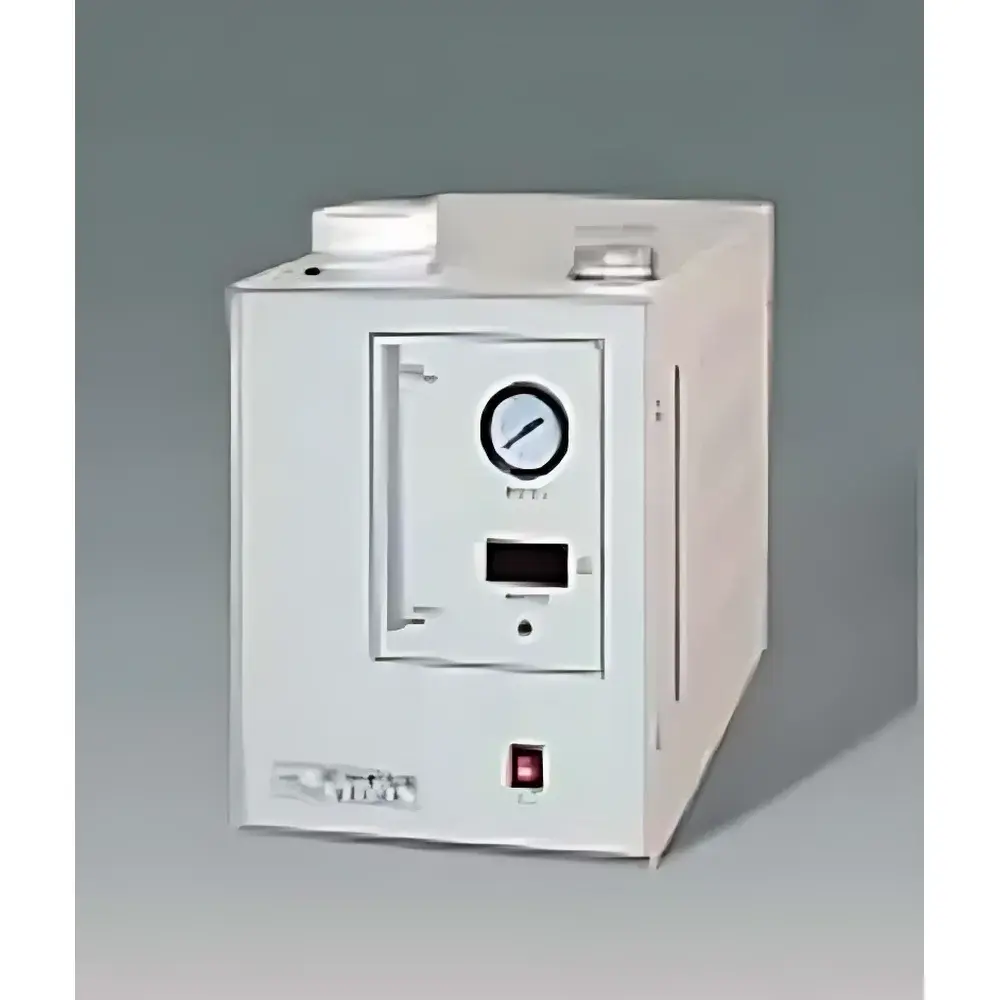
Zhonghui Pu SPH-300A/500A High-Purity Hydrogen Generator
| Brand | Zhonghui Pu |
|---|---|
| Origin | Beijing, China |
| Manufacturer Type | Direct Manufacturer |
| Model | SPH-300A / SPH-500A |
| Hydrogen Generation Principle | Aqueous Alkaline Electrolysis |
| Output Flow Rate | 0–300 mL/min (SPH-300A) / 0–500 mL/min (SPH-500A) |
| Output Pressure | 0–0.4 MPa |
| Hydrogen Purity | 99.999% |
| Pressure Stability | < 0.001 MPa |
| Power Supply | 220 V ±10%, 50 Hz |
| Power Consumption | 150 W (SPH-300A) / 250 W (SPH-500A) |
| Dimensions (W×D×H) | 360 × 200 × 260 mm |
| Net Weight | ~9 kg |
| Gas Filtration | Stainless Steel Filter + Low-Sulfur Silicone Seals |
Overview
The Zhonghui Pu SPH-300A and SPH-500A are benchtop hydrogen generators engineered for continuous, on-demand production of ultra-high-purity hydrogen gas (99.999%) via aqueous alkaline electrolysis of deionized water. Designed specifically for analytical laboratories employing gas chromatography (GC), GC–MS, and other hydrogen-dependent instrumentation, these units eliminate the operational risks, logistical constraints, and cost volatility associated with high-pressure cylinder supply. The core electrolytic cell operates under controlled current density and thermal management to ensure stable H₂ generation without membrane degradation or electrode passivation—critical for long-term baseline stability in sensitive detection systems. Unlike PEM-based generators, alkaline electrolysis offers robust tolerance to feed water quality variations while maintaining consistent purity output across the full flow range.
Key Features
- Automated pressure and flow regulation: Integrated PID-controlled electrochemical stack and precision back-pressure regulator maintain setpoint stability within ±0.001 MPa and ±1% of full-scale flow, enabling seamless integration with GC carrier gas modules.
- Gas purification architecture: Dual-stage filtration comprising a sintered stainless steel particulate filter followed by low-sulfur silicone elastomer seals minimizes sulfur-containing contaminants—essential for preserving detector sensitivity and preventing column bleed in sulfur-sensitive applications (e.g., sulfur chemiluminescence detection).
- Fail-safe engineering: Built-in anti-alkaline-backflow valve, over-pressure relief mechanism (0.45 MPa setpoint), and real-time electrolyte level monitoring prevent caustic solution ingress into downstream lines—a common failure mode in alkaline electrolyzers.
- Intuitive local interface: LED display shows real-time H₂ pressure (MPa), flow rate (mL/min), and system status; front-panel controls allow manual override of auto-regulation modes for method development or troubleshooting.
- Compact footprint & low thermal load: 360 × 200 × 260 mm chassis fits standard lab benches; total power draw remains below 250 W, reducing HVAC burden and enabling placement near temperature-sensitive instruments.
Sample Compatibility & Compliance
The SPH series delivers hydrogen meeting ASTM D7622–22 specifications for GC carrier gas purity (≥99.999% H₂, O₂ ≤0.1 ppm, H₂O ≤1 ppm, total hydrocarbons ≤0.1 ppm). Its low-sulfur seal design complies with ASTM D7217 requirements for sulfur-free gas delivery in trace-level environmental and petrochemical analysis. While not certified to ISO 8573-1 Class 0 for compressed air, its verified output satisfies ISO 8573-1 Class 1.2.1 for gaseous hydrogen used in analytical instrumentation. Units are designed for use with Type I deionized water (resistivity ≥18.2 MΩ·cm, TOC <5 ppb) and conform to IEC 61010-1:2012 safety standards for laboratory electrical equipment.
Software & Data Management
The SPH-300A/500A operate as standalone hardware with no proprietary software dependency—ideal for GLP/GMP environments requiring audit-trail simplicity. All operational parameters (pressure, flow, runtime hours, fault codes) are logged internally and accessible via front-panel navigation. Optional RS-232 or analog 0–10 V output enables integration with Lab Information Management Systems (LIMS) or centralized facility monitoring platforms. No FDA 21 CFR Part 11 electronic signature functionality is included, consistent with its classification as auxiliary gas supply hardware rather than regulated analytical instrumentation.
Applications
- Carrier gas source for capillary GC and GC–MS systems requiring high-purity, low-moisture hydrogen (e.g., flame ionization detection, thermal conductivity detection, and hyphenated techniques).
- Fuel gas supply for hydrogen flame photometric detectors (FPD) and pulsed discharge helium ionization detectors (PDHID).
- Reductive atmosphere generation in catalytic reaction screening setups and materials synthesis gloveboxes where cylinder logistics impede workflow continuity.
- Calibration gas dilution systems requiring stable, metered H₂ flow for dynamic blending of standard mixtures (e.g., ASTM D6299 precision verification protocols).
- On-site hydrogen supply for portable FTIR and Raman spectrometers equipped with hydrogen-cooled detectors.
FAQ
What feed water quality is required for optimal performance?
Deionized water with resistivity ≥18.2 MΩ·cm and total organic carbon (TOC) <5 ppb is mandatory. Tap water or distilled water will cause rapid electrolyte contamination and reduced gas purity.
Can the unit be operated continuously for 24/7 applications?
Yes—designed for unattended operation up to 12 months between maintenance cycles, provided feed water meets specification and ambient temperature remains within 15–30°C.
Is the hydrogen output suitable for use with mass spectrometry interfaces?
Yes, the 99.999% purity with sub-ppm oxygen and moisture levels meets OEM requirements for most electron ionization (EI) and chemical ionization (CI) sources when coupled with appropriate inline purifiers.
How often does the electrolyte require replacement?
Under normal operating conditions (8 hrs/day, 5 days/week), potassium hydroxide electrolyte should be refreshed every 6–12 months depending on usage intensity and water quality.
Does the generator include remote monitoring capability?
Standard configuration includes analog voltage output (0–10 V) for pressure and flow telemetry; RS-232 serial interface is available as a factory-configured option for digital integration.



