
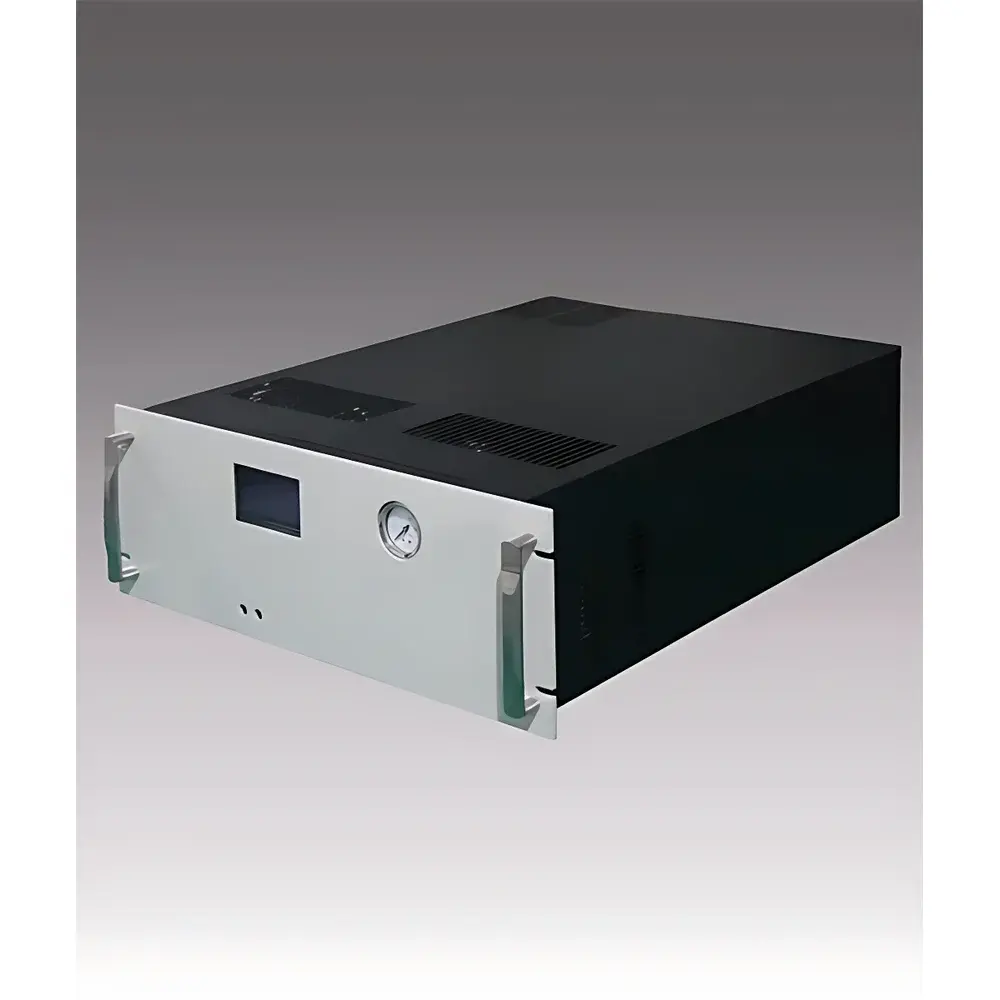
Zhonghuipu ZA-10LC Rack-Mounted Zero Air Generator with Integrated Oil-Free Compressor
| Brand | Zhonghuipu |
|---|---|
| Origin | Beijing, China |
| Manufacturer Type | Direct Manufacturer |
| Product Category | Domestic |
| Model | ZA-10LC |
| Quotation | Upon Request |
| Hydrocarbon Removal Principle | High-Temperature Catalytic Oxidation using Multi-Metallic Noble Metal Catalysts |
| Output Flow Rate | 1–10 L/min @ 45 psig |
| Output Pressure Range | 0–0.35 MPa |
| Total Hydrocarbons (THC) | <20 ppb |
| Dew Point | <−20 °C |
| NO/NO₂/NOₓ/SO₂/O₃/H₂S | <0.5 ppb |
| CO | <25 ppb |
| Ambient Operating Temperature | 1–40 °C |
| Relative Humidity | <80% RH |
| Power Supply | 220 V ±10%, 50–60 Hz |
| Average Power Consumption | 400 W |
| Dimensions (W×D×H) | 482 × 600 × 267 mm |
| Net Weight | ~35 kg |
Overview
The Zhonghuipu ZA-10LC is a rack-mountable zero air generator engineered for high-purity, continuous air supply in analytical laboratories, environmental monitoring stations, and calibration facilities. It employs a dual-stage purification architecture centered on high-temperature catalytic oxidation—where ambient air is compressed by an integrated Thomas oil-free scroll compressor and passed over a proprietary multi-metallic noble metal catalyst bed operating above 350 °C. This process quantitatively oxidizes residual hydrocarbons (C₁–C₈), carbon monoxide, and trace volatile organic compounds into CO₂ and H₂O, which are subsequently removed via a high-efficiency desiccant and coalescing filtration system. The resulting zero air meets stringent purity specifications required for photometric ozone analyzers, chemiluminescent NOₓ detectors, FTIR gas cells, and EPA Method 205/TO-14/TO-15 validation protocols. Its rack-mount form factor (19″ EIA standard) enables seamless integration into centralized gas supply cabinets or analytical instrument racks without requiring floor space.
Key Features
- Rack-mount 19″ chassis (482 × 600 × 267 mm) compliant with standard laboratory equipment enclosures
- Integrated Thomas oil-free scroll compressor—low-noise (<52 dB[A]), maintenance-free operation, and zero lubricant contamination risk
- High-temperature catalytic oxidation module with dual-zone noble metal catalyst (Pt/Pd/Rh-based) ensuring complete CO and THC conversion at >99.99% efficiency
- Multi-stage post-catalysis purification: stainless-steel particulate filter (≤0.01 µm retention), desiccant dryer (dew point ≤ −20 °C), and proprietary NOₓ/S-compound scavenger cartridges (imported from USA)
- Embedded microcontroller with backlit LCD interface supporting real-time pressure, flow, temperature, and system status monitoring
- Comprehensive safety architecture: over-temperature cutoff, pressure relief valve, compressor thermal protection, and automatic shutdown on filter saturation or dew point excursion
- RS-232 serial interface for remote status polling, event logging, and integration with building management systems (BMS) or LIMS
Sample Compatibility & Compliance
The ZA-10LC delivers zero air compatible with trace-level gas analysis instrumentation requiring ultra-low background interference. Its certified output purity—THC <20 ppb, CO <25 ppb, NO/NO₂/SO₂/O₃/H₂S <0.5 ppb—aligns with ISO 8573-1 Class 1 (solid particles), Class 2 (water), and Class 1 (oil aerosol) specifications. It satisfies the zero air requirements of U.S. EPA Reference Methods (e.g., Method 21 for VOC leak detection, Method 25A for TO-15 calibration), ASTM D6420 (gas chromatography), and EN 14625 (ambient air quality monitoring). The unit is designed for GLP-compliant environments; all operational parameters—including runtime, alarm events, and filter service intervals—are timestamped and exportable via RS-232 for audit trails per FDA 21 CFR Part 11 Annex 11 data integrity guidelines.
Software & Data Management
While the ZA-10LC operates autonomously via its onboard controller, its RS-232 port supports ASCII-based command-response protocol for integration into third-party SCADA or laboratory automation platforms. Users may configure custom polling intervals (1–300 sec), trigger event logs on pressure deviation (>±5% setpoint), or initiate manual purge cycles remotely. All system diagnostics—including catalyst bed temperature stability, dew point drift, and compressor current draw—are recorded with UTC timestamps and stored in non-volatile memory for ≥12 months. Export formats include CSV and plain-text log files compatible with MATLAB, Python pandas, or LabArchives ELN ingestion workflows.
Applications
- Calibration gas generation for ambient air monitoring networks (e.g., EPA SLAMS, EEA AirBase)
- Zero-air purge source for Fourier-transform infrared (FTIR) spectroscopy sample cells and cavity ring-down spectrometers (CRDS)
- Carrier and combustion air supply for GC-FID, GC-PDHID, and PTR-MS systems
- Baseline verification in UV-Vis and chemiluminescence NOₓ analyzers per ISO 10849
- Reference air in cleanroom particle counters and airborne molecular contamination (AMC) monitors
- Support gas for laser-induced breakdown spectroscopy (LIBS) and spark emission systems requiring inert, dry, hydrocarbon-free environments
FAQ
What is the expected service life of the catalytic converter under continuous operation?
The noble metal catalyst is rated for ≥15,000 hours of continuous use at nominal flow (5 L/min) and ambient inlet air meeting ISO 8573-1 Class 4 particulate and Class 3 moisture specifications.
Can the ZA-10LC be operated in parallel with other zero air generators for higher total flow?
Yes—provided downstream pressure regulation and check valves are installed to prevent backflow; however, individual unit calibration and alarm thresholds must remain independent per ISO/IEC 17025 clause 6.4.6.
Is the unit suitable for Class 100 (ISO 5) cleanroom installation?
The ZA-10LC itself is not cleanroom-rated, but its outlet gas meets ISO 14644-1 Class 5 particle limits when paired with an optional HEPA-grade final filter (part #ZA-FIL-HEPA-01); cabinet mounting must comply with IEST-RP-CC002.3 vibration isolation guidelines.
Does the RS-232 interface support Modbus RTU or only proprietary ASCII commands?
It uses a documented ASCII command set (available in the Technical Manual Rev. 3.2); Modbus RTU adaptation requires external protocol converter hardware.
How frequently must the desiccant and NOₓ scavenger cartridges be replaced?
Under typical lab conditions (25 °C, 50% RH), replacement is recommended every 6 months or after 4,000 operating hours—whichever occurs first—as indicated by the controller’s service timer and dew point sensor drift alert.



