
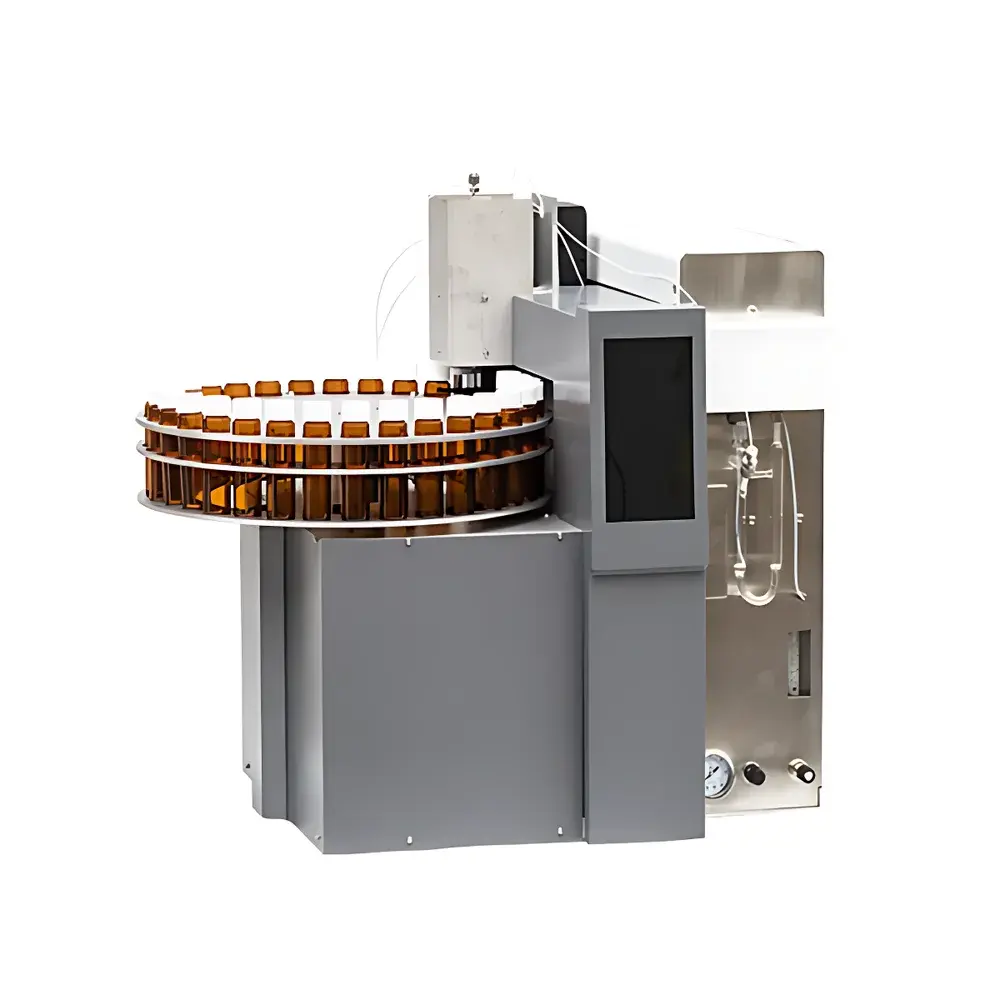
Zhonghui Pu APT30 Automated Purge and Trap Sampler
| Brand | Zhonghui Pu |
|---|---|
| Origin | Beijing, China |
| Manufacturer Type | Direct Manufacturer |
| Instrument Category | Domestic |
| Model | APT30 |
| Instrument Type | Water & Soil Integrated Purge-and-Trap System |
| Sample Positions | 30 |
| Trap Temperature Range | Ambient to 450 °C (during purge, desorption, and conditioning) |
| Sample Heating Temperature | Ambient to 100 °C |
| Vial Cooling Temperature | Ambient +1 °C |
| Heating Rate | >50 °C/s up to 350 °C |
| Cooling Rate | >300 °C/min (200 °C → 50 °C in ≤50 s) |
| Water Removal Trap Temp Range | Ambient +1 °C to 240 °C |
| Transfer Line Temp Range | Ambient to 200 °C (optional upgrade to 330 °C) |
| 6-Port Valve Temp Range | Ambient to 200 °C (optional upgrade to 330 °C) |
| Foam Eliminator Temp Range | Ambient to 200 °C |
| Distilled Water Heating Range | Ambient to 90 °C |
| Liquid Injection Volume | 1–25 mL |
| Solid Sample Rehydration Volume | 1–25 mL |
| Temperature Control Accuracy | ±1 °C |
| Peak Power Consumption | 1000 W |
Overview
The Zhonghui Pu APT30 Automated Purge and Trap Sampler is an integrated, laboratory-grade sample introduction system engineered for trace-level volatile organic compound (VOC) analysis in aqueous and solid environmental matrices. It operates on the principle of dynamic headspace extraction: inert gas purging volatilizes target analytes from the sample matrix; analytes are then quantitatively trapped on a sorbent-packed trap at cryogenic or ambient conditions; finally, rapid thermal desorption transfers the concentrated analytes into a gas chromatograph (GC) or GC–mass spectrometer (GC–MS) for separation and detection. Designed to meet stringent regulatory requirements for environmental monitoring, the APT30 supports fully unattended operation across 30 sample positions—including automated spiking, liquid addition, purge gas control, trap conditioning, desorption, and post-run cleaning—ensuring high reproducibility, minimal carryover, and compliance with multi-matrix analytical workflows.
Key Features
- 30-position autosampler with programmable robotic arm for precise vial handling and positional repeatability;
- Independent thermal control zones: trap (ambient to 450 °C), purge tube (ambient to 100 °C), transfer line (ambient to 200 °C, optional 330 °C), 6-port valve (ambient to 200 °C, optional 330 °C), water removal trap (ambient +1 °C to 240 °C), and foam eliminator (ambient to 200 °C);
- High-speed thermal management: heating rate >50 °C/s (to 350 °C); cooling rate >300 °C/min (200 °C → 50 °C in ≤50 s); vial cooling stabilized at ambient +1 °C;
- Integrated foam suppression module with real-time bubble detection and mechanical/thermal de-foaming to prevent gas-line blockage and cross-contamination;
- Ultra-inert, de-activated fused-silica and stainless-steel transfer pathways—certified for low ng-level recovery and negligible memory effects;
- Programmable liquid handling: syringe pump–driven precision delivery of internal standards (1–25 mL), rehydration water for solids (1–25 mL), and cleaning solvents (cold/hot water or methanol);
- Valve architecture: low-dead-volume 6-port switching valve housed within heated enclosure—eliminates cold spots and ensures quantitative analyte transfer;
- Self-diagnostic firmware with motor stall detection, temperature deviation alerts, and automatic emergency shutdown to protect hardware integrity;
- 7-inch capacitive touchscreen interface with embedded method library—including preloaded protocols aligned with Chinese EPA methods—and user-editable parameter storage;
- Gas-free actuation: all mechanical motions driven by stepper motors—no external compressed air or nitrogen required for positioning or valve actuation.
Sample Compatibility & Compliance
The APT30 is validated for direct analysis of drinking water, groundwater, surface water, wastewater, soil, sediment, and sludge samples per national and industry-standard methodologies. It fully satisfies operational requirements specified in HJ 639–2012, HJ 686–2014, HJ 788–2016, HJ 605–2011, HJ 893–2017, HJ 977–2018, HJ 1020–2019, and GB/T 5750.8–2006. Its modular trap design allows interchangeable sorbent configurations (e.g., Tenax TA, Carbopack B/C, Carboxen 1000) to accommodate diverse volatility and polarity ranges. The integrated water removal trap (operable from ambient +1 °C to 240 °C) enables selective condensation and venting of moisture—critical for maintaining GC column lifetime and detector stability during high-humidity sample analysis. All thermal zones maintain ±1 °C accuracy across their full range, supporting GLP-compliant data generation when paired with audit-trail-enabled chromatography data systems.
Software & Data Management
The APT30 operates via embedded firmware with local method storage and execution—no external PC dependency for routine runs. Method parameters (purge time, desorption ramp, trap bake-out cycles, spiking volumes, cleaning sequences) are stored in non-volatile memory and support version-controlled editing. While the instrument does not include native LIMS integration or remote cloud connectivity, its RS-232 and Ethernet interfaces enable bidirectional communication with third-party chromatography data systems (CDS) such as Thermo Chromeleon, Agilent OpenLab CDS, or Waters Empower. Time-stamped event logs—including temperature profiles, valve actuation timestamps, motor status, and error codes—are retained onboard for ≥30 days and exportable via USB. For regulated environments, the system supports 21 CFR Part 11–compliant CDS integration through electronic signature and audit trail handshaking protocols when configured with compatible software layers.
Applications
- Regulatory VOC monitoring in municipal drinking water supplies and wastewater treatment effluents;
- Soil vapor intrusion assessment and contaminated site characterization (e.g., petroleum hydrocarbons, chlorinated solvents);
- Method validation and QC/QA testing under ISO/IEC 17025-accredited laboratories;
- Research-scale screening of emerging contaminants (e.g., halogenated anisoles, nitrosamines, alkylbenzenes) in complex environmental digests;
- Multi-laboratory round-robin studies requiring inter-laboratory precision due to standardized thermal desorption kinetics and trap geometry;
- Automated calibration curve generation with internal standard spiking at each injection cycle.
FAQ
Does the APT30 support both aqueous and solid-phase samples without hardware modification?
Yes—the system includes dual-mode sample handling: liquid samples are purged directly from 40-mL VOA vials, while solid samples (soil, sediment) undergo automated rehydration (1–25 mL distilled water) followed by heated purge. No manual intervention or accessory swaps are required.
Can the trap temperature exceed 400 °C during desorption?
Yes—the trap zone is rated to 450 °C, enabling complete elution of high-boiling-point compounds (e.g., naphthalene, biphenyl, brominated flame retardants) and rigorous trap regeneration between runs.
Is the transfer line heated independently from the valve and trap zones?
Yes—each thermal zone (trap, transfer line, valve, water trap, purge tube, foam eliminator) has independent PID-controlled heaters and RTD feedback, allowing simultaneous but differentiated temperature programming.
What maintenance intervals are recommended for long-term reliability?
Sorbent traps should be replaced every 200–300 injections depending on matrix cleanliness; O-rings and septa require replacement every 6 months or after 500 cycles; annual calibration verification of all temperature zones using NIST-traceable thermocouples is advised.
Does the system provide electronic records suitable for FDA or CNAS audits?
When interfaced with a 21 CFR Part 11–compliant CDS, the APT30 contributes timestamped, immutable run metadata—including method ID, operator login, temperature logs, and fault events—to the audit trail. Standalone operation retains local logs but lacks electronic signatures unless integrated into a validated software environment.




