
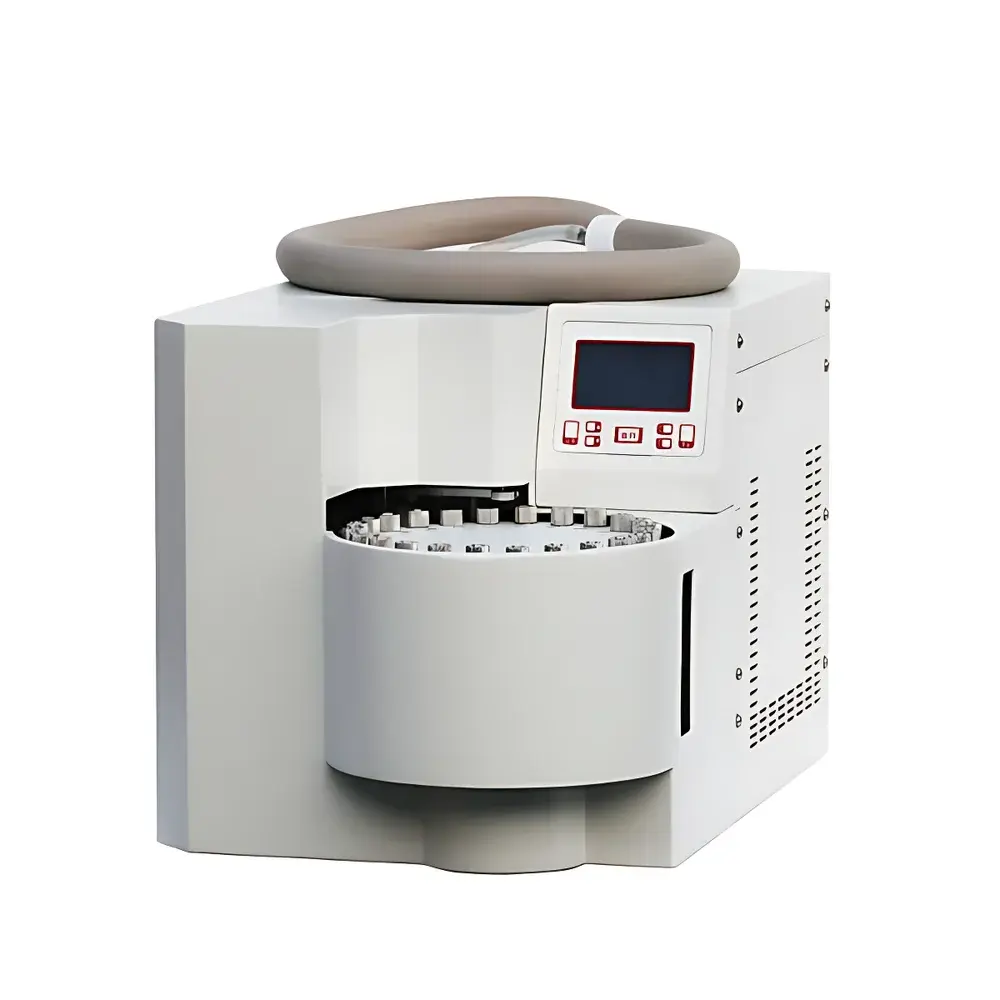
Zhonghuipu JX-7AT Fully Automated Two-Stage Thermal Desorber
| Brand | Zhonghuipu |
|---|---|
| Origin | Beijing, China |
| Manufacturer Type | Direct Manufacturer |
| Instrument Type | Two-Stage Thermal Desorber / Thermal Desorber |
| Automation Level | Fully Automated |
| Primary Desorption Temperature Range | 40–400 °C |
| Secondary Desorption (Cold Trap) Temperature Range | −35–450 °C |
| Valve & Transfer Line Temperature Range | 40–240 °C, Accuracy: ±1 °C |
| Cold Trap Temperature Range | −35 to −5 °C |
| Temperature Control Accuracy | ±1 °C |
| Sample Positions | 24 |
| Secondary Desorption Heating Rate | >70 °C/s |
| Peak Width (at 450 °C) | <3 s |
| Sample Tube Dimensions | 1/4″ OD × 3.5″ L |
| Enrichment Time | 0–60 min |
| Injection Time | 0–10 min |
| Simulated Sampling Time | 0–60 min |
| Simulated Sampling Flow Rate | 0–200 mL/min |
| RSD | ≤2.5% (benzene in 0.05 μg methanol) |
| Max Power Consumption | 500 W |
Overview
The Zhonghuipu JX-7AT Fully Automated Two-Stage Thermal Desorber is an engineered solution for quantitative trace analysis of volatile and semi-volatile organic compounds (VOCs and SVOCs) in environmental, occupational health, and indoor air quality applications. It operates on the principle of thermal desorption coupled with cryofocusing: analytes are first thermally released from sorbent tubes during primary desorption, then refocused onto a cryogenically cooled trap (−35 °C), and finally rapidly transferred—via ultra-fast secondary desorption (>70 °C/s)—into a gas chromatograph (GC) or GC-MS system. This two-stage architecture ensures high sensitivity, narrow analyte band widths (<3 s peak width at 450 °C), and minimal breakthrough or carryover, making it especially suitable for compliance-driven analyses requiring low detection limits and high reproducibility.
Key Features
- Fully automated 24-position sample carousel enables unattended batch processing, reducing operator intervention and improving throughput consistency.
- Integrated Peltier-based cooling system achieves stable cold trap temperatures from −35 °C to −5 °C without liquid nitrogen or external chillers—lowering operational cost and simplifying laboratory infrastructure.
- Motor-driven, high-precision sampling valve housed in a fully heated zone (40–240 °C) eliminates dead volume and ensures inert, leak-tight transfer; no external pneumatic supply required.
- All fluidic pathways—including transfer lines, valve manifolds, and trap housing—are constructed from electropolished, deactivated 316 stainless steel, with PTFE seals rated for continuous operation up to 240 °C—ensuring ultra-low background and resistance to adsorption or degradation of reactive analytes.
- Optimized variable-diameter fittings minimize interfacial dead volume between sorbent tubes and heated lines, preserving chromatographic integrity and maximizing desorption efficiency.
- Onboard simulated sampling function allows precise calibration and method validation using standard gases or permeation sources, supporting traceable flow rates (0–200 mL/min) and durations (0–60 min).
Sample Compatibility & Compliance
The JX-7AT accommodates industry-standard 1/4″ OD × 3.5″ sorbent tubes (e.g., Tenax TA, Carbopack B/C, Carboxen series) and supports dual-bed configurations for broad volatility coverage. Its performance meets or exceeds requirements specified in major regulatory methods, including: ASTM D6196 (VOCs in indoor air), ISO 16017-1 (indoor/outdoor air VOC analysis), US EPA TO-17 (determination of VOCs in air), and Chinese national standards GB 50325-2020 (indoor air benzene/TVOC), GB/T 18883-2022, HJ 583-2010, HJ 644-2013, and HJ 734-2014. The instrument’s temperature stability (±1 °C), repeatability (RSD ≤2.5% for benzene at 0.05 μg level), and programmable timing parameters support GLP-compliant data generation and audit readiness.
Software & Data Management
Controlled via intuitive Windows-based software, the JX-7AT supports full method development—including independent ramp/hold profiles for primary desorption, cold trap conditioning, secondary desorption, and GC interface synchronization. All temperature zones, timing parameters, and pressure settings are logged with timestamps and user IDs. Audit-trail functionality records all method changes, run executions, and error events, aligning with FDA 21 CFR Part 11 expectations for electronic records in regulated environments. Export options include CSV and XML formats compatible with LIMS integration and third-party data review platforms.
Applications
- Environmental monitoring of ambient, indoor, and workplace air for benzene, toluene, ethylbenzene, xylenes (BTEX), aldehydes, and C2–C12 hydrocarbons.
- Quality control of building materials, adhesives, coatings, and consumer products per VOC emission testing protocols.
- Method development and validation for accredited laboratories performing ISO/IEC 17025-compliant VOC analyses.
- Research into atmospheric chemistry, odor profiling, and emissions characterization from industrial stacks or mobile sources.
- Support for field-deployable sampling campaigns where lab-based reanalysis requires robust, reproducible thermal desorption performance.
FAQ
Does the JX-7AT require liquid nitrogen or mechanical cryocoolers for cold trapping?
No. It uses solid-state Peltier cooling to achieve −35 °C, eliminating consumables and maintenance associated with cryogenic fluids.
Can the instrument be integrated with third-party GC or GC-MS systems?
Yes. It features standard 1/8″ VCR and Swagelok-compatible fittings and provides TTL/RS232 trigger outputs for seamless synchronization with any GC vendor’s hardware.
Is the system compliant with FDA 21 CFR Part 11 for electronic records?
The software includes configurable user access levels, electronic signatures, and immutable audit trails—meeting core technical requirements for Part 11 compliance in regulated QC/QA labs.
What is the maximum allowable desorption temperature for the cold trap during secondary heating?
The secondary desorption stage reaches up to 450 °C with programmable ramp rates exceeding 70 °C/s, enabling efficient elution of high-boiling SVOCs such as naphthalene, biphenyl, and polycyclic aromatic hydrocarbons (PAHs).
How is carryover minimized between sequential analyses?
Through a combination of high-purity inert flow paths, bake-out cycles for all heated zones, and automated trap regeneration routines—including post-desorption purge and high-temperature trap cleaning steps—validated by blank tube testing per ISO 16017-1 protocols.
Related Products





